The V&A/RCA History of Design MA programme is widely recognized as much more than a standard postgraduate course. It operates as an inspiring and impactful community of leaders spanning sectors such as museums, cultural organizations, universities, and the wider creative industries. Collaboration and engagement remain central to the programme’s enduring ethos, shaping how students approach historical inquiry and modern material culture. Each year, master’s students come together to organize a public symposium and produce a companion publication, sharing the best of their dissertation research and reminding audiences how design and objects fundamentally shape our daily lives. In this retrospective account, 2026 graduate Liv Curnen details the deeply co-creative process behind this year’s student-led symposium and publication.
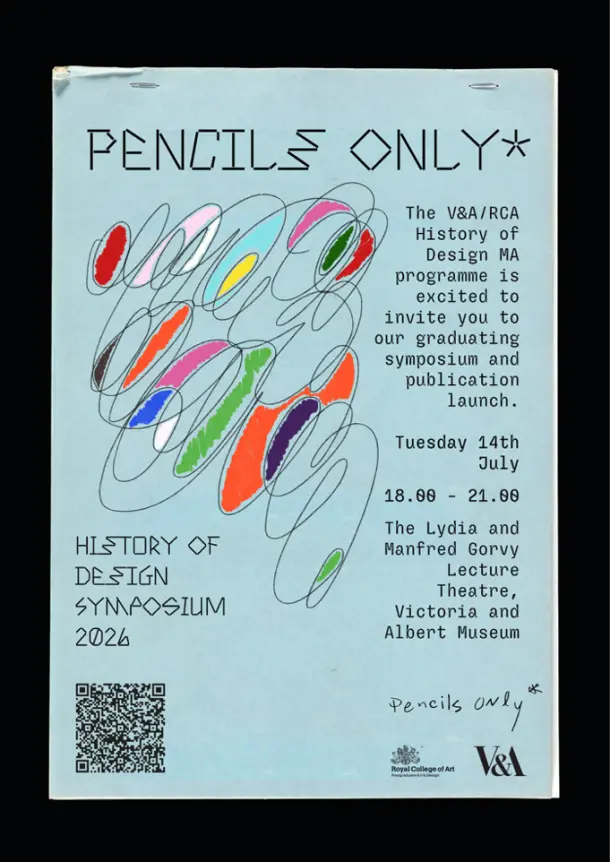
On 14 July 2026, in joyous celebration and formal recognition of their academic achievements, this year’s graduating students from the Victoria and Albert Museum and Royal College of Art History of Design (HoD) programme hosted the Pencils Only symposium and publication launch. The event took place within the Lydia and Manfred Gorvy Lecture Theatre at V&A South Kensington. Because the annual HoD symposium and publication are entirely organized, funded through effort, and produced by the students themselves, each year’s iteration stands as a completely unique reflection of its specific cohort.
The inherent variety in the 2026 cohort’s research topics posed a distinct yet welcome challenge: the graduates needed to successfully highlight their individual scholarly achievements while simultaneously presenting them in a cohesive, unified manner to the public. Rather than viewing this diversity as a hurdle, the cohort embraced it as an invitation to collaborate closely. They crafted an event guided equally by their mutual investment in one another and the fascinating objects they spent the year studying. As a symposium co-organizer and the evening’s emcee, Liv Curnen compiled a comprehensive reflection on their collaborative approach, emphasizing that the entire journey began with a simple, resonant name.
What’s in a name?
Like many great ideas born within academic communities, the theme Pencils Only originated among friends gathered inside the Royal College of Art (RCA) ArtBar. The concept emerged as a playful yet pointed nod to the ubiquitous warning signs posted inside the rare archives and manuscript rooms that HoD students frequent during their rigorous research. In nearly all archives housing old manuscripts, fragile documents, and irreplaceable historical records, researchers are strictly permitted to bring "pencils only" to prevent accidental ink stains and permanent damage to historical materials.
Given the 2026 cohort’s shared dedication to challenging, interrogating, and expanding the traditional structures that have long guided the study of objects and material culture, the pencil quickly revealed itself as a powerful unifying symbol for their collective work. It came to represent impermanent mark-making, the fluidity of historical interpretation, and the inevitability of change within the discipline. Following a lively brainstorming session at the ArtBar, Pencils Only was formally proposed to the entire cohort. It was democratically selected over other strong contenders, such as Ex-Libris—derived from the Latin phrase meaning "from the books of"—and Impressions.
While each of these proposed themes possessed the potential to tie their diverse research topics together, the cohort found it difficult to imagine a more fitting representative than the humble yet potent writing instrument. This sentiment was echoed by RCA Head of Programme Dr. Sarah Cheang, who highlighted the cleverness and symbolic depth of the title during her official opening remarks at the symposium.

Designing our ‘look’
With a compelling theme firmly established, the cohort’s next major undertaking involved designing a distinct visual identity to match the spirit of Pencils Only. While practical constraints meant not every student could directly participate in the hands-on design process, those with specific graphic design expertise found thoughtful ways to embed the core principles of collectivity into the visual branding.
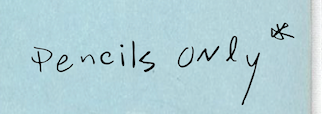
Designers Lauren Pencil and Sally Holditch devised an ingenious method to include as many of their peers as possible in the symposium’s primary poster design. They constructed a unique composite graphic that spelled out Pencils Only using individual letters drawn directly from the handwriting of various students in the cohort. This subtle yet powerful element provided a tangible, visual representation of the pencil’s unifying influence across the group. Even though the final event and its accompanying publication featured more than 20 distinct research presentations and compositions, balancing individual scholarly identity with a cohesive group presence remained a primary objective—one that their collaborative visual identity successfully achieved.
History of Design in conversation
It was fundamentally important to the cohort that the Pencils Only symposium transcend a traditional showcase of isolated student research. Instead, they wanted the event to actively embody the critical, probing questions they had spent the entire academic year interrogating. To achieve this, the students established unique, discursive groups and thematic pairings. They used the specific perspectives of their individual research projects to investigate and challenge their peers’ underlying thought processes.

For instance, Carolina Sánchez Rojas and Karima Grillo combined their respective decolonial perspectives to re-evaluate contemporary global museum practices. Together, they emphasized the vital necessity of community involvement, active repair, and shared joy within cultural institutions. Meanwhile, Narin Keitikul and Sally Holditch drew upon their experiences conducting digital design histories to prompt the audience to reconsider conventional definitions of the "artefact," particularly as modern human lives become increasingly digital and intangible.
In another compelling pairing, Elizabeth (Xinyi) He and Caûla Kazanlı shed fresh light on the complex relationship between global cultural exchange and the broader concept of modernity. They achieved this by creatively placing the design and historical context of late 19th-century Ottoman clocks into a direct dialogue with the historical travel diaries of V&A founding director Henry Cole. True to the defining character of the History of Design programme, these dynamic conversations constantly pushed against the boundaries of the Pencils Only theme. They repeatedly asked audiences and speakers alike to consider what has historically been written, what has been systematically erased, and what might eventually be re-written when scholars are equipped with the right critical tools.
Reflecting on the culmination of Pencils Only, Curnen noted that the overwhelming success of the event was built upon her colleagues’ genuine capacity for intellectual curiosity about one another and their respective ideas. The arduous planning process was continuously strengthened by a collective willingness to question not only how a peer’s research might enrich the symposium, but how their unique perspectives and individual skills would carry the entire group across the finish line. By recognizing each other’s distinct individuality as an essential support structure for their collective endeavor, the 2026 HoD cohort successfully modeled the exact kind of collaborative leadership and deep camaraderie that will undoubtedly serve them well as they step into their new roles as the newest members of the broader HoD alumni network.