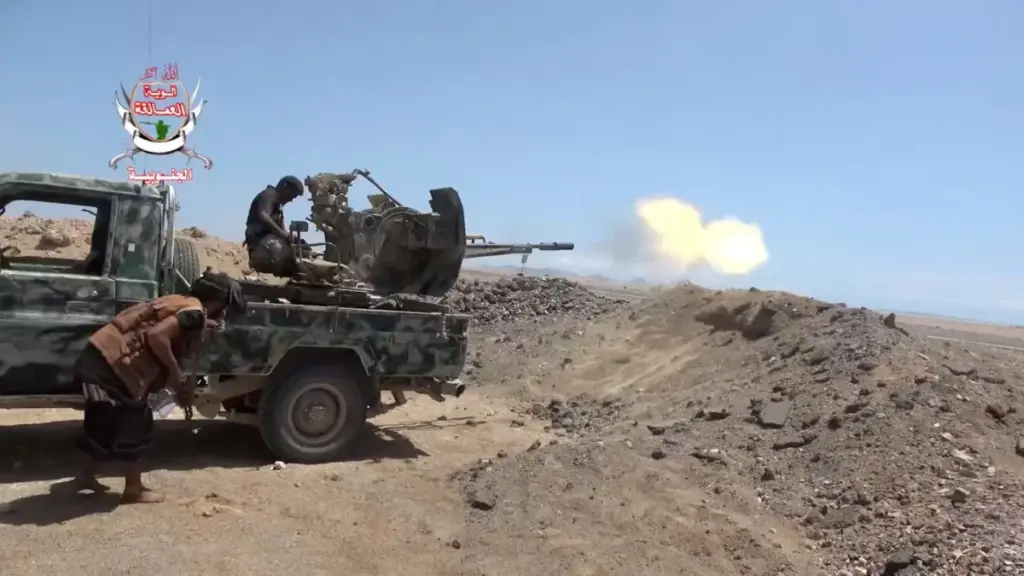
The military of Yemen’s internationally recognized government has announced that its forces have killed more than a thousand Houthi fighters during a massive wave of targeted operations over a 24-hour period. The announcement marks a significant escalation in the protracted civil conflict that has devastated the Arabian Peninsula’s poorest nation for years, drawing in regional and international powers.
According to Colonel Majed Abdullah al-Nazili, the official spokesman for the Yemeni government forces, at least 1,150 members of the Iran-aligned Houthi movement lost their lives across nearly 2,000 targeted military engagements nationwide. These operations form the core of a newly intensified government offensive officially designated as "Operation Dawn of Yemen."
Colonel al-Nazili detailed the extensive material damage inflicted upon the Houthi forces during the 24-hour window, stating that government troops successfully destroyed multiple Houthi ammunition depots alongside at least 180 combat, transport, and logistical supply vehicles. He emphasized that ground forces continue to press forward with their ongoing assault, pushing deeper into contested territory to reclaim ground from the insurgent movement.
Independent verification of the government’s battlefield casualty claims remains elusive. Al Jazeera and other major international news outlets have noted that verifying military statistics in active combat zones within Yemen is exceptionally difficult due to restricted access, fractured telecommunications, and the fluid nature of the frontline positions.
The surge in domestic ground fighting coincides with a sharp deterioration in regional security, underscored by a recent aerial attack targeting King Khalid International Airport in Riyadh, the capital of Saudi Arabia. The Saturday strike resulted in several casualties—including both deaths and injuries—and forced widespread flight cancellations at one of the region’s busiest aviation hubs.
The attack on Riyadh has prompted urgent diplomatic and military deliberations in Western capitals. When questioned by reporters at the White House regarding whether the United States would directly intervene or join coalition strikes against the Houthis in the aftermath of the airport assault, U.S. President Donald Trump responded briefly that he "will make a decision soon."
Reporting from the ground in Yemen, Al Jazeera’s Yousef Mawry noted that while the Houthis had not yet officially claimed responsibility for the specific drone or missile attack on the Saudi capital, the group’s posture has grown increasingly aggressive toward regional and international aviation. The Iran-backed movement has recently issued formal warnings to international commercial aviation companies, advising them to completely avoid utilizing Saudi airspace. The insurgent group declared that any aircraft operating within Saudi skies—with the specific exception of flights over the holy cities of Mecca and Medina—will be treated as a legitimate military target.
Furthermore, Mawry reported that the Houthis are actively preparing to expand the scope of the war across multiple new fronts, including taking direct aim at the potential military participation of international actors such as Pakistan.
"The Houthis say that if Pakistan engages in any military activities against them on behalf of Saudi Arabia, then they will be treated in the same fashion as the Saudis are currently being dealt with," Mawry explained. He added that the group has reportedly discussed plans to launch ballistic missiles toward Pakistan and target Pakistan-flagged commercial vessels operating within the vital shipping lanes of the Red Sea and the Arabian seas.
International security analysts warn that the widening geographical scope of the conflict threatens to destabilize global trade and maritime security further. Baraa Shiban, an associate fellow in international security and a dedicated Yemen expert at the London-based Royal United Services Institute (RUSI) think tank, told Al Jazeera that the ongoing violence is unlikely to subside in the near term.
"The fighting is spreading on multiple fronts, but it is a situation that will keep escalating," Shiban said, noting that the intensity of the violence will not be "dying down" anytime soon. He highlighted a critical vacuum in diplomatic efforts, pointing out that peace talks have stalled completely. "There is no mediation happening this time—there are no regional or local mediators that are able to cool down the situation," he added.
At the heart of the current ground offensive is a high-stakes campaign by Saudi-backed Yemeni forces to recapture critical territory surrounding the Bab al-Mandeb strait. This narrow body of water serves as an irreplaceable chokepoint and trade route for global commercial shipping transiting between the Indian Ocean and the Mediterranean Sea via the Red Sea and the Suez Canal.
Fierce battles are currently raging around the strategic southern Yemeni coastal cities of Mocha and Dhubab. Both urban centers are situated directly along the Red Sea coast and hold immense geopolitical and tactical importance for maintaining dominance over the southern entrance to the Bab al-Mandeb strait.
The Houthis, who successfully overthrew the capital city of Sanaa and established control over large swaths of northwestern Yemen starting in late 2014, seized control of the strait area in September. This move effectively gave them operational leverage over the vital maritime shipping lanes, although both the Houthi movement and the Saudi-backed government continue to dispute control of the corridor, leaving international cargo vessels navigating the troubled waters under a cloud of persistent danger.