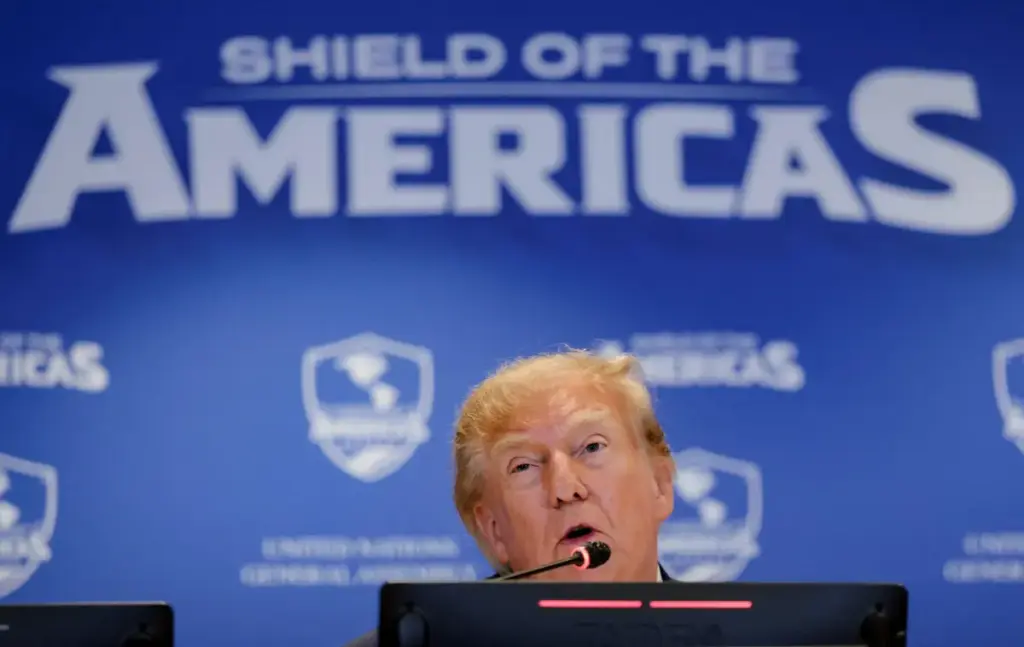
United States President Donald Trump has pledged to deploy the nation’s “unmatched military might” against powerful drug cartels operating across the Western Hemisphere, delivering the warning during a high-stakes gathering of the Washington-led Shield of the Americas coalition in New York City.
The meeting, held on the sidelines of the annual United Nations General Assembly (UNGA), brought together regional leaders, heads of state, and foreign ministers from the newly formed anti-cartel alliance. During the session, President Trump strongly urged member countries to join forces with the United States in targeting 24 distinct criminal organizations. These syndicates have previously been characterized by the White House as the “ISIS of the Western Hemisphere,” owing to their extreme brutality, vast territorial control, and destabilizing impact on regional governance and security.
Addressing the assembled diplomats and leaders, President Trump emphasized the urgent need for a unified regional front against transnational drug trafficking and organized crime. He stated that he was formally asking all nations within the Shield of the Americas coalition to designate narco-terrorists as common, shared threats to regional stability. Furthermore, he called upon participating governments to apply crushing economic and diplomatic sanctions against all identified groups, cutting off their access to international financial systems, trade networks, and logistical supply chains.
The diplomatic push yielded immediate, tangible diplomatic commitments from the coalition. Following the closed-door discussions, the governments of the 15 participating nations issued a joint declaration outlining their cooperative intentions. According to the joint statement, member states intend to impose comprehensive asset freezes and strict visa restrictions on members, associates, and financial supporters of the targeted criminal organizations. Additionally, the participating countries agreed to pursue aggressive criminal charges against key figures within these syndicates, signaling a coordinated legal offensive across multiple national jurisdictions.
At the very top of the coalition’s cross-hairs are two transnational criminal networks that have already been officially designated as foreign terrorist organizations by Washington: Mara Salvatrucha, commonly known as MS-13, and Tren de Aragua. MS-13 remains one of Central America’s most entrenched and powerful criminal gangs, with extensive operational cells spanning parts of the United States, Mexico, and Central America. Tren de Aragua, a notorious Venezuelan gang originating from a prison in Aragua state, has rapidly expanded its footprint across South America in recent years, establishing active criminal networks and extortion rings in Colombia, Peru, Chile, and beyond.
Beyond these two primary targets, the expansive list of 24 criminal organizations includes major Mexican drug cartels responsible for the vast majority of illicit narcotics flowing northward. It also encompasses influential South American armed groups such as Colombia’s National Liberation Army (ELN), Brazil’s powerful prison-origin criminal syndicates Primeiro Comando da Capital (PCC) and Comando Vermelho (Red Command), and Peru’s historic insurgent-turned-narco-trafficking group, the Shining Path.
Despite the strong rhetorical commitments and the joint statement issued in New York, regional analysts and on-the-ground observers point out that translating these multilateral political goals into domestic enforcement will be a complex and gradual process. Speaking from Bogota, Colombia, Al Jazeera correspondent Alessandro Rampietti noted that the newly announced measures remain largely symbolic for the time being, largely because every participating nation must adhere strictly to its own domestic legal procedures, constitutional frameworks, and legislative processes.
“For example, here in Colombia, it will require a law to pass through Congress before such designations and asset freezes can be fully operationalized,” Rampietti reported. He added that the Colombian government has already initiated steps by asking its national legislature to move forward in drafting the necessary enabling legislation. “So while the practical consequences may not be immediate, this is clearly an important step towards building what the US has been trying to achieve in Latin America through the formation of this security alliance,” he explained.
The Shield of the Americas coalition is currently composed of governments that share close diplomatic alignment with President Trump’s foreign policy agenda. The alliance includes nations such as Argentina, Ecuador, and El Salvador, whose respective leaders have frequently received praise, political endorsement, or strong diplomatic backing from Washington. Furthermore, the coalition has expanded its membership in recent months following political shifts that brought Trump-aligned administrations to power in countries like Colombia and Peru, signaling a realignment of security priorities among several key South American nations.
Concurrently, notable regional heavyweights such as Brazil and Mexico have chosen not to join the coalition, reflecting deep-seated divisions across Latin America regarding the correct approach to regional security, national sovereignty, and relations with the United States.
US Secretary of State Marco Rubio, who attended the high-level meeting alongside President Trump, voiced strong support for the coalition’s objectives. Rubio praised what he described as the emergence of strong regional leaders who demonstrate a clear, unwavering commitment to confronting the immense challenges posed by transnational terrorism and organized crime syndicates.
The gathering in New York City represents the latest manifestation of the Trump administration’s broader strategy to rally hemisphere-wide support behind a significantly more aggressive and militarized approach to combating international drug trafficking. Since returning to office last year, President Trump has made dismantling Latin American cartels a centerpiece of his foreign and domestic security policy. As part of this hardline posture, the administration formally designated major drug cartels as foreign terrorist organizations and subsequently ordered dozens of kinetic military strikes against maritime vessels in the Caribbean Sea and the eastern Pacific Ocean.
According to US officials, these targeted maritime strikes have intercepted and destroyed numerous boats heavily laden with illicit narcotics destined for American shores. However, these military operations have also generated intense international scrutiny and severe humanitarian controversy. Independent human rights monitors and United Nations experts have repeatedly stated that the lethal strikes violate foundational tenets of international law, warning that the unilateral military actions could potentially amount to crimes against humanity given the mounting death toll.
Official estimates indicate that the ongoing military campaign against suspected drug-running vessels has resulted in the deaths of more than 223 people. These casualties have further strained diplomatic relations between Washington and various regional governments that are wary of US military interventionism within their territorial waters and maritime economic zones.
The intensification of Washington’s focus on the Western Hemisphere is deeply rooted in the Trump administration’s National Security Strategy, which was released late last year. The strategic document formally laid out plans for a revamped and modernized version of the Monroe Doctrine—the historic 19th-century US foreign policy asserting American primacy and dominance in the Western Hemisphere. While the original doctrine was used to deter European colonization, modern critics argue that the administration’s revival of the policy echoes decades of past US military and political interventionism in Latin American domestic affairs.
In tandem with these security policies, President Trump has made provocative statements regarding territorial and strategic ambitions in the wider region, including public suggestions about retaking control of the Panama Canal and annexing neighboring Canada and the Arctic territory of Greenland. On the sidelines of the UNGA meetings, Trump did sign a formal agreement concerning Greenland, though the diplomatic pact ultimately stopped short of his original demands that the autonomous island be transferred entirely to US sovereignty as American territory.
This assertive and unilateral focus on hemispheric dominance has naturally raised anxieties and deep-seated concerns across Latin America and the Caribbean, where memories of historical US interventions remain vivid. These tensions came to a head during the broader United Nations General Assembly proceedings, where Brazilian President Luiz Inácio Lula da Silva delivered a sharp rebuke against Washington’s renewed security paradigm.
In his address to the UN General Assembly, President Lula bristled openly at the US approach, issuing a direct warning to countries throughout Latin America and the Caribbean to remain vigilant against what he termed “renewed hegemonic temptations” from foreign powers. Emphasizing the sovereign independence of South America’s largest nation, President Lula delivered a clear and defiant message to the international community.
“Brazil is nobody’s backyard,” Lula declared.