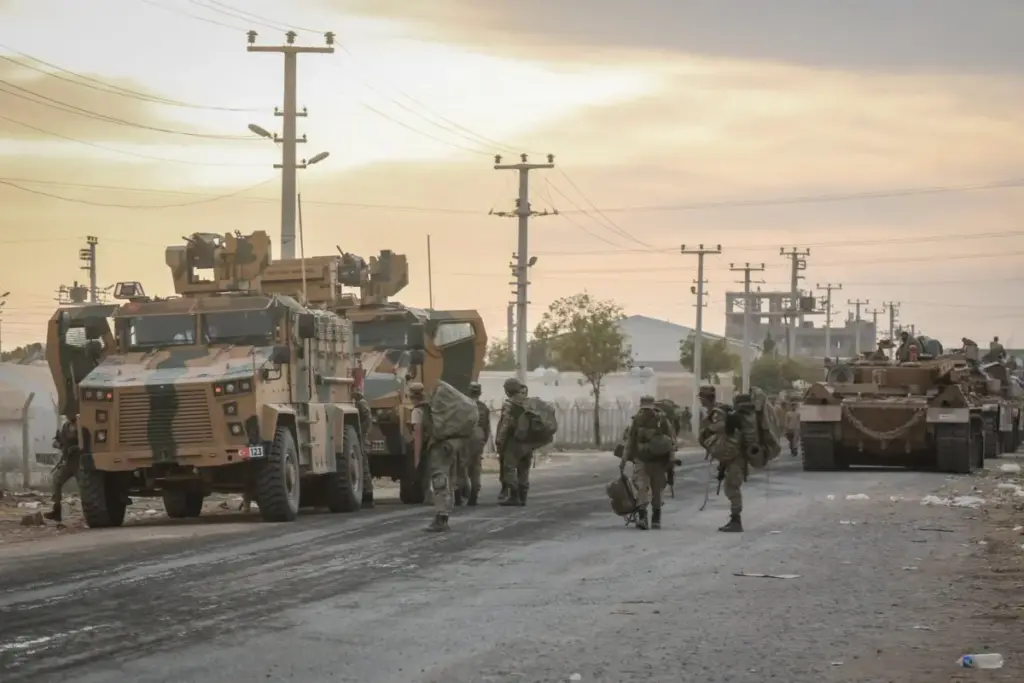
Türkiye’s Ministry of National Defense on Friday marked the seventh anniversary of Operation Peace Spring, paying solemn tribute to the officers, soldiers, and security personnel who participated in the landmark cross-border counterterrorism operation carried out in northern Syria.
In an official statement shared across its social media channels, the ministry honored the Turkish troops who stepped forward to take part in the operation, which was originally launched with the fundamental objectives of securing Türkiye’s southern borders, dismantling terror networks along the frontier, and actively supporting broader regional security and stability. The leadership in Ankara emphasized that the sacrifices made by the armed forces during this critical period continue to stand as a testament to the nation’s unwavering commitment to national defense and international counterterrorism efforts.
Alongside the tribute to active participants, the ministry paused to remember the soldiers who were killed in the line of duty during the rigorous campaign, offering deep condolences to their grieving families and the Turkish nation at large. Furthermore, the statement expressed profound gratitude to the wounded veterans who sustained injuries while executing their duties, recognizing their enduring service, resilience, and personal sacrifices for the country’s safety.
Ankara originally launched Operation Peace Spring in northern Syria to systematically eliminate terrorist elements entrenched east of the Euphrates River, neutralize immediate threats to Türkiye’s borders, pave the way for the safe and voluntary return of displaced Syrian refugees, and safeguard the territorial integrity and political unity of the neighboring Syrian state. Turkish security planners repeatedly stressed at the time that the presence of hostile armed groups directly jeopardized domestic tranquility and cross-border stability, leaving military action as a necessary measure under international law and the right to self-defense.
In the years following the initial military phases, a massive stabilization and normalization effort was undertaken to transform the war-torn landscape into a secure environment for civilians. According to data highlighted by Turkish security officials, ongoing efforts to restore normal, everyday life in the region have successfully cleared approximately 600 settlements of terrorists belonging to the PKK’s Syrian wing, the YPG.
The military campaign itself achieved rapid tactical milestones in its opening days. Within just four days of the offensive, Turkish Armed Forces successfully cleared the strategic border town of Ras al-Ain. Just a day later, the vital neighboring town of Tal Abyad was liberated from PKK/YPG control. Across the entire theater of operations, the campaign successfully secured more than 4,000 square kilometers of territory, removing heavily fortified positions, trench networks, and command hubs utilized by the militant groups.
Following the conclusion of active combat operations, the Turkish Armed Forces, working in close coordination with the Syrian National Army, shifted their primary strategic focus toward maintaining long-term security, establishing rule of law, and enabling displaced local civilians to return safely to their ancestral homes. The establishment of local councils played a pivotal role in this transitional phase, empowering local residents to govern their own communities while generating vital job opportunities to stimulate the local economy.
With the backing of institutional support and civil administration initiatives, the region has witnessed significant, tangible infrastructure improvements over the past seven years. Among the most critical achievements has been the comprehensive rehabilitation and resolution of chronic water and power shortages that had plagued local populations during years of conflict and neglect. Schools, hospitals, and municipal services have progressively been brought back online, providing residents with basic human necessities and a semblance of routine governance.
The broader geopolitical landscape surrounding northern Syria also experienced notable shifts recently. On August 25, the U.S.-backed YPG terrorist group publicly announced that its self-proclaimed autonomous administration, alongside all of its associated military and civilian administrative structures, had been formally dissolved. This dissolution followed a significant agreement reached between the Syrian administration and the YPG on January 29, which outlined a formal cease-fire and established terms for the group’s gradual integration into official state institutions.