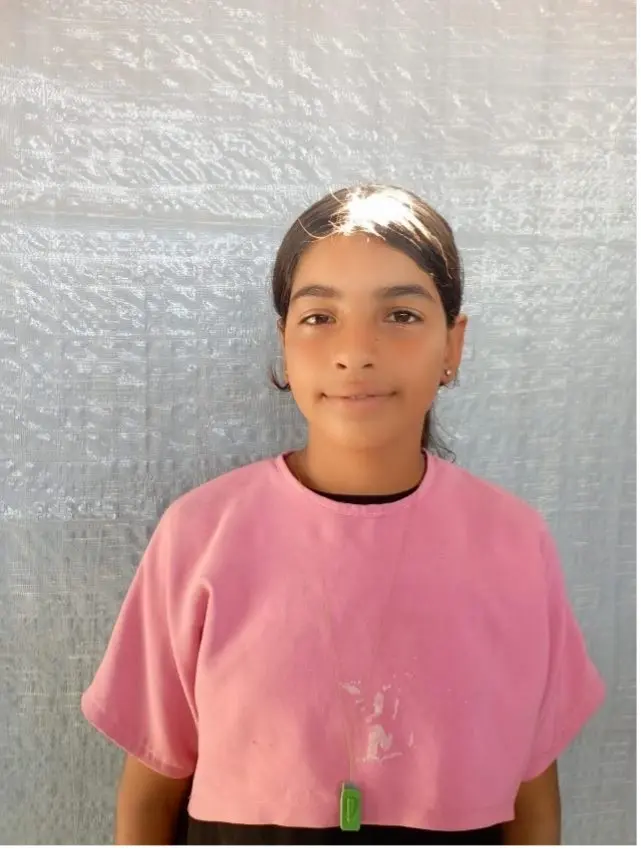
At just 12 years old, Amira has already endured a lifetime of profound grief, displacement, and the systematic destruction of her world. Yet, despite the unimaginable trauma and the harsh, unrelenting realities of daily survival in Gaza, she continues her online education, tending to her studies with quiet determination and holding tightly to a singular, enduring dream: to grow up, become a nurse, and heal others.
Amira’s childhood was fractured years before the current conflict began. When she was only nine years old, she lost her father to cancer. For young Amira, her father had been much more than a parent; he was the foundational pillar of her universe—a steady source of unconditional love, safety, and inner strength. His passing fundamentally altered the trajectory of her early years, casting a long shadow of sorrow over her family.
Just as Amira and her family were learning to navigate life in the wake of that immense loss, the war in Gaza erupted, plunging them into yet another devastating cycle of displacement, uncertainty, and fear.
Forced from Home and Into a Tent
Before the conflict forced them to flee, Amira lived a relatively stable life alongside her mother, Manal, and her siblings in the Al-Salam neighbourhood of Rafah. It was a home filled with memories, routine, and a sense of belonging. However, when evacuation orders and relentless violence closed in around them, the family had no choice but to pack up and leave everything they had ever known behind.
Believing—as so many displaced families desperately did—that the upheaval would be temporary and that they would soon be allowed to return, they packed only the barest essentials. They took a few changes of clothing, some bedding, and basic kitchen utensils, locking the door behind them with hopes of a swift return.
Instead, their hopes were shattered. Their neighborhood was targeted, and their family home was entirely destroyed. With no house to return to and no safe haven available, the family remained permanently displaced, eventually finding themselves forced to set up a makeshift tent in an attempt to carve out some form of shelter.
Life inside the tent quickly deteriorated into a daily battle for survival. The structure offered virtually no protection against the punishing extremes of the regional climate. During the scorching summer months, the tent became a stifling, suffocating heat trap. Conversely, when winter arrived, it offered bitter, bone-chilling cold. Heavy seasonal rains routinely leaked through the worn fabric, soaking their meager belongings and turning the dirt floor beneath them into a thick, impassable quagmire of mud.
Basic human necessities—water and food—became luxuries secured only through exhausting, daily labor. Amira and her family frequently spent grueling hours standing in long lines to collect water from passing distribution trucks. When they lacked the financial resources to purchase food, they were forced to rely entirely on the goodwill of community kitchens and humanitarian aid distributions just to stave off hunger.
Losing Everything Again to Fire
As if the psychological toll of losing their home and enduring the hardships of tent life were not enough, the family suffered yet another catastrophic blow when their tent caught fire, reducing what little they had left to ashes.
The sudden blaze swept through their temporary shelter, destroying the few remaining items they had managed to salvage from their former life. Their last changes of clothing, their remaining cooking equipment, and the few personal effects that offered them a semblance of normalcy were completely obliterated.
Reflecting on the devastating incident, Amira’s mother, Manal, shared the agonizing reality of their situation: “Everything we owned was turned to ashes.” The fire stripped the family bare once more, leaving them entirely devoid of the fundamental items required to sustain daily life with any measure of dignity or comfort.
Today, the family’s immediate physical needs are overwhelming. They urgently require a structurally sound, weather-resistant shelter equipped with waterproof coverings to withstand the elements. Furthermore, they lack basic sanitation facilities such as a private bathroom, as well as essential cooking equipment, clean clothes, and proper shoes to protect them from the harsh ground.
Continuing to Study Despite Displacement
Despite the compounding tragedies, the constant upheaval, and the daily struggle merely to secure food and water, Amira refuses to let her education slip away. Operating under conditions that would deter even the most seasoned scholars, she continues her studies online and is currently enrolled in the seventh grade.
Her daily routine extends far beyond textbooks and digital screens. Living without the basic conveniences of modern life—such as a reliable electricity grid or a washing machine—Amira steps up to shoulder domestic responsibilities, spending hours washing the family’s clothes entirely by hand.
Amid these grueling chores, she guards her ambitions fiercely. Amira dreams of a future in the medical field, aspiring to become a nurse who can care for others in their moments of greatest vulnerability. To keep that dream alive, she relies on her resilience, hoping against the odds that she will be given the chance to finish her education and rebuild her life.
When she finds brief moments of respite, Amira enjoys expressing herself through drawing. Art offers her a quiet mental escape from the chaotic and stressful environment surrounding her, though she currently lacks even the basic stationery and materials needed to properly practice and nurture her creative hobby.
For now, her most pressing physical needs remain starkly basic: winter clothing, proper underwear, and shoes to shield her from the cold and rough terrain.
Supporting Orphaned Children in Gaza
The deep vulnerabilities faced by children like Amira highlight the critical importance of sustained humanitarian intervention in the region. Organizations such as Islamic Relief have long worked to address these systemic challenges, operating an Orphan Sponsorship Programme in Gaza since 1999 to provide a safety net for vulnerable youths who have lost their primary breadwinners.
The programme utilizes a one-to-one sponsorship model, directly pairing an individual donor with an eligible child. Through this connection, the child’s guardian receives a dependable monthly financial stipend. In the context of Gaza, where market conditions and needs fluctuate violently day by day, families are given the flexibility to allocate this crucial support toward whatever they deem most urgently required—whether that money goes toward purchasing nutritious food, warm clothing, essential healthcare, or educational materials to keep children in school.
In response to the unprecedented scale of the current crisis, Islamic Relief has significantly scaled up its operational capacity and expanded the programme. Today, more than 25,000 children across Gaza are receiving regular sponsorship support through the organization. Despite this massive expansion, the depth of the need remains staggering, with over 5,000 additional children currently lingering on the waiting list, hoping for a sponsor to step forward.
Where logistics and security allow, sponsored families also receive supplementary seasonal assistance. This includes the distribution of food parcels during Ramadan and Qurbani, Eid gifts for the children, and specialized winter items designed to help families weather the coldest months of the year with greater security.
Holding On to Hope
Amira’s story is not an isolated incident; rather, it reflects the harsh, daily reality confronting thousands of children across Gaza who have been robbed of their parents, their homes, their neighborhoods, and any lingering sense of security or predictability.
Yet, beneath the weight of profound loss, children like Amira continue to open their laptops, review their schoolwork, and quietly map out a future beyond the confines of their current suffering.
Her aspirations remain remarkably grounded and hopeful: she simply wants to continue her education, train to become a nurse, and one day live safely and peacefully with her family under a secure roof.
Through established initiatives like Islamic Relief’s Orphan Sponsorship Programme, individuals around the world have the opportunity to step in as a vital support system, helping to provide consistent, reliable aid to orphaned children and their families throughout Gaza.