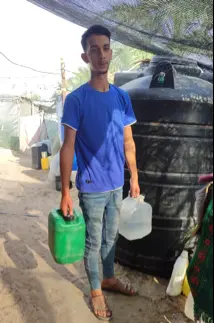
Having lost his father when he was just two years old, Muhammed has long known the weight of responsibility. Today, while navigating the harsh and unforgiving reality of displacement in Gaza, the young man strives to be a pillar of unwavering strength for his two younger sisters and his aging grandfather.
Despite the total destruction of his family home and the daily indignities of living inside a cramped tent, Muhammed has steadfastly refused to give up. To him, education is not merely a routine pursuit or a collection of academic credits; it is the ultimate lifeline and the only reliable tool he has to build a safer, more stable future for himself and the people he loves.
Before the current crisis erupted, Muhammed and his family lived a quiet, simple, and peaceful life sheltered within his maternal grandparents’ home. His routine was that of any ordinary, hardworking teenager. He attended school regularly, applied himself diligently to his studies, and found joy in the simple pleasures of youth. In his free time, he could often be found swimming or playing football with his friends and cousins in the neighborhood. His younger sisters grew up in a nurturing environment, entirely surrounded by a loving and supportive family that shielded them from harsh realities.
That fundamental sense of safety, stability, and normalcy vanished overnight when the shelling began. Faced with imminent danger, the family was forced to flee their home with practically nothing, escaping with little more than the clothes they were wearing on their backs.
The transition to life in displacement brought unprecedented daily struggles. Survival required relentless physical labor. The family had to spend hours each day fetching water from distant points and collecting firewood just to cook simple meals. The thick, toxic smoke from open fires constantly irritated their lungs and affected their breathing, posing health risks in an already vulnerable environment. Furthermore, their small, improvised living space—a flimsy tent—offered virtually no insulation or protection against the biting cold weather, heavy rains, and relentless winds of winter.
Determined to Continue His Education
Despite the overwhelming chaos, physical exhaustion, and constant uncertainty surrounding his family’s survival, Muhammed remained stubbornly determined to finish his schooling and take his high-school examinations.
The logistical hurdles were immense. Muhammed had to walk long distances every day just to find a location with a stable internet connection so he could access his coursework and take his crucial exams. Upon returning to the damp, freezing environment of his family’s tent, he would continue studying late into the night, seizing every rare moment of quiet he could find amid the surrounding noise and crowding of the displacement camp.
His extraordinary resilience and hard work ultimately paid off. Muhammed graduated from high school with an impressive score of 84 percent—an academic achievement made all the more remarkable by the harrowing, unstable circumstances under which he had prepared.
The opportunity to transition to university provided him with a renewed sense of hope. His first semester was granted free of charge, allowing him to enroll and begin studying digital marketing, a field he hopes will offer viable career prospects.
However, sustaining his higher education remains a daunting financial and practical challenge. Muhammed worries intensely about how he will manage to pay for future tuition fees. Compounding this worry is the urgent need for a laptop, a fundamental tool required to complete his coursework, research, and digital marketing assignments effectively.
Islamic Relief’s Orphan Sponsorship Provides Vital Support
During this prolonged period of extreme hardship, the monthly sponsorship Muhammed receives through Islamic Relief has emerged as a crucial source of stability for his family.
The financial assistance helps them cover essential daily needs, easing a portion of the relentless economic pressure that weighs on the household. By alleviating some of these immediate survival burdens, the sponsorship affords Muhammed the vital breathing room he needs to focus on his lectures, manage his assignments, and continue working toward his long-term goals.
Before the outbreak of the war, Islamic Relief was actively supporting 8,700 sponsored orphans. Today, the scale of the crisis has driven that number up dramatically. The programme now supports nearly 25,200 orphaned children across the region, representing an approximate 190 percent increase in aid delivery. Thanks to the steady generosity of international sponsors, organizations like Islamic Relief have effectively tripled the number of children they are able to support inside Gaza.
Despite these scaled-up efforts, the need remains overwhelmingly vast. There are currently more than 5,100 orphaned children sitting on waiting lists, desperately hoping for the lifeline of sponsorship that can change their trajectories.
For Muhammed, earning a university degree is deeply personal. It is the pathway to securing independent employment, achieving financial self-reliance, and eventually lifting his family out of ongoing vulnerability.
A Family Still in Urgent Need
Despite moments of academic success, daily life inside the displacement tent remains painfully difficult. Muhammed and his family urgently require safer, sturdier shelter, particularly as winter brings freezing temperatures and heavy rains. A larger, more durable tent equipped with proper protective rain coverings is essential to shield them from the elements.
Beyond structural shelter, the family lacks basic household provisions. They are in dire need of mattresses, thick warm blankets, secure storage options for their meager clothing and personal belongings, proper cooking equipment, and seasonally appropriate winter clothing and shoes for Muhammed and his younger sisters.
For Muhammed personally, securing a laptop is non-negotiable if he is to remain enrolled in his university courses and complete his digital marketing assignments. Assistance with upcoming tuition fees would likewise ensure that he does not have to abandon his education due to financial destitution.
These fundamental provisions would restore a baseline of safety and dignity to the household, enabling Muhammed to direct his energy toward his studies rather than daily survival.
Holding on to Hope
Muhammed has lost his childhood home, his neighborhood, and the predictable life he once knew. Yet, he has stubbornly retained his belief in the transformative power of education.
His refusal to abandon his studies while living amid the ruins of displacement is a testament to his resilience and his deep conviction that a better future is still possible for himself and his family. With continued targeted support and community solidarity, young people like Muhammed can hold on to their ambitions, protect their education, and preserve their hope for the future.
With ongoing support, organizations like Islamic Relief aim to maintain their operations as a critical lifeline for orphaned children throughout Palestine.