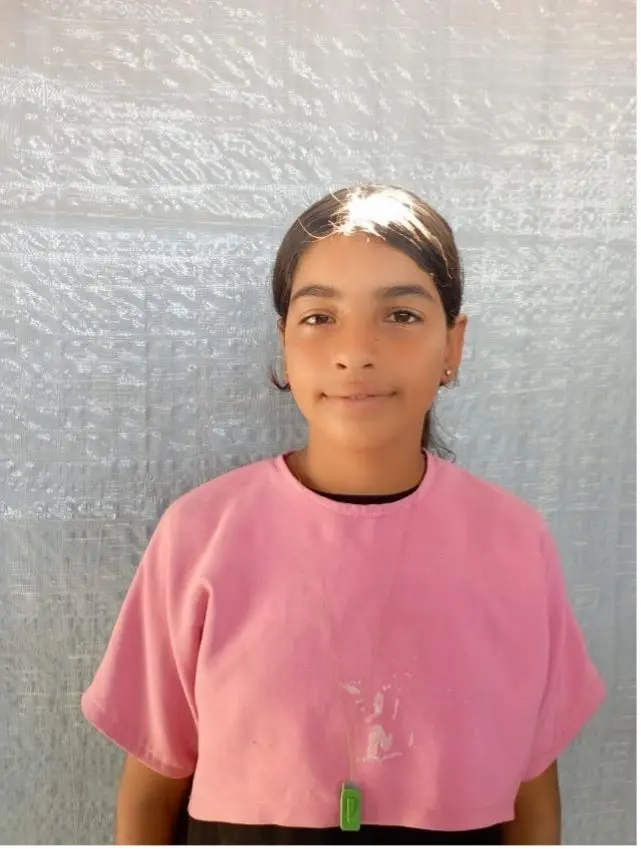
At just 12 years old, Amira has already confronted a magnitude of hardship that few children should ever have to witness. Having endured the devastating loss of her father, the trauma of displacement, and the complete destruction of her family home, she nonetheless presses forward. Amid the rubble of a fractured daily reality, she continues her education online and holds steadfast to a singular, guiding ambition: to grow up and become a nurse, dedicating her life to healing others.
Amira’s world shifted irrevocably when she was only nine years old. It was then that she lost her father to cancer. For young Amira, he had been much more than a parent; he was an unwavering source of love, safety, and emotional strength. His passing altered the very fabric of her childhood, plunging her and her family into grief. Yet, just as they were learning to navigate a life without him, the war in Gaza began, plunging them into yet another profound cycle of loss, uncertainty, and unrelenting fear.
Forced to Leave Their Home
Before the conflict upended their lives, Amira lived alongside her mother, Manal, and her siblings in the Al-Salam neighbourhood of Rafah. It was a place of familiar routines, community ties, and relative stability. However, as the violence encroached, the family was issued orders that forced them to flee, joining the vast numbers of civilians searching for safety where little could be found.
When the family packed what little they could carry, they left the vast majority of their personal belongings behind. They took only a sparse collection of clothes, a few pieces of bedding, and the most basic kitchen items, operating under the deeply hopeful assumption that their absence would be temporary. They imagined they would soon be able to return to their neighbourhood, unlock their front door, and resume their lives.
Instead, that hope was systematically dismantled. Their house was targeted and destroyed, leaving them among the permanently displaced. With nowhere else to go and no permanent housing available, the family ultimately had to set up a makeshift tent, transforming a patch of open ground into their new living quarters.
Life inside the tent presented a punishing daily endurance test. The shelter offered little protection from the elements, becoming stiflingly hot during the scorching summer months and bitterly, bone-chillingly cold when winter arrived. Rainwater leaked steadily through the fabric during storms, while the ground beneath them routinely turned into thick, impassable mud.
Basic survival became an exhaustive logistical challenge. The family struggled constantly to secure adequate access to clean water and nutritious food. Amira and her relatives would sometimes spend hours waiting in long lines to collect water from passing distribution trucks, while relying entirely on community-run kitchens whenever they lacked the financial means to buy food on their own.
Losing Everything Again
Just as the family was beginning to adjust to the gruelling realities of tent life, disaster struck once more. In a devastating incident, their tent caught fire and burned to the ground, stripping them of the very few material possessions they had managed to salvage from their former lives.
The fire consumed their remaining changes of clothes, their basic cooking equipment, and every other personal item they had depended on for daily existence. Reflecting on the sudden and absolute nature of the disaster, Manal shared the stark reality of their situation, noting that everything they owned was turned to ashes. The fire left the family once again entirely devoid of the essential items required to sustain basic daily life.
Today, their needs are urgent and multifaceted. They require a significantly stronger, sturdier shelter equipped with waterproof coverings to withstand harsh weather, along with a functional bathroom, new cooking equipment, and basic clothing and shoes for every family member.
Continuing to Study Despite Displacement
Despite the profoundly dire conditions that dictate every moment of her daily routine, Amira refuses to let her circumstances completely eclipse her intellectual development. She continues her education through online learning channels and is currently navigating her seventh-grade coursework.
Life in a tent without a reliable source of electricity or modern conveniences like a washing machine means that household chores demand immense physical effort. Amira contributes actively to her family’s survival by washing clothes entirely by hand, balancing her domestic responsibilities with her academic commitments. Through it all, her professional aspirations remain clear: she dreams of becoming a nurse, an ambition that fuels her determination to continue her studies against the odds.
Beyond her schoolwork and chores, Amira finds joy in creative outlets like drawing, though the lack of basic materials currently prevents her from practising her art regularly. Her immediate personal needs remain pressing, spanning winter clothing, proper undergarments, and shoes to protect her from the elements.
Supporting Orphaned Children in Gaza
The challenges faced by Amira and her family reflect a broader, deeply concerning humanitarian situation across the region, where thousands of children have lost parents, homes, and any foundational sense of security. To help address these profound needs, organizations on the ground have mobilized long-term support systems.
Islamic Relief, for instance, has been actively supporting orphaned children in Gaza through its specialized Orphan Sponsorship Programme since 1999. The initiative operates on a one-to-one sponsorship model, directly connecting an individual donor with a specific child. Under this arrangement, the child’s guardian receives a regular monthly financial payment. In Gaza, families are given the flexibility to direct this crucial support toward the needs they deem most urgent at any given time, whether that includes purchasing food, securing clothing, covering healthcare expenses, or funding education.
In response to the current crisis, Islamic Relief has significantly scaled up the capacity of the programme. More than 25,000 children throughout Gaza are currently receiving regular sponsorship support, while an additional 5,000 children remain on the waiting list, underscoring the sheer scale of the need.
Where operational access and logistics permit, sponsored families also receive supplementary seasonal support. This includes specialized food parcels distributed during Ramadan and Qurbani, Eid gifts for the children, and essential winter items designed to help families weather the coldest months.
Holding On to Hope
Amira’s story stands as a testament to both the devastating impact of conflict on young lives and the unbreakable resilience of children caught in the crosshairs of war. Having lost her father, her home, and her sense of stability, she continues to look forward, focusing intently on her education and her vision for the future.
Her aspirations remain remarkably grounded: she wishes only to continue learning, to train as a nurse, and to eventually live somewhere safe and secure alongside her family.
Through initiatives like Islamic Relief’s Orphan Sponsorship Programme, donors around the world are offered a direct channel to provide regular, sustained support to orphaned children and their families in Gaza, helping to keep hope alive for children striving to build a better tomorrow.