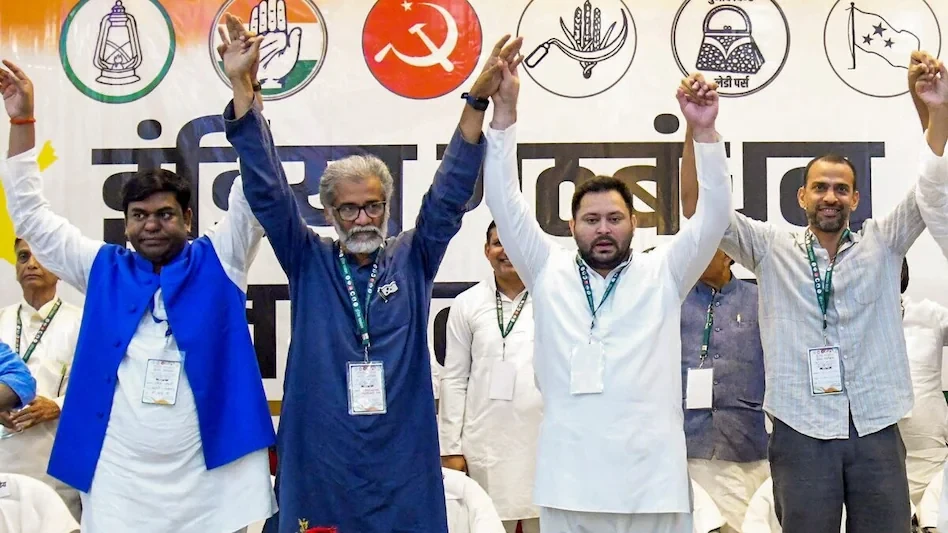
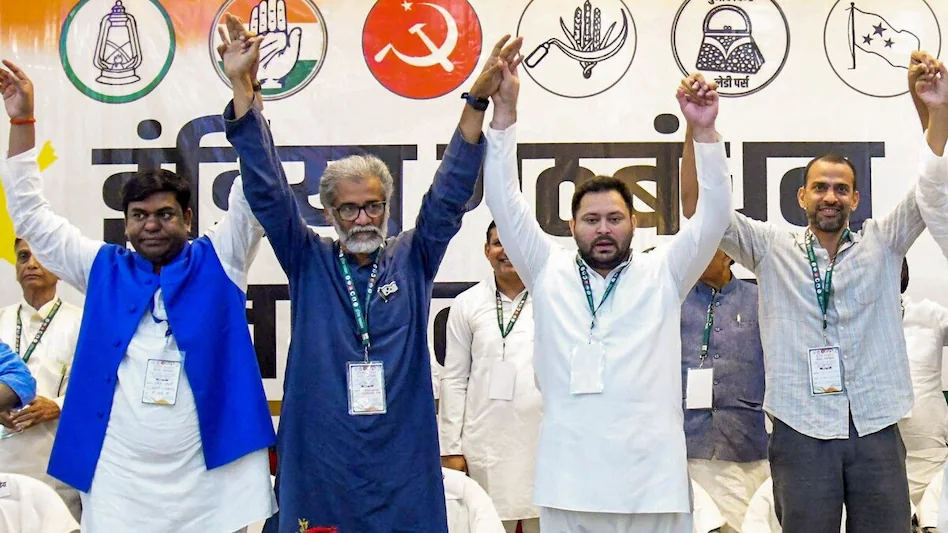
Patna: As Bihar gears up for the high-stakes 2025 Assembly elections, the state’s Muslim community—constituting 17.7 percent of the population—finds itself standing at a profound political crossroads. Across the 243 constituencies of the state legislative assembly, voters from the minority community are once again confronting a familiar and agonizing dilemma: how to balance the fundamental democratic demand for fair political representation with the urgent, overriding necessity of resisting the relentless advance of Hindutva politics.
With two major competing political formations dominating the landscape—the opposition Grand Alliance, known locally as the Mahagathbandhan, and the ruling National Democratic Alliance (NDA)—the political calculations for Muslim voters have grown increasingly complex. Despite holding a decisive demographic presence that can tilt the balance in numerous constituencies, Muslims continue to experience stark underrepresentation in the candidate lists unveiled by major political parties. This persistent disconnect has reignited intense debates across political circles, community platforms, and household drawing rooms throughout the state. The central question echoing through Bihar is whether the community should maintain its traditional, pragmatic backing of secular parties that offer security against majoritarian forces while delivering minimal legislative presence, or whether they should assert themselves independently for genuine political agency, even at the grave risk of dividing the secular vote and inadvertently aiding the opposition.
Uneven Representation in the Grand Alliance
Historically, the Rashtriya Janata Dal (RJD), spearheaded by party supremo Lalu Prasad Yadav and his son Tejashwi Yadav, has functioned as the primary political home for Bihar’s Muslim population. The community has long anchored its electoral faith in the party’s social justice platform. However, when the RJD recently announced its lineup of 143 candidates for the upcoming electoral battle, it fielded only 18 Muslim candidates, translating to roughly 12.6 percent of its total ticket distribution. When measured against the community’s nearly 18 percent share of the state population, fair proportionality would dictate a presence closer to 41 seats. Political critics and community analysts point out that this shortfall reflects a deliberate structural underallocation, leaving Muslims with less than half of their rightful demographic share within the alliance’s primary constituent.
This rising tide of dissatisfaction extends far beyond mere numerical counts. Several incumbent Muslim MLAs found themselves denied tickets altogether, while others faced sudden changes to their traditional constituencies, causing severe local disruption. Within the internal ranks of the RJD, growing numbers of party functionaries and supporters allege that the Yadav community—representing roughly 14 percent of the state’s population—continues to dominate the party’s core decision-making apparatus at the expense of its broader coalition partners. Speaking on the condition of anonymity, a senior RJD functionary acknowledged that Muslim voices are frequently sidelined or inadequately prioritized when final candidate selections are locked in.
Meanwhile, coalition partners within the Grand Alliance have presented a mixed picture. The Indian National Congress, which secured 61 seats under the seat-sharing arrangement within the Grand Alliance, has fielded 10 Muslim candidates, amounting to roughly 16.7 percent of its roster. While this relatively higher proportional share has earned the national party some cautious praise from community leaders, the sudden denial of tickets to a few sitting legislators has still triggered localized resentment and friction on the ground. Compounding matters further, Mukesh Sahni’s Vikassheel Insaan Party (VIP), another key player in the opposition coalition, failed to nominate a single Muslim candidate, reinforcing persistent criticisms that hard-nosed alliance arithmetic and caste calculations routinely supersede true political inclusion.
The Left parties, which have traditionally enjoyed steady support from sections of Muslim voters, particularly in rural and agrarian pockets, offered little corrective balance. The Communist Party of India (Marxist-Leninist) Liberation, contesting under the collective banner of the Grand Alliance, fielded a mere two Muslim candidates, while other communist factions completely shut out minority nominees. Altogether, the broader Grand Alliance has fielded a total of 30 Muslim candidates across the 243-seat assembly, accounting for approximately 11.9 percent of its total ticket distribution—a figure that remains well below population parity.
“Better Than NDA, But Still Inadequate”
Reflecting on these seat-sharing arrangements, Professor Pushpendra, a former director at the Tata Institute of Social Sciences (TISS), observes that while the RJD has undeniably fared better than the constituents of the ruling NDA, its overall ticket distribution still falls considerably short of basic equity.
“RJD has underallocated by roughly five percentage points compared with the Muslim population,” Professor Pushpendra notes, pointing out the internal power dynamics of the alliance. “When 37 percent of RJD tickets go to Yadavs, the imbalance within the Muslim-Yadav equation becomes starkly evident.”
He further elaborates that the RJD currently finds itself politically squeezed between multiple rivals. On one side stands the formidable machinery of the ruling NDA, while on the other, the electoral space is increasingly crowded by smaller, disruptive challengers such as Prashant Kishor’s newly minted Jan Suraaj Party and Asaduddin Owaisi’s All India Majlis-e-Ittehadul Muslimeen (AIMIM). Notably, the Jan Suraaj Party has fielded approximately 30 Muslim candidates, surpassing the RJD in absolute numbers, while the AIMIM wages its entire electoral campaign on the explicit platform of securing robust Muslim representation and political rights.
“They actively accuse the RJD of exploiting Muslims’ genuine fear of the BJP’s return to power to justify persistent underrepresentation,” Professor Pushpendra observes regarding the tactical arguments deployed by these emerging political alternatives.
NDA’s Calculated Distance
In sharp contrast to the opposition’s uneasy balancing act, the approach adopted by the ruling National Democratic Alliance is marked by a deliberate and calculated distance from the minority community. Out of the total 243 assembly seats, the NDA has fielded a mere five Muslim candidates across all its constituent parties. Four of these tickets were granted by Chief Minister Nitish Kumar’s Janata Dal (United), while a single ticket was allotted by Chirag Paswan’s Lok Janshakti Party (Ram Vilas). Meanwhile, the Bharatiya Janata Party (BJP), which is contesting 101 seats on its own symbol, completely refrained from fielding any Muslim candidates.
“The BJP does not hide its Hindutva politics or its historical hostility toward Muslims,” Professor Pushpendra remarks, analyzing the ideological alignment of the ruling bloc. “But its allies’ tokenism—four and one seat respectively—shows how deeply they have aligned themselves with the BJP’s core ideological position.”
Chief Minister Nitish Kumar, who was once widely credited with implementing targeted welfare measures and administrative steps that earned him substantial goodwill among minority voters in earlier decades, has witnessed a steady erosion of his political credibility within the community. His recent legislative support for contentious measures such as the Waqf (Amendment) Bill and the Citizenship Amendment Act (CAA), coupled with inflammatory remarks from a JD(U) Member of Parliament who publicly stated that the party would not work for Muslims because they “don’t vote for us,” has severely ruptured remaining bonds of trust. In the previous 2020 assembly elections, the JD(U) fielded 11 Muslim candidates, none of whom managed to secure a victory. With a drastically reduced tally of just four tickets this time around, the ruling party appears to have effectively written off the prospect of securing meaningful minority support.
A Strategic Dilemma
For ordinary Muslim voters across Bihar, the core electoral question has evolved beyond simple representation into a matter of basic political survival. Voting strategically for the Grand Alliance offers a viable mechanism to block the consolidation of Hindutva forces, yet it simultaneously forces the community to silently endure systemic marginalization within the architecture of secular politics. Conversely, demanding immediate, proportionate representation and refusing to compromise risks fracturing the anti-BJP opposition vote—an outcome that could inadvertently clear the path for an NDA victory.
This persistent tension highlights a long-standing paradox within the community: an overwhelming, unwavering electoral loyalty to secular political parties that is rarely matched by a corresponding degree of genuine political agency.
“If proportional representation were applied strictly,” notes a prominent Patna-based political analyst, “Tejashwi Yadav, whose community is numerically smaller than Muslims, would have no structural claim to the chief minister’s post.” This stark observation underscores the yawning chasm separating demographic weight from actual political power within Bihar’s deeply entrenched, caste-driven political ecosystem.
Balancing Act and Political Calculations
The RJD routinely defends its cautious candidate selection process as a delicate and necessary balancing act. Party strategists argue that fielding an overtly high number of Muslim candidates runs the severe risk of provoking aggressive BJP accusations of minority appeasement, a narrative that could alienate crucial Hindu voting blocs, particularly among the Extremely Backward Classes (EBCs) and Other Backward Classes (OBCs). By carefully calibrating its ticket distribution, the RJD attempts to maintain its broad secular credentials while simultaneously holding together a complex, multi-caste coalition.
This calculated pragmatism, however, leaves a large segment of the Muslim population deeply frustrated and disillusioned. While some community intellectuals and political observers argue that secular parties routinely exploit the threat of the BJP bogeyman to corral minority votes without ceding any meaningful political space in return, others maintain that in the face of a rising majoritarian climate, the community has few viable alternatives outside of strategic alliances with imperfect secular partners.
A Pivotal Election
The upcoming 2025 assembly elections in Bihar hold the potential to fundamentally reshape the trajectory of Muslim political engagement in the state. With the AIMIM operating largely outside mainstream coalitions and Jan Suraaj emerging as an unpredictable wildcard, the community’s immediate bargaining power remains inextricably tied to the Grand Alliance, despite all its internal flaws and shortcomings. Whether Muslim voters choose pragmatic consolidation behind the RJD-Congress combine or register their mounting discontent through political abstention or alternative voting options will significantly influence both the electoral outcome and the future evolution of minority politics in Bihar.
In a state where the intersections of caste, religion, and raw political power define every electoral contest, this decision carries profound, existential weight. The central question remains whether Muslims will accept strategic subordination for the sake of defeating Hindutva forces, or whether they will insist on political dignity even at the risk of dividing the opposition. Once again, the ballot box will serve as their primary voice, but the stakes have arguably never been higher.
The Identity Politics Trap
Reflecting on these systemic challenges, Professor Mohammad Sajjad of the Department of History describes the prevailing environment as a classic identity politics trap.
“Anti-Muslim hatred and Hindu consolidation are both distinct symptoms of identity politics,” Professor Sajjad explains. “Unfortunately, even the RJD cannot ensure that traditional Yadav votes successfully transfer to Muslim candidates on the ground.”
He points out that ordinary Muslim citizens, unlike aspiring legislators and political elites, are continuously forced into an impossible choice. “They must either focus entirely on defeating saffron regression to avoid Yogi or Hemanta-style state repression, completely setting aside the issue of underrepresentation, or they must assert their right to representation and risk letting saffron-aligned forces win. In both scenarios, the choices available to the community are severely restrictive.”
Concluding his assessment, Professor Sajjad emphasizes the root cause of the crisis: “The poison of majoritarianism leaves very little operational room for minorities. It is only within a genuinely non-majoritarian social and political environment that minorities can effectively negotiate with other communities, various castes, and the government.”
Echoing these sentiments, Professor Pushpendra reiterates that political representation and community protection should never be viewed as competing concerns, but rather as mutually reinforcing goals. Reflecting on the lessons of the previous 2020 assembly elections, he notes, “When the AIMIM managed to win five seats in the Seemanchal region, it clearly demonstrated the deep-seated desire of Muslims for authentic political agency. Even from a purely pragmatic standpoint, the RJD could have done much more to counter these political spoilers and actively reassure its loyal Muslim base.”