DEIR EL-BALAH, Gaza Strip — Sitting behind a modest counter inside a bustling shop that sells prepaid internet access cards in Deir el-Balah, 24-year-old Ahmad Mohsen often finds himself looking back at a life that might have been. Three years ago, before the outbreak of Israel’s devastating war on Gaza, Mohsen’s horizon was defined by textbooks, clinical rotations, and professional aspirations. He had recently graduated with a degree in nursing and was actively preparing to complete the administrative and practical procedures required to obtain his official professional license.
Back then, his ambitions were straightforward and hopeful: he dreamed of securing a position in a bustling hospital ward, pursuing a master’s degree to deepen his medical expertise, and taking specialized healthcare courses to advance his career. Instead, the relentless onslaught of war radically rerouted his trajectory, transforming a promising young healthcare professional into a retail worker striving to make ends meet in a battered economy.
During the harrowing opening months of the military campaign, Mohsen sought to put his training to use by volunteering at the Al-Aqsa Martyrs Hospital in Deir el-Balah. Day after day, he labored amid an overwhelming influx of wounded patients and mounting casualties, offering whatever medical aid he could manage under impossible conditions. However, as the months dragged on without financial compensation, the harsh realities of economic survival forced him to step away from the humanitarian work to which he had dedicated himself.
"I got tired, and I wasn’t being paid for my efforts, so I started looking for another job that would give me at least a small income," Mohsen reflected, gesturing toward the cards stacked neatly on his desk.
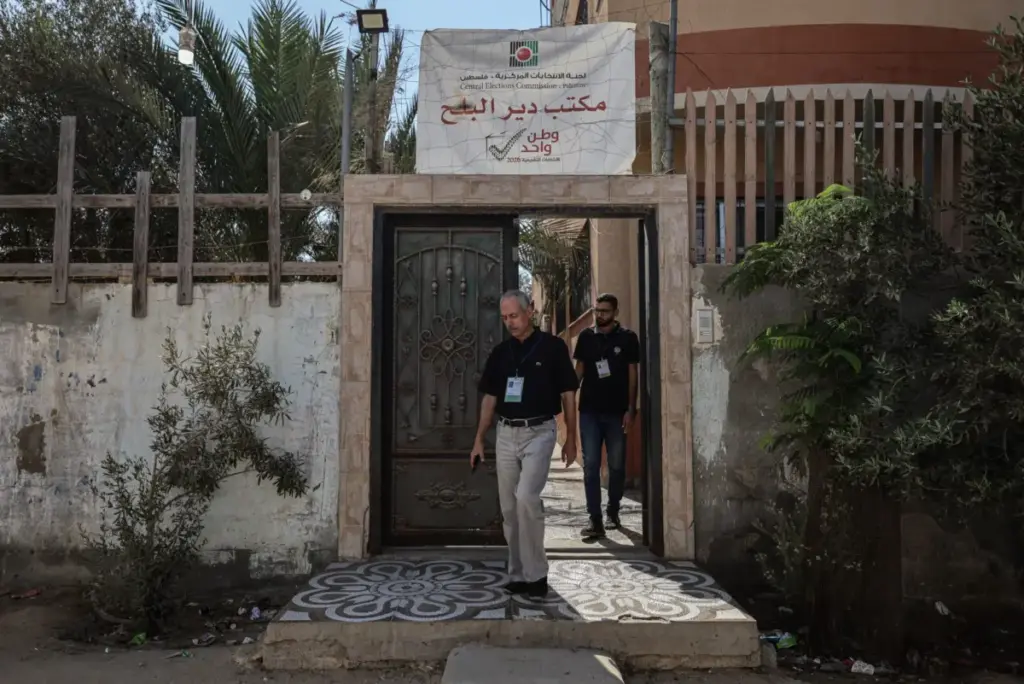
Now, as the Palestinian Central Elections Commission prepares for the upcoming Palestinian legislative elections scheduled for November 28, Mohsen stands on the cusp of a historic moment. This election will mark his very first national vote and the first time Palestinians head to the legislative polls since 2006. For Mohsen and millions of other young Palestinians, the upcoming vote is not merely a political exercise, but an urgent test of whether governance can finally address the catastrophic conditions shaping their daily lives.
He has clear priorities for the candidates seeking his vote. He wants politicians to directly tackle the sweeping socioeconomic crises plaguing his generation, including staggering unemployment, personal security, housing shortages, and the collapse of the education and healthcare sectors.
"The first thing I want is to be able to find a stable job with a decent salary so I can support myself and my family, and the second thing is to have security," he said.
Mohsen’s deep-seated anxieties are shared by nearly everyone living across the besieged and war-torn Gaza Strip, where unemployment currently hovers at an astronomical 80 percent. The enclave’s local economy has been comprehensively dismantled following years of a stringent Israeli blockade compounded by a war that has claimed the lives of more than 74,000 Palestinians.
Compounding his personal struggles, Mohsen’s family owns a parcel of land located east of Gaza’s vital Salah al-Din Street—an area where Israeli forces currently restrict civilian access, leaving him entirely cut off from his property. Like many displaced and dispossessed residents, he holds onto the hope that, in accordance with the terms of the October 2025 ceasefire agreement, Israel will soon withdraw its forces from the restricted zones and permit large-scale reconstruction to finally begin across the devastated territory.
For Mohsen, casting a ballot is ultimately meaningless if political transitions fail to yield tangible, material improvements in the day-to-day realities of ordinary citizens.
"A candidate should put themselves in the people’s place and speak with the people’s voice, not someone else’s voice," he emphasized. "They should speak for us, the young people who have been wronged for 20 years through wars and destruction. There needs to be an end to this."
Democratic Memories
Unlike young voters like Mohsen who have never experienced a national ballot, 53-year-old Ghassan Marwan carries vivid memories of the historic 2006 legislative elections, which were ultimately won by Hamas.
Before the decades of turmoil upended his existence, Marwan was a skilled goldsmith. Through years of dedicated labor, he successfully established a manufacturing workshop that served as a thriving, reliable source of financial independence for his entire household. When he walked to the polling station in 2006, he did so with high hopes that the democratic process would elevate living standards, cement long-term security and employment opportunities, and secure a stable, prosperous future for his children.
He fondly recalls casting his vote inside a school located in Nuseirat for an independent candidate list headed by prominent politician Mustafa Barghouti, describing the atmosphere of that election period as remarkably transparent, fair, and orderly.

"I witnessed a great deal of transparency and integrity. It was like a democratic celebration," Marwan recalled. "But unfortunately, that experience was not repeated over the past 20 years."
Two decades later, Marwan’s world has been turned completely upside down. He lost both his family home and his manufacturing workshop in January 2024 during the height of the military offensive. More than 30 years of hard work, enterprise, and savings were wiped out in an instant, leaving him unable to provide even a fraction of the stability he had meticulously built for his family.
"After losing your home and your source of income, what else do you want?" he asked bitterly. "All you hope for is reconstruction, calm, and security in the country."
What inflicts the deepest pain upon Marwan is the daily reality of watching his children grow up surrounded by temporary canvas tents rather than the permanent, secure home he worked a lifetime to provide. Furthermore, the war has forced him to shoulder basic survival chores that he never could have envisioned managing after decades of established professional life, such as walking long distances to search for water and carrying heavy containers back to his family’s makeshift shelter.
"After all these years, I am carrying water from far away. Am I going to remain in this situation?" he asked, his voice heavy with fatigue. "I am 53 today. In 10 years, I will be in my 60s, and I will not be able to carry this burden."
Marwan believes that this profound physical and psychological exhaustion has naturally eroded public enthusiasm for conventional politics. The political apathy he observes around him is not born of indifference, he argues, but rather from the crushing weight of systemic frustration and despair.
"Our interest in politics has declined, not because it does not concern us, but because of all the frustration and despair that have accumulated," he explained. "People have become preoccupied with how to get by and secure their daily bread."
As a result, the prospect of holding elections amid the vast landscapes of destruction, rubble, and mass displacement leaves him deeply torn between fleeting glimmers of hope and profound skepticism.
"Sometimes I feel that talking about elections is almost a joke, because there are no clear conditions for holding them," he admitted.
Recovery is Priority
Preparations are moving forward regardless of these formidable hurdles. The Palestinian Central Elections Commission is actively organizing to execute the vote smoothly across the occupied West Bank, occupied East Jerusalem, and the Gaza Strip. Commission estimates indicate that approximately 1.24 million Palestinians residing inside Gaza will be eligible to cast ballots in the upcoming election.
According to Jamil al-Khalidi, the commission’s regional director in Gaza, the administrative undertaking is confronting unprecedented logistical and security obstacles due to the sheer scale of infrastructural devastation and the massive waves of displacement triggered by the war. In response to these complex realities, election officials have developed rigorous contingency plans, including preparations to produce necessary voting materials locally within the enclave should Israel maintain restrictions on the entry of external supplies and electoral equipment.
For Iyad al-Qarra, a political analyst and writer based in Gaza, the years of conflict have not extinguished the political consciousness of Palestinians. Instead, the war has fundamentally redefined what the public expects political institutions and leaders to deliver.
Following nearly three years of relentless displacement, widespread destruction, and the total evaporation of livelihoods, al-Qarra argues that the political demands of Gaza’s population are now inextricably tied to the capacity of future leaders to restore normalcy to society, moving far beyond empty political slogans or routine administrative governance.
Al-Qarra notes that the universal priority across the territory is the emergence of a capable leadership cadre that can authentically represent the populace and urgently address basic survival needs. Foremost among these demands are the physical reconstruction of Gaza, the rehabilitation of shattered public infrastructure, the revival of the collapsed health and education sectors, and the creation of economic conditions that empower citizens to reclaim their autonomy and livelihoods.
"There is a widespread desire for leadership that puts Gaza’s recovery at the top of its priorities, given the heavy price the Strip has paid," al-Qarra said.