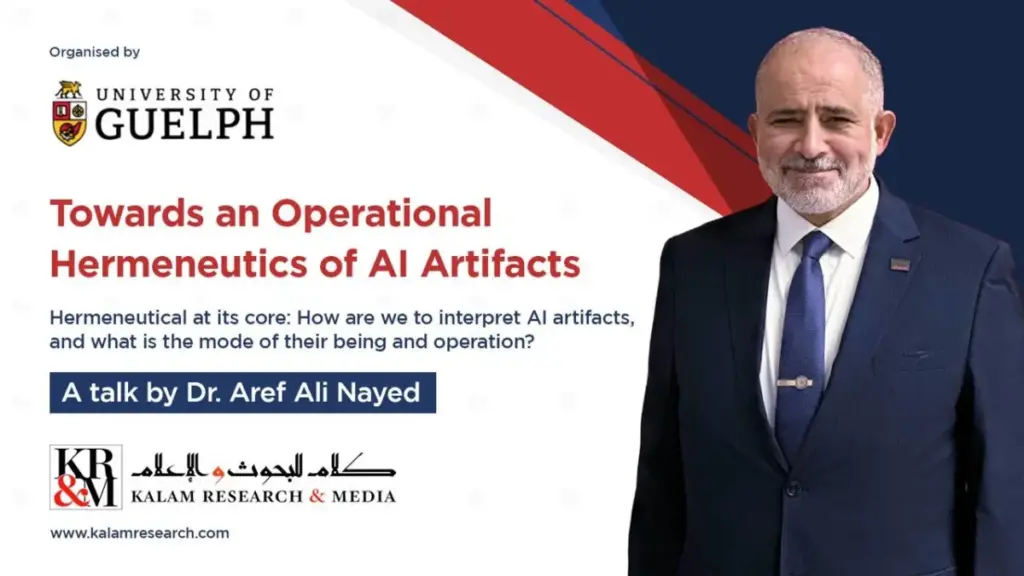
GUELPH, ONTARIO — In a significant academic homecoming that bridges decades of philosophical inquiry with the pressing technological challenges of the twenty-first century, Dr. Aref Ali Nayed, Chairman of Kalam Research & Media (KRM), recently delivered a compelling lecture at the University of Guelph. The presentation explored the intricate intersection of hermeneutics, artificial intelligence, and the ethical governance of emerging technologies, drawing deeply on academic frameworks that Dr. Nayed first conceptualized on the very same campus three decades ago.
The event served as a major milestone in KRM’s ongoing engagement with leading Canadian research institutions, highlighting how classical philosophical traditions can inform and guide modern technological development. By examining AI not merely as a computational tool but as an active participant in the generation and interpretation of meaning, Dr. Nayed’s lecture offered faculty, researchers, and students a fresh perspective on the responsible stewardship of artificial intelligence.
About the Lecture
The core of Dr. Nayed’s presentation focused on how Operational—a rigorous intellectual framework he originally developed during his doctoral research at the University of Guelph in the 1990s—provides essential, foundational tools for understanding and ethically engaging with AI-generated artifacts. As artificial intelligence systems rapidly evolve from simple data processors into sophisticated generators of text, imagery, and complex decisions, society faces unprecedented questions regarding interpretation, authenticity, and accountability.
During the lecture, Dr. Nayed discussed at length how modern AI systems function fundamentally as operational artifacts. Rather than acting as passive conduits of human instruction, these systems actively interpret inputs, generate novel meanings, and profoundly shape human understanding across educational, professional, and social spheres. This dynamic interaction necessitates a sophisticated hermeneutical approach—one that goes beyond technical compliance and addresses the very nature of machine-mediated interpretation.
The presentation explored how these operational artifacts create new layers of textual and visual meaning that human societies must learn to navigate critically. By applying operational hermeneutics to machine outputs, scholars and practitioners can better decode the underlying assumptions, biases, and generative processes embedded within AI systems, paving the way for more transparent and ethically sound technology governance.
Watch the Full Lecture
For those unable to attend the event in person, the complete lecture has been made available to the public online, capturing the depth of Dr. Nayed’s insights and the subsequent academic discussions that took place at the University of Guelph.
[YouTube player iframe placeholder]
Related Initiatives and Institutional Partnerships
This high-profile lecture was a central component of Dr. Nayed’s broader engagement with the Centre for Advancing Responsible and Ethical Artificial Intelligence (CARE-AI) at the University of Guelph. The visit successfully reinforced and deepened the ongoing institutional collaboration between Kalam Research & Media and Canadian AI research entities, all of which share a dedicated focus on developing robust, practical ethical frameworks for artificial intelligence.
The partnership with CARE-AI is not an isolated endeavor; rather, it forms a vital node within a broader network of collaborative relationships that KRM maintains with leading Canadian AI institutions. This network includes esteemed organizations such as the Vector Institute for Artificial Intelligence and the Canadian Institute for Advanced Research (CIFAR). Through these strategic alliances, researchers from diverse cultural, philosophical, and technical backgrounds are working collectively to address the global governance challenges posed by rapid technological acceleration.
Readers interested in learning more about the specifics of Dr. Nayed’s institutional engagements can find further documentation through official KRM channels regarding his comprehensive visit to the CARE-AI facilities.
Further Reading and Academic Monographs
To complement the themes addressed during his University of Guelph lecture, Dr. Nayed has recently published a comprehensive academic paper that expands significantly upon the theoretical underpinnings of his presentation.
Titled “Towards an Operational Hermeneutics of AI Artifacts,” the newly released monograph examines in meticulous detail how AI-generated outputs must be understood as operational artifacts that demand active, deliberate hermeneutical engagement. The paper proposes innovative new frameworks for interpreting machine-generated content while directly confronting the complex ethical dimensions inherent in contemporary human-AI interaction.
Academic researchers, ethicists, and technology developers seeking a deeper dive into these concepts can access the full monograph directly through the Kalam Research & Media publishing platform.
The University of Guelph Partnership and Intellectual Homecoming
The University of Guelph holds profound significance in Dr. Nayed’s long and distinguished intellectual journey. It was within these very lecture halls and academic offices in the 1990s that he first formulated the foundational concepts of Operational Hermeneutics. Returning to Guelph represented a true homecoming of ideas, bringing decades of intellectual refinement, practical application, and global experience back to the birthplace of the theory—now freshly adapted to confront the unprecedented contemporary challenges of artificial intelligence ethics.
This historical continuity underscores the enduring relevance of philosophical frameworks developed decades before the current generative AI boom. While the computational power and data scales of today’s models are vastly different from the technological landscape of the 1990s, the fundamental questions surrounding human comprehension, interpretation, and meaning remain remarkably consistent. By returning to Guelph, Dr. Nayed demonstrated that classical hermeneutical traditions possess the elasticity and depth required to make sense of cutting-edge technological shifts.
KRM’s Pioneering Research in Artificial Understanding
While conventional artificial intelligence research has predominantly concentrated on optimizing machine performance, processing speed, and data scalability, Kalam Research & Media has charted a distinct and visionary course. KRM has pioneered dedicated research into Artificial Understanding (AU)—a specialized approach that moves beyond mere computational efficiency to ask fundamental, foundational questions about comprehension, meaning, and interpretation within artificial systems.
The AU research program, firmly anchored in the principles of Operational Hermeneutics, pursues several key aims designed to reshape how humanity conceptualizes machine intelligence. Rather than treating AI as an autonomous oracle, the program seeks to clarify the boundaries between human insight and machine simulation, ensuring that technology remains genuinely subservient to human values and intellectual flourishing. This ongoing research agenda continues to generate vital discussions among ethicists, theologians, and computer scientists worldwide as they grapple with the long-term societal implications of sentient-seeming technologies.