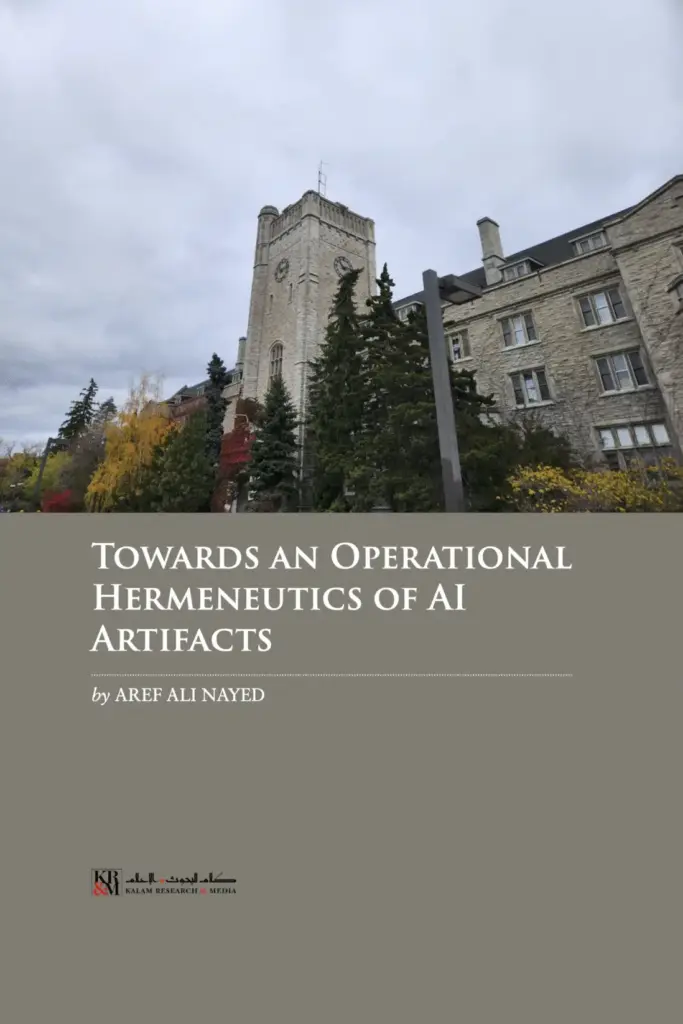
In a significant development bridging the worlds of classical philosophy and cutting-edge computer science, scholar and researcher Dr. Aref Ali Nayed has released a new 26-page academic paper that introduces a novel theoretical framework for interpreting artificial intelligence. Published in 2025, the monograph draws directly upon Dr. Nayed’s pioneering work in Operational Hermeneutics, a field of study he originally developed during his time at the University of Guelph in Canada during the 1990s. By extending these established hermeneutical principles into the modern domain of artificial intelligence, the paper sets out to offer a comprehensive new perspective on how humanity understands, interacts with, and assigns meaning to AI-generated outputs.
The intersection of philosophy and machine learning has grown increasingly urgent as artificial intelligence systems become more deeply embedded in daily life, producing complex texts, vivid imagery, and sophisticated lines of computer code. Dr. Nayed’s latest publication addresses this urgency by establishing a rigorous intellectual foundation for analyzing these digital creations. At the core of the paper is the extension of Operational Hermeneutics—traditionally used for the interpretation of texts, human actions, and cultural artifacts—so that it can be rigorously applied to AI artifacts. This includes everything from natural language responses and synthesized visuals to automated code repositories generated by contemporary machine learning models.
To ground this modern application in a rich intellectual tradition, the monograph carefully traces the philosophical lineage of what constitutes an "artifact," moving historically from the foundational insights of Aristotle all the way through to the modern administrative and design theories of Herbert Simon. This historical contextualization allows the paper to position AI systems not merely as opaque black boxes or simple tools, but as sophisticated artifact-generating engines that require a sophisticated interpretive framework. By connecting ancient and modern concepts of making, doing, and creating, the paper bridges a longstanding gap between the humanities and the hard sciences, offering a shared vocabulary for technologists and philosophers alike.
Moving from historical theory to practical application, the research paper proposes four distinct modes of human engagement with AI artifacts: actuating, manipulating, utilizing, and actualizing. These four categories provide a nuanced taxonomy for understanding the varying depths of human interaction with machine outputs. Rather than treating human-AI interaction as a monolithic experience, the framework recognizes that users engage with AI systems in profoundly different ways, ranging from the immediate triggering of a process to the deeper actualization of meaning within a broader socio-technical context. This granular approach helps clarify the shifting roles of human agency and machine generation in contemporary workflows.
In addition to exploring modes of engagement, the monograph tackles the pressing domain of AI ethics by viewing it through the rigorous lens of interpretive responsibility. As algorithms increasingly influence decision-making across journalism, law, medicine, and governance, the question of who bears responsibility for the interpretation and downstream effects of AI outputs has become paramount. The paper addresses this challenge directly, introducing the groundbreaking concept of "hermeneutic harm" within AI contexts. This conceptual addition highlights the potential damages that can arise not just from computational errors or biased data, but from flawed, irresponsible, or distorted interpretations of what machine-generated artifacts actually mean in human societies.
The release of this 26-page monograph also marks the formal announcement of a major collaborative research initiative designed to turn these theoretical insights into practical realities. This ambitious interdisciplinary program brings together a diverse coalition of academic institutions and research organizations spanning multiple continents. The founding partners of the initiative include the University of Guelph in Canada, where Dr. Nayed’s foundational work originated, alongside the Sheikh Mohammed bin Zayed University for the Humanities in Abu Dhabi, the specialized artificial intelligence institution MBZUAI, Kalam Research and Media, and Agathon Systems Ltd.
By uniting institutions with deep expertise in both the humanities and advanced artificial intelligence engineering, the collaborative research program aims to develop hermeneutically-informed AI design principles and robust governance frameworks. As the global technology sector grapples with questions of safety, ethics, transparency, and accountability, this partnership seeks to ensure that future AI systems are designed with a deep appreciation for human interpretation, cultural context, and ethical responsibility. Researchers, policymakers, and academics interested in examining the full scope of Dr. Nayed’s arguments and exploring the detailed architecture of the proposed framework can access and download the complete monograph directly through the published research repository.