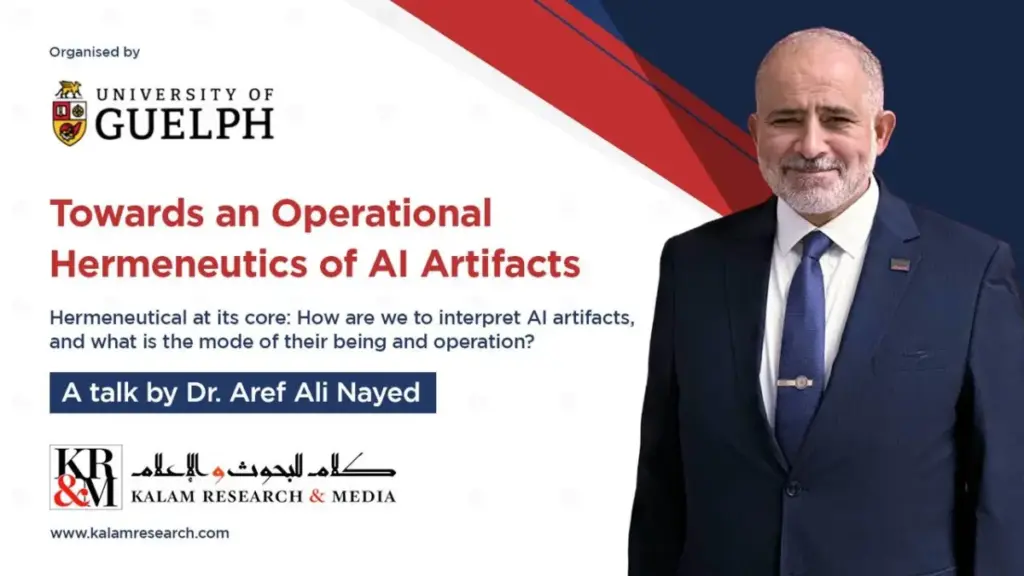
Dr. Aref Ali Nayed, Chairman of Kalam Research & Media (KRM), recently delivered a compelling lecture at the University of Guelph, exploring the intricate intersection of hermeneutics, artificial intelligence, and the ethical governance of emerging technologies. The presentation brought a significant intellectual homecoming to the Canadian institution, drawing on foundational frameworks developed decades ago and applying them directly to the modern challenges posed by contemporary machine learning systems.
About the Lecture
The presentation examined how Operational Hermeneutics—a theoretical framework that Dr. Nayed originally developed during the 1990s at the University of Guelph—provides essential tools for understanding and ethically engaging with AI-generated artifacts. During his address, Dr. Nayed discussed the ways in which modern artificial intelligence systems function not merely as computational processors, but as operational artifacts capable of interpreting data, generating meaning, and actively shaping human understanding.
As society grapples with the rapid proliferation of generative artificial intelligence, machine-generated texts, synthetic media, and autonomous decision-making tools, the need for robust interpretive frameworks has never been more urgent. Dr. Nayed’s lecture emphasized that traditional ethical guidelines often fall short because they treat AI outputs as passive tools rather than active participants in the generation of cultural and cognitive meaning. By applying operational hermeneutics, researchers, policymakers, and technologists can better navigate the complexities of human-machine interaction, ensuring that artificial intelligence remains aligned with human values and ethical standards.
Watch the Full Lecture
For those interested in experiencing the full depth of Dr. Nayed’s insights, the complete lecture has been made publicly available via video. The recorded session captures the nuanced discussion on machine comprehension, the philosophical foundations of operational hermeneutics, and the pressing imperative for ethical governance in the age of advanced computing.
Related Initiatives and Institutional Collaboration
This academic visit was part of Dr. Nayed’s broader engagement with the Centre for Advancing Responsible and Ethical Artificial Intelligence (CARE-AI) at the University of Guelph. The visit served to strengthen the ongoing collaboration between Kalam Research & Media and Canadian AI research institutions that are actively dedicated to developing rigorous ethical frameworks for artificial intelligence.
The partnership bridges philosophical inquiry with practical technological development, fostering an environment where humanists and computer scientists can collaborate effectively. As AI systems become more deeply embedded in daily life, institutional partnerships of this nature are vital for ensuring that technological advancement is matched by critical self-reflection and ethical oversight.
Further Reading and Academic Monographs
To complement the themes addressed during his lecture, Dr. Nayed has recently published a comprehensive academic paper that expands extensively on the relationship between machine outputs and interpretive frameworks. Titled “Towards an Operational Hermeneutics of AI Artifacts,” the monograph examines how AI-generated outputs must be understood as operational artifacts that fundamentally require hermeneutical engagement.
The paper proposes innovative methodologies and theoretical frameworks for interpreting machine-generated content, moving beyond surface-level utility to address the deeper ethical dimensions of human-AI interaction. Scholars, students, and technology practitioners can access the full publication through the Kalam Research & Media platform to further explore how hermeneutic philosophy applies to the digital age.
The University of Guelph Partnership and Intellectual Homecoming
The University of Guelph holds profound significance in Dr. Nayed’s long and distinguished intellectual journey. It was precisely on this campus during the 1990s that he first formulated the foundational concepts of Operational Hermeneutics during his doctoral research. His return to Guelph represents a true homecoming of ideas, bringing decades of intellectual refinement back to the very birthplace of the theory, now repurposed to address the defining technological challenges of the twenty-first century.
This renewed engagement with the University of Guelph and CARE-AI is part of a broader, expanding network of collaborations that Kalam Research & Media maintains with leading Canadian artificial intelligence institutions. These strategic relationships include prominent organizations such as the Vector Institute for Artificial Intelligence and the Canadian Institute for Advanced Research (CIFAR), reflecting a shared international commitment to responsible technological innovation.
KRM’s Research into Artificial Understanding
While conventional artificial intelligence research has historically focused on optimizing machine performance, processing speed, and pattern recognition, Kalam Research & Media has pioneered a distinct and necessary path: the study of Artificial Understanding (AU). This innovative research approach shifts the inquiry away from mere data processing to ask fundamental questions concerning comprehension, meaning, and true interpretation within artificial systems.
Grounded firmly in the principles of Operational Hermeneutics, KRM’s Artificial Understanding research program seeks to redefine how scientists and philosophers conceptualize machine intelligence. By investigating the boundaries between calculating data and comprehending meaning, the research initiative aims to foster a future where artificial intelligence operates with a transparent, accountable, and ethically sound foundation.