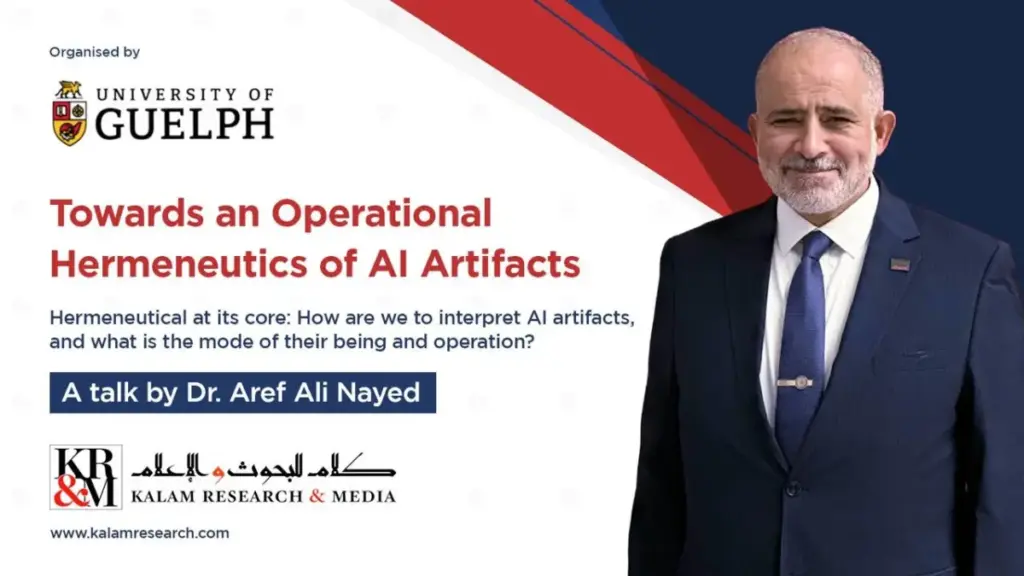
Dr. Aref Ali Nayed, Chairman of Kalam Research & Media (KRM), recently delivered a compelling and thought-provoking lecture at the University of Guelph, exploring the intricate intersection where hermeneutics, artificial intelligence, and the ethical governance of emerging technologies meet. The high-profile presentation served as both an academic exploration and a significant homecoming, drawing on decades of intellectual development while addressing the urgent, contemporary challenges posed by rapidly evolving artificial intelligence systems.
About the Lecture
The presentation closely examined how "Operational Hermeneutics"—a theoretical and methodological framework originally developed by Dr. Nayed during the 1990s right there at the University of Guelph—provides essential, robust tools for understanding and ethically engaging with AI-generated artifacts. Before a room of scholars, students, and technology researchers, Dr. Nayed discussed the ways in which modern artificial intelligence systems function far beyond simple computational tools. Instead, he argued, they operate as operational artifacts that actively interpret data, generate meaning, and profoundly shape human understanding in the digital age.
The lecture delved into several key topics surrounding this premise, addressing the philosophical underpinnings of machine outputs and the responsibility of human creators and users in establishing ethical boundaries. By framing AI systems through the lens of operational hermeneutics, Dr. Nayed offered the audience a fresh perspective on how society can decode and critically evaluate machine-generated content rather than passively accepting it at face value.
Watch the Full Lecture
For those unable to attend the event in person, the complete presentation has been made publicly available. The embedded video below captures the full scope of Dr. Nayed’s lecture at the University of Guelph, offering viewers an in-depth look at his arguments regarding AI artifacts, human comprehension, and the future of ethical governance in technology.
Related Initiatives
This academic lecture was not an isolated event, but rather a core component of Dr. Nayed’s broader engagement with the Centre for Advancing Responsible and Ethical Artificial Intelligence (CARE-AI) at the University of Guelph. This visit served to significantly strengthen the ongoing collaboration between Kalam Research & Media and Canadian AI research institutions that are dedicated to developing comprehensive, responsible, and ethical frameworks for artificial intelligence deployment. As AI systems become more deeply integrated into daily life, partnerships between philosophy-driven research organizations and technical institutions have become increasingly vital.
Readers interested in learning more about the specific discussions and goals of this institutional visit can read more about Dr. Nayed’s visit to CARE-AI ↗.
Further Reading
To complement the themes and insights shared during his lecture, Dr. Nayed has recently published a comprehensive academic paper that expands extensively on the subject.
Titled “Towards an Operational Hermeneutics of AI Artifacts,” the newly released monograph examines how AI-generated outputs must be understood as operational artifacts that inherently demand active hermeneutical engagement. Rather than viewing AI outputs as neutral reflections of objective reality, the paper proposes innovative frameworks for properly interpreting machine-generated content. Furthermore, it tackles the complex ethical dimensions of human-AI interaction, offering scholars and developers alike a guiding framework to navigate the uncharted waters of artificial intelligence generation.
Those wishing to dive deeper into the academic foundations of this research can read the full monograph ↗.
About the University of Guelph Partnership
The University of Guelph holds deep intellectual significance in Dr. Nayed’s academic journey. It was on this very campus during the 1990s that he first conceptualized and developed the foundational principles of Operational Hermeneutics during his doctoral research. His return to Guelph represents a powerful homecoming of ideas, bringing decades of intellectual refinement back to their birthplace, where they are now being directly applied to the pressing, contemporary challenges of AI ethics and digital philosophy.
This visit highlights the broader network of collaborations that Kalam Research & Media maintains with leading Canadian AI institutions. Beyond the University of Guelph and CARE-AI, KRM’s collaborative efforts extend to other prominent Canadian research hubs, including the Vector Institute for Artificial Intelligence and the Canadian Institute for Advanced Research (CIFAR), fostering an international dialogue on the responsible future of technology.
KRM’s Artificial Understanding Research
While mainstream technology research often remains laser-focused on improving raw machine performance, speed, and processing power, Kalam Research & Media has charted a distinctly different course. KRM has pioneered dedicated research into Artificial Understanding (AU)—a specialized approach that moves past mere data processing to ask fundamental questions about comprehension, true meaning, and sophisticated interpretation within artificial systems.
The AU research program, which remains deeply grounded in the traditions of Operational Hermeneutics, pursues several key aims designed to bridge the widening gap between technical capability and genuine philosophical comprehension. By questioning how machines interpret data and how humans make sense of those machine interpretations, KRM aims to steer the global technological conversation toward more meaningful, transparent, and ethically sound outcomes.
For a deeper dive into the methodology and long-term goals of this initiative, you can learn more about KRM’s Artificial Understanding program ↗.