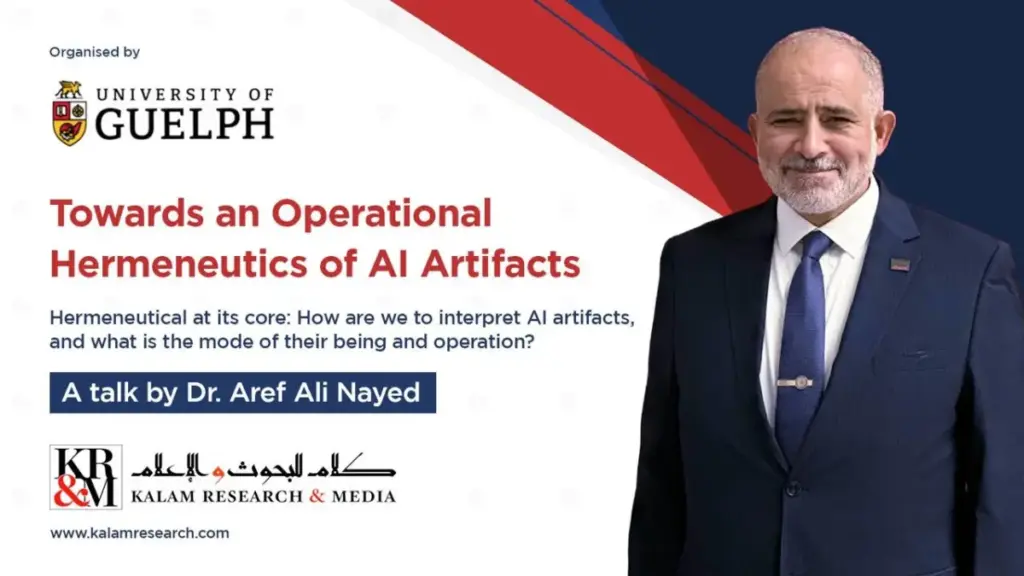
Dr. Aref Ali Nayed, Chairman of Kalam Research & Media (KRM), recently delivered a compelling academic lecture at the University of Guelph, offering deep insights into the intersection of hermeneutics, artificial intelligence, and the ethical governance of emerging technologies. The high-profile event marked a significant intellectual homecoming for Dr. Nayed, who originally developed his foundational framework of Operational Hermeneutics at the very same institution during the 1990s.
The comprehensive presentation brought decades of academic refinement back to its birthplace, applying time-tested philosophical concepts to the urgent, contemporary challenges posed by modern artificial intelligence. By bridging traditional philosophy and cutting-edge computer science, Dr. Nayed’s address provided academics, researchers, and technologists with vital tools to navigate an increasingly automated world.
About the Lecture
The core of Dr. Nayed’s presentation centered on how Operational Hermeneutics—the specialized framework he pioneered during his doctoral research at the University of Guelph three decades ago—provides essential, indispensable tools for understanding and ethically engaging with AI-generated artifacts. As artificial intelligence systems rapidly evolve from simple computational tools into complex generators of text, imagery, and decision-making frameworks, society faces unprecedented questions regarding how these systems operate.
During the lecture, Dr. Nayed discussed at length how modern AI systems function fundamentally as operational artifacts. Rather than acting as neutral conduits of data, these technologies actively interpret information, generate meaning, and profoundly shape human understanding. Because machine learning models synthesize vast repositories of human knowledge to produce outputs that mimic human cognition, they require sophisticated interpretive frameworks. Dr. Nayed argued that conventional technical governance is insufficient on its own; instead, society must employ rigorous hermeneutical engagement to properly evaluate what AI systems produce and how those outputs influence human culture, thought, and behavior.
The engaging presentation resonated deeply with an audience of faculty members, graduate students, and artificial intelligence researchers, sparking robust academic discourse surrounding the accountability and transparency of automated systems. Attendees had the opportunity to explore how philosophical traditions can directly inform technical development and policy-making in the digital age.
Watch the Full Lecture
For those unable to attend the event in person, the complete lecture has been made publicly available. The recorded session captures the depth of Dr. Nayed’s insights, the nuances of his philosophical framework, and the engaging question-and-answer session that followed the primary presentation. Viewers can watch the full video directly through the embedded player below to experience the comprehensive academic discourse hosted at the University of Guelph.
Related Initiatives
Dr. Nayed’s lecture was not an isolated event, but rather a prominent cornerstone of his broader, ongoing engagement with the Centre for Advancing Responsible and Ethical Artificial Intelligence (CARE-AI) at the University of Guelph. This high-level academic visit significantly strengthened the ongoing collaboration between Kalam Research & Media and Canadian AI research institutions that are dedicated to formulating robust ethical frameworks for artificial intelligence.
As artificial intelligence systems become increasingly pervasive across all sectors of society, institutions like CARE-AI and KRM recognize the critical need for interdisciplinary cooperation. By combining technical expertise with deep ethical and philosophical inquiry, these partnerships aim to guide the future development of technology in a direction that respects human dignity, promotes transparency, and safeguards societal values. Those interested in learning more about the scope of this institutional visit can read more about Dr. Nayed’s visit to CARE-AI.
Further Reading
Building directly upon the themes, philosophies, and methodologies addressed during his lecture at the University of Guelph, Dr. Nayed has recently published a comprehensive academic paper that expands the discourse for an international readership.
The newly released monograph, titled “Towards an Operational Hermeneutics of AI Artifacts,” examines in rigorous detail how machine-generated outputs must be understood as operational artifacts that demand active hermeneutical engagement. Rather than passively consuming or blindly trusting AI-generated content, scholars, policymakers, and everyday users must adopt structured interpretive approaches. The paper proposes innovative new frameworks specifically designed for interpreting machine-generated content while deeply addressing the complex ethical dimensions inherent in human-AI interaction. Academics and technology ethics professionals can read the full monograph to explore these advanced concepts further.
About the University of Guelph Partnership
The University of Guelph holds a profound and unique significance in Dr. Nayed’s extensive intellectual journey. It was within these very academic halls during the 1990s that he first formulated and developed the foundational concepts of Operational Hermeneutics during his rigorous doctoral research. His triumphant return to Guelph represents a powerful homecoming of ideas, bringing decades of academic refinement, global leadership, and practical application back to their birthplace. Today, these exact theories are being successfully redeployed to tackle the most pressing contemporary challenges in artificial intelligence ethics.
Furthermore, KRM’s enduring partnership with the University of Guelph and CARE-AI is part of an expansive, highly collaborative network connecting KRM with leading Canadian artificial intelligence institutions. This prestigious network also includes vital cooperative efforts with renowned entities such as the Vector Institute for Artificial Intelligence and the Canadian Institute for Advanced Research (CIFAR), ensuring that KRM’s philosophical insights actively inform Canada’s vibrant AI research ecosystem.
KRM’s Artificial Understanding Research
In a landscape where the vast majority of conventional artificial intelligence research remains narrowly focused on optimizing machine performance, data processing speeds, and algorithmic efficiency, Kalam Research & Media has charted a remarkably distinct path. KRM has pioneered dedicated research into Artificial Understanding (AU)—a visionary approach that asks fundamental, searching questions about comprehension, genuine meaning, and deep interpretation within artificial systems.
While artificial intelligence can rapidly process vast datasets and generate sophisticated responses, the question of whether these systems genuinely understand what they are communicating remains a critical philosophical hurdle. Grounded firmly in the principles of Operational Hermeneutics, KRM’s cutting-edge Artificial Understanding research program seeks to bridge the chasm between mere data manipulation and authentic comprehension. Readers who wish to dive deeper into this specialized field can learn more about KRM’s Artificial Understanding program to discover how the organization continues to shape the global dialogue on the future of human-machine relations.