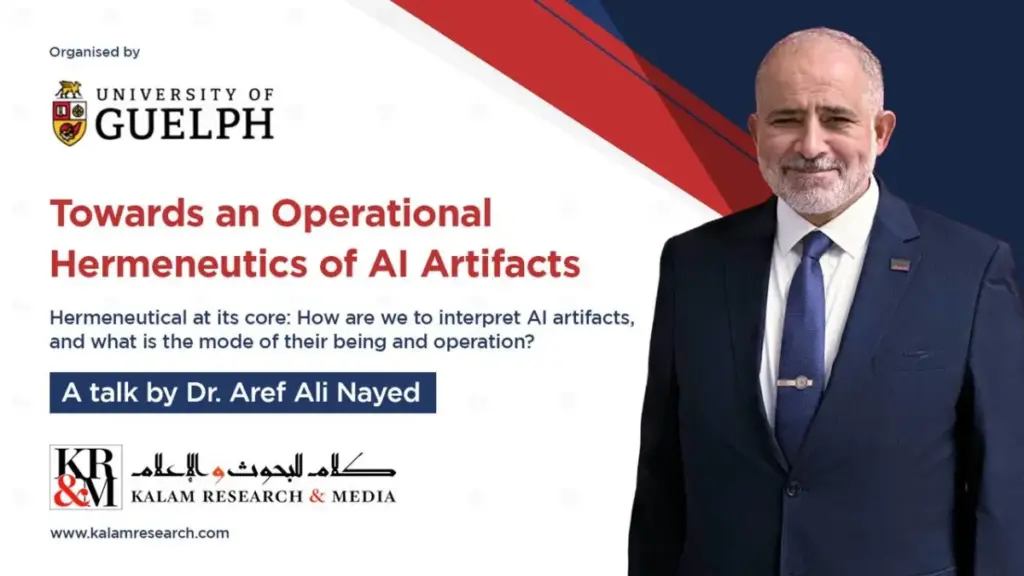
Dr. Aref Ali Nayed, Chairman of Kalam Research & Media (KRM), recently returned to the University of Guelph to deliver a comprehensive public lecture exploring the critical intersection of hermeneutics, artificial intelligence, and the ethical governance of emerging technologies. The event marked a significant academic homecoming for Dr. Nayed, who originally developed the foundational framework of "Operational Hermeneutics" at the very same institution during his doctoral research in the 1990s.
About the Lecture
The presentation examined how Operational Hermeneutics provides essential intellectual tools for understanding and ethically engaging with AI-generated artifacts. Before a gathered audience of scholars, students, and technology researchers, Dr. Nayed discussed the ways in which modern artificial intelligence systems function not merely as computational engines, but as operational artifacts that actively interpret, generate meaning, and shape human understanding.
As AI tools increasingly permeate daily life, professional workflows, and societal institutions, the lecture underscored the urgency of moving beyond basic technical compliance toward a deeper philosophical comprehension of machine outputs. Dr. Nayed detailed how applying hermeneutical frameworks allows researchers and policymakers to critically analyze how AI systems construct narratives, process cultural symbols, and influence human cognition. The discussion emphasized that addressing the challenges of modern technology requires bridging the gap between rigorous technical development and deep humanistic inquiry.
Watch the Full Lecture
Related Initiatives
The lecture formed a central component of Dr. Nayed’s broader engagement with the Centre for Advancing Responsible and Ethical Artificial Intelligence (CARE-AI) at the University of Guelph. This high-profile visit served to strengthen ongoing institutional collaboration between KRM and Canadian AI research centers that are dedicated to creating robust ethical frameworks for artificial intelligence governance.
Through cooperative dialogues with CARE-AI leadership and faculty members, the partnership seeks to foster international and cross-disciplinary exchanges. By combining KRM’s expertise in philosophical and hermeneutical research with Canada’s prominent technological infrastructure, both organizations aim to help shape global standards for responsible AI deployment and development.
Read more about Dr. Nayed’s visit to CARE-AI →
Further Reading
For scholars and professionals looking to dive deeper into the theoretical arguments presented during the event, Dr. Nayed has recently published a comprehensive academic paper expanding upon these themes.
Titled “Towards an Operational Hermeneutics of AI Artifacts,” the publication examines how AI-generated outputs can be understood as operational artifacts that require dedicated hermeneutical engagement. The paper proposes innovative frameworks for interpreting machine-generated content and addresses the intricate ethical dimensions of human-AI interaction in an increasingly automated world.
About the University of Guelph Partnership
The University of Guelph holds profound significance in Dr. Nayed’s intellectual and academic journey. It was on this campus during the 1990s that he first formulated the core concepts of Operational Hermeneutics during his doctoral studies. His recent return to Guelph represents a powerful homecoming of ideas, bringing decades of intellectual refinement back to their birthplace—now freshly applied to the contemporary challenges of artificial intelligence ethics.
This academic partnership between KRM and the University of Guelph, alongside CARE-AI, forms an integral part of a wider network of collaborations connecting KRM with leading Canadian AI institutions. These collaborative efforts extend to renowned research hubs such as the Vector Institute for Artificial Intelligence and the Canadian Institute for Advanced Research (CIFAR), ensuring that philosophical insights actively inform national and international technological policies.
KRM’s Artificial Understanding Research
Unlike conventional artificial intelligence research, which predominantly focuses on raw computational power, processing speed, and algorithmic performance, Kalam Research & Media has pioneered research in "Artificial Understanding" (AU). This distinctive approach asks fundamental questions regarding comprehension, meaning, and true interpretation within artificial systems, moving past mere data processing to evaluate whether machines can genuinely grasp the significance of what they compute.
The AU research program, deeply rooted in the traditions of Operational Hermeneutics, pursues several strategic aims designed to steer the future of technology toward human-centric values, ensuring that artificial systems remain accountable to human meaning-making processes and ethical standards.