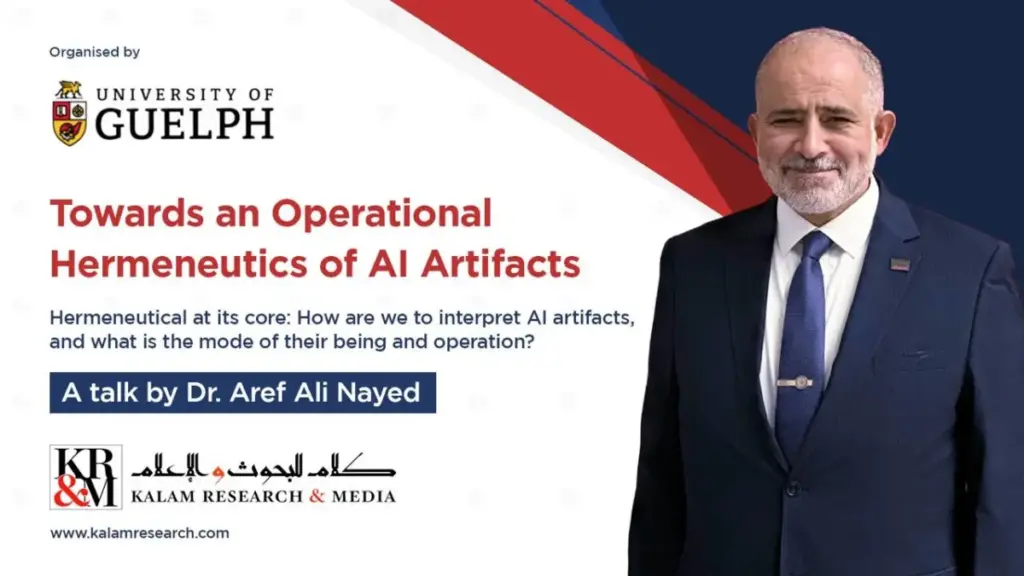
Dr. Aref Ali Nayed, Chairman of Kalam Research & Media (KRM), recently delivered a compelling lecture at the University of Guelph, offering deep insights into the intersection of hermeneutics, artificial intelligence, and the ethical governance of emerging technologies. The academic gathering brought together researchers, students, and technology ethicists to examine how philosophical traditions can guide the rapid advancement of modern computational systems.
The presentation served as a centerpiece for Dr. Nayed’s broader engagement with Canadian academic institutions, highlighting the ongoing intellectual exchange between KRM and leading hubs of artificial intelligence research. By bridging ancient philosophical questions of meaning with cutting-edge technological development, the lecture opened new pathways for understanding how society interacts with intelligent machines.
About the Lecture
The core of Dr. Nayed’s presentation examined how Operational Hermeneutics—a robust theoretical framework he originally developed in the 1990s during his doctoral studies at the University of Guelph—provides essential tools for understanding and ethically engaging with AI-generated artifacts. As artificial intelligence systems become increasingly sophisticated, they do much more than simply process data or compute algorithms. Dr. Nayed discussed how modern AI systems function fundamentally as operational artifacts that actively interpret, generate meaning, and shape human understanding.
Rather than viewing AI outputs as neutral mathematical results, the lecture emphasized that machine-generated content carries interpretive weight. Because these systems synthesize vast amounts of human knowledge and cultural data, their outputs require sophisticated hermeneutical engagement. Attendees explored how applying operational hermeneutics can help society better comprehend the underlying mechanics of machine interpretation, ensuring that technological progress remains aligned with human values and ethical standards.
Related Initiatives and Institutional Partnerships
This significant lecture was a key component of Dr. Nayed’s collaborative visit to the Centre for Advancing Responsible and Ethical Artificial Intelligence (CARE-AI) at the University of Guelph. The visit successfully strengthened ongoing partnerships between Kalam Research & Media and Canadian AI research institutions that are dedicated to formulating robust ethical frameworks for artificial intelligence governance.
The collaboration between KRM and CARE-AI represents a vital bridge between theological, philosophical, and technical disciplines. As artificial intelligence increasingly influences public discourse, economic systems, and daily life, interdisciplinary partnerships of this nature are crucial for anticipating ethical challenges and developing proactive governance models. Through these joint initiatives, researchers aim to ensure that artificial intelligence development remains transparent, accountable, and deeply respectful of human dignity.
Further Reading and Academic Contributions
To expand upon the themes addressed during his University of Guelph lecture, Dr. Nayed has recently published a comprehensive academic monograph titled “Towards an Operational Hermeneutics of AI Artifacts.”
The newly published paper examines in detail how AI-generated outputs must be understood as operational artifacts that demand active hermeneutical engagement. By proposing innovative frameworks for interpreting machine-generated content, the monograph addresses the complex ethical dimensions inherent in contemporary human-AI interaction. Scholars and practitioners interested in the philosophical underpinnings of technology can access the full publication through the Kalam Research & Media platform to gain a deeper understanding of these evolving concepts.
The University of Guelph Partnership and Intellectual Homecoming
The University of Guelph holds profound significance in Dr. Nayed’s long and distinguished intellectual journey. It was on this very campus during the 1990s that he first formulated and developed the foundational concepts of Operational Hermeneutics. His return to Guelph represents a powerful homecoming of ideas, bringing decades of intellectual refinement back to their birthplace where they are now being actively applied to the most pressing contemporary challenges in AI ethics.
This enduring connection with the University of Guelph forms an integral part of KRM’s broader network of collaborations with leading Canadian AI institutions. These partnerships also extend to prominent organizations such as the Vector Institute for Artificial Intelligence and the Canadian Institute for Advanced Research (CIFAR), fostering a vibrant ecosystem of cross-disciplinary research and ethical inquiry.
KRM’s Pioneering Research in Artificial Understanding
While the vast majority of conventional artificial intelligence research remains narrowly focused on optimizing machine performance, speed, and computational efficiency, Kalam Research & Media has charted a distinct and visionary path. KRM has pioneered research in Artificial Understanding (AU)—a specialized approach that moves beyond mere data processing to ask fundamental, foundational questions about comprehension, meaning, and interpretation within artificial systems.
The AU research program, which is firmly grounded in the principles of Operational Hermeneutics, addresses the profound philosophical gap between data retrieval and genuine comprehension. By investigating how artificial systems might truly grasp the semantic and contextual weight of the information they handle, KRM’s research program seeks to redefine the relationship between human thought and machine capability. This groundbreaking work continues to shape international dialogues on the future of technology, ensuring that the advancement of artificial intelligence is mirrored by an equally rigorous commitment to artificial understanding and ethical responsibility.