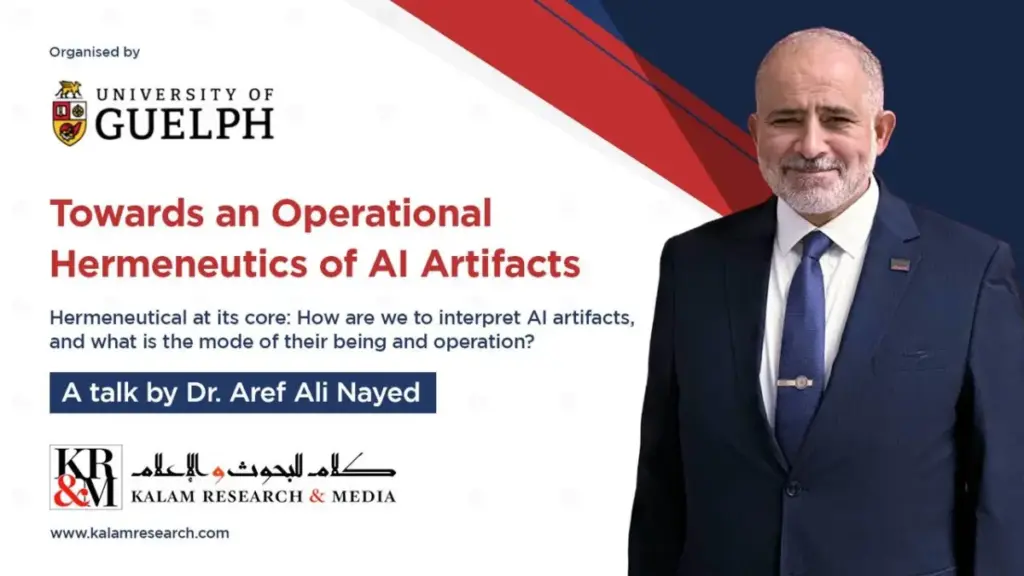
Dr. Aref Ali Nayed, Chairman of Kalam Research & Media (KRM), recently delivered a compelling lecture at the University of Guelph, offering profound insights into the intersection of hermeneutics, artificial intelligence, and the ethical governance of emerging technologies. The presentation served as a significant milestone in ongoing international dialogues concerning how society can better comprehend, interpret, and govern increasingly complex machine-generated systems.
About the Lecture
The presentation examined how Operational Hermeneutics—a robust intellectual framework originally developed by Dr. Nayed in the 1990s during his time at the University of Guelph—provides essential, foundational tools for understanding and ethically engaging with AI-generated artifacts. During his address, Dr. Nayed discussed the ways in which modern artificial intelligence systems function not merely as computational engines, but as operational artifacts that actively interpret, generate meaning, and shape human understanding across diverse cultural and intellectual spheres.
The lecture tackled crucial questions regarding how contemporary society interacts with machine outputs. By framing AI systems through the lens of operational hermeneutics, Dr. Nayed highlighted the necessity of moving beyond surface-level technological assessments to deeply evaluate the interpretive layers embedded within machine-generated content. This approach allows ethicists, technologists, and policymakers to better grasp the hidden assumptions, biases, and structural frameworks that govern how artificial intelligence constructs and disseminates meaning.
Watch the Full Lecture
Related Initiatives
This high-profile lecture formed an integral part of Dr. Nayed’s broader engagement with the Centre for Advancing Responsible and Ethical Artificial Intelligence (CARE-AI) at the University of Guelph. The visit successfully reinforced and strengthened ongoing collaborative efforts between Kalam Research & Media and prominent Canadian AI research institutions that are dedicated to formulating robust ethical frameworks for the development and deployment of artificial intelligence.
Through these institutional partnerships, researchers aim to bridge the persistent gap between rapid technological innovation and normative ethical oversight. The engagement underscores a shared commitment to ensuring that emerging technologies remain aligned with human values, transparency, and accountability.
Read more about Dr. Nayed’s visit to CARE-AI ⟶
Further Reading
To complement the themes explored during his presentation, Dr. Nayed has recently published a comprehensive academic paper that expands extensively upon the core arguments of the lecture.
Entitled “Towards an Operational Hermeneutics of AI Artifacts,” the publication examines how AI-generated outputs can be properly understood as operational artifacts that fundamentally require active hermeneutical engagement. The paper proposes innovative analytical frameworks designed specifically for interpreting machine-generated content while directly addressing the complex ethical dimensions inherent in contemporary human-AI interaction. Scholars, practitioners, and policymakers interested in the philosophical underpinnings of machine intelligence can access the complete monograph online.
About the University of Guelph Partnership
The University of Guelph holds profound intellectual and personal significance in Dr. Nayed’s academic journey. It was precisely on this campus during the 1990s that he originally formulated the foundational concepts of Operational Hermeneutics as part of his rigorous doctoral research. His return to Guelph represents a powerful homecoming of ideas, bringing decades of theoretical refinement and practical application back to their original birthplace, where they are now being actively deployed to address pressing contemporary challenges in artificial intelligence ethics.
This academic homecoming highlights the enduring relevance of philosophical inquiry in the face of modern technological transformations. KRM’s ongoing partnership with the University of Guelph and CARE-AI is situated within an even broader network of strategic collaborations linking Kalam Research & Media with leading Canadian AI research organizations, including the Vector Institute for Artificial Intelligence and the Canadian Institute for Advanced Research (CIFAR). These collaborative networks foster a vibrant cross-disciplinary dialogue that brings together computer scientists, ethicists, philosophers, and social scientists.
KRM’s Artificial Understanding Research
While conventional artificial intelligence research has historically remained heavily focused on optimizing machine performance, computational efficiency, and raw data processing capabilities, Kalam Research & Media has pioneered a strikingly distinctive trajectory centered on Artificial Understanding (AU). This innovative approach raises fundamental, probing questions concerning comprehension, meaning-making, and profound interpretation within artificial systems.
The AU research program, deeply rooted in the traditions of Operational Hermeneutics, seeks to move beyond mere information retrieval and pattern recognition. By investigating how artificial systems can genuinely engage with the nuances of human meaning, KRM’s research agenda opens new pathways for creating technology that respects the complexity of human thought, culture, and ethics.