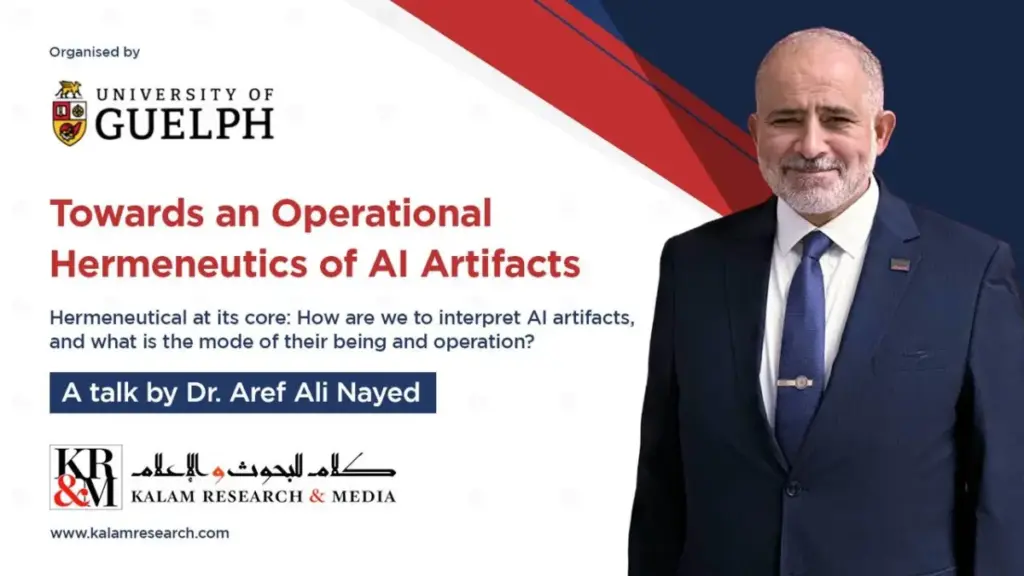
Dr. Aref Ali Nayed, Chairman of Kalam Research & Media (KRM), recently delivered a compelling and thought-provoking lecture at the University of Guelph, examining the profound intersection of hermeneutics, artificial intelligence, and the ethical governance of emerging technologies. The academic engagement marked a significant homecoming for Dr. Nayed, whose intellectual journey with the institution spans decades and forms the bedrock of his current work in machine ethics and comprehension.
The presentation offered a rigorous examination of how Operational Hermeneutics—a theoretical and methodological framework originally formulated by Dr. Nayed during his doctoral research at the University of Guelph in the 1990s—provides essential, foundational tools for understanding and ethically engaging with AI-generated artifacts. As contemporary society grapples with the rapid integration of machine learning systems into daily life, commerce, and governance, Dr. Nayed’s lecture addressed the reality of AI systems functioning not merely as calculators or data processors, but as operational artifacts that actively interpret, generate meaning, and shape human understanding.
About the Lecture
The core of Dr. Nayed’s lecture focused on bridging the philosophical gap between classical traditions of interpretation and the hyper-modern realities of machine intelligence. By framing AI outputs through the lens of Operational Hermeneutics, the presentation challenged traditional views of technology as passive tools. Instead, Dr. Nayed discussed how modern algorithms and generative models operate as active participants in the construction of human knowledge, necessitating a robust framework for ethical engagement and critical interpretation.
The discourse explored how these operational artifacts demand new ways of thinking about authorship, truth, and responsibility. Attendees, which included faculty members, researchers, and students from various disciplines, engaged with concepts addressing how machine-generated content mediates our perception of reality and why traditional ethical models often fall short when applied to autonomous systems.
Related Initiatives and Institutional Collaboration
This high-profile lecture was part of Dr. Nayed’s broader, ongoing engagement with the Centre for Advancing Responsible and Ethical Artificial Intelligence (CARE-AI) at the University of Guelph. The visit served to strengthen and expand the ongoing collaboration between Kalam Research & Media and Canadian AI research institutions that are dedicated to developing comprehensive, robust ethical frameworks for the deployment of artificial intelligence.
The partnership between KRM, the University of Guelph, and CARE-AI forms a vital node in a wider network of collaborations with leading Canadian AI entities. These linkages include prestigious institutions such as the Vector Institute for Artificial Intelligence and the Canadian Institute for Advanced Research (CIFAR), reflecting a shared international commitment to ensuring that technological advancement is matched by rigorous ethical oversight and philosophical grounding.
Further Reading and Academic Contributions
Expanding directly upon the themes addressed during his University of Guelph lecture, Dr. Nayed has recently published a comprehensive academic paper that dives deeper into the mechanics of machine interpretation. Titled “Towards an Operational Hermeneutics of AI Artifacts,” the monograph examines how AI-generated outputs must be understood as operational artifacts that inherently require hermeneutical engagement rather than passive acceptance.
The paper proposes innovative frameworks designed specifically for interpreting machine-generated content, tackling the complex ethical dimensions inherent in human-AI interaction. By offering scholarly tools to decode and evaluate the outputs of complex systems, the publication contributes significantly to global academic conversations surrounding algorithmic transparency, accountability, and the philosophy of technology.
The University of Guelph Partnership and Intellectual Homecoming
The University of Guelph holds profound personal and intellectual significance in Dr. Nayed’s academic trajectory. It was on this very campus during the 1990s that he first conceptualized and developed the foundational principles of Operational Hermeneutics during his advanced graduate studies.
His return to Guelph represents a powerful homecoming of ideas—bringing decades of intellectual refinement, practical application, and global leadership back to their birthplace. Today, those original theoretical frameworks are being successfully adapted and applied to some of the most pressing contemporary challenges in artificial intelligence ethics and digital governance.
KRM’s Pioneering Research in Artificial Understanding
While the broader technology sector continues to pour immense resources into optimizing raw machine performance, Kalam Research & Media has charted a distinct intellectual path. KRM has pioneered research in Artificial Understanding (AU)—a groundbreaking approach that moves beyond mere computation to ask fundamental, foundational questions about comprehension, meaning, and interpretation within artificial systems.
Grounded deeply in the traditions of Operational Hermeneutics, the AU research program seeks to redirect the global conversation on technology. Rather than asking simply what machines can do or how fast they can process information, KRM’s Artificial Understanding initiative investigates what machines actually mean, how they interpret symbols, and what implications their generative outputs hold for human agency and civilization. Through ongoing academic lectures, international partnerships, and rigorous scholarly publishing, Kalam Research & Media continues to lead critical dialogues ensuring that the future of artificial intelligence remains anchored in deep ethical reflection and human understanding.