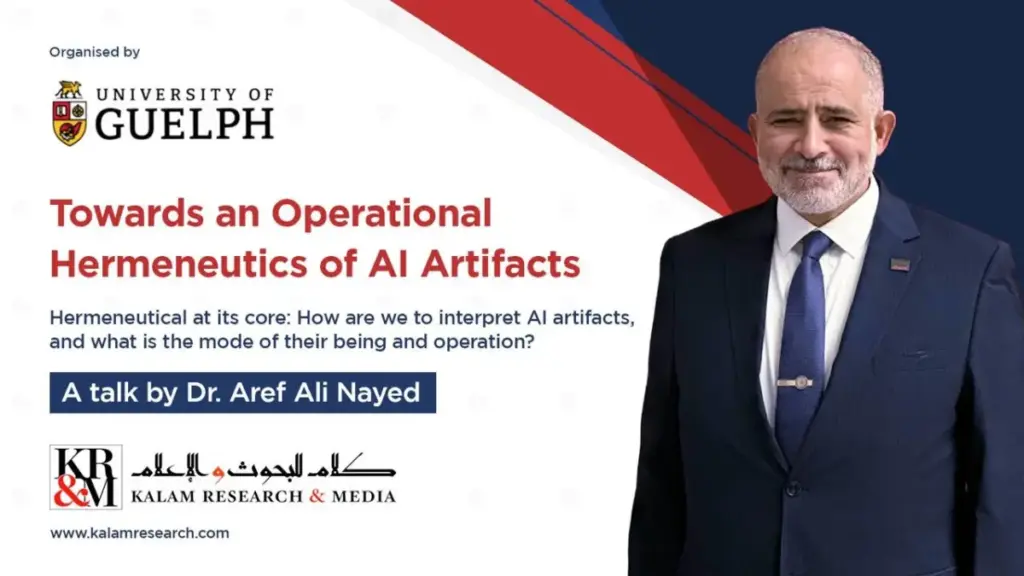
Dr. Aref Ali Nayed, Chairman of Kalam Research & Media (KRM), recently delivered a compelling and forward-looking lecture at the University of Guelph, bringing decades of philosophical evolution back to the institution where his foundational academic framework was first conceived. The lecture, which explored the complex intersection of hermeneutics, artificial intelligence, and the ethical governance of emerging technologies, served as a significant milestone in ongoing academic dialogues regarding how modern society interprets and manages machine intelligence.
The presentation closely examined how "Operational Hermeneutics"—a rigorous theoretical and practical framework originally developed by Dr. Nayed in the 1990s during his time at the University of Guelph—provides essential tools for understanding and ethically engaging with AI-generated artifacts. As artificial intelligence systems rapidly evolve from simple computational tools into sophisticated generators of text, imagery, and code, Dr. Nayed discussed how these systems function as operational artifacts. Rather than acting as neutral conduits of data, modern AI systems actively interpret, generate meaning, and profoundly shape human understanding, necessitating a sophisticated hermeneutical approach to ensure they serve human flourishing rather than undermine it.
This high-profile academic visit was deeply integrated into Dr. Nayed’s broader engagement with the Centre for Advancing Responsible and Ethical Artificial Intelligence (CARE-AI) at the University of Guelph. The visit successfully reinforced and strengthened the ongoing collaboration between Kalam Research & Media and Canadian AI research institutions, all of which share a vital commitment to developing robust, ethical frameworks for the deployment and governance of artificial intelligence.
The University of Guelph holds profound personal and intellectual significance in Dr. Nayed’s scholarly journey. It was within the halls of Guelph that he initially formulated the core tenets of Operational Hermeneutics during his doctoral research. His return to the campus represented a genuine homecoming of ideas, bringing decades of intellectual refinement back to their birthplace. Today, those foundational concepts are being directly applied to some of the most pressing contemporary challenges in artificial intelligence ethics and machine comprehension.
This academic engagement closely mirrors themes explored in Dr. Nayed’s recently published comprehensive monograph, titled “Towards an Operational Hermeneutics of AI Artifacts.” The publication examines how AI-generated outputs must be understood as operational artifacts that demand active hermeneutical engagement rather than passive acceptance. The paper proposes innovative new frameworks for interpreting machine-generated content and critically addresses the complex ethical dimensions inherent in human-AI interaction. Through this work, KRM continues to push the boundaries of how academic scholarship addresses the rapid technological shifts transforming global societies.
The partnership between Kalam Research & Media and the University of Guelph, alongside CARE-AI, forms an integral part of a much broader international and interdisciplinary network of collaborations. KRM maintains active relationships with leading Canadian AI research institutions, including the renowned Vector Institute for Artificial Intelligence and the Canadian Institute for Advanced Research (CIFAR). These strategic alliances allow researchers to pool intellectual resources, tackling the multifaceted challenges posed by rapid technological advancements from both a technical and a humanistic perspective.
A defining characteristic of KRM’s scholarly footprint in this domain is its pioneering research into Artificial Understanding (AU). While conventional artificial intelligence research has historically remained heavily focused on optimizing machine performance, processing speed, and computational efficiency, KRM has carved out a distinct approach. Artificial Understanding asks fundamental, deeply philosophical questions regarding comprehension, meaning, and interpretation within artificial systems. It moves beyond the mere mechanics of data processing to investigate whether and how machines can genuinely grasp context and significance.
Grounded firmly in the principles of Operational Hermeneutics, KRM’s dedicated Artificial Understanding research program seeks to bridge the widening gap between technical capabilities and human-centric meaning. By addressing how artificial systems process and construct significance, the program aims to establish rigorous standards for transparency, interpretability, and ethical accountability. This initiative represents a vital counterweight to purely utilitarian approaches to technology development, ensuring that human values remain at the very center of the digital evolution.
The lecture at the University of Guelph and the accompanying academic publications highlight the ongoing urgency of fostering dialogue between technologists, ethicists, and philosophers. As artificial intelligence continues to permeate every facet of modern life—from governance and education to creative arts and daily communication—the frameworks established by scholars like Dr. Nayed offer a vital compass. By examining machine outputs through the lens of operational hermeneutics, researchers and policymakers are better equipped to navigate the uncharted territories of the digital age, ensuring that emerging technologies remain understandable, accountable, and fundamentally aligned with human well-being.