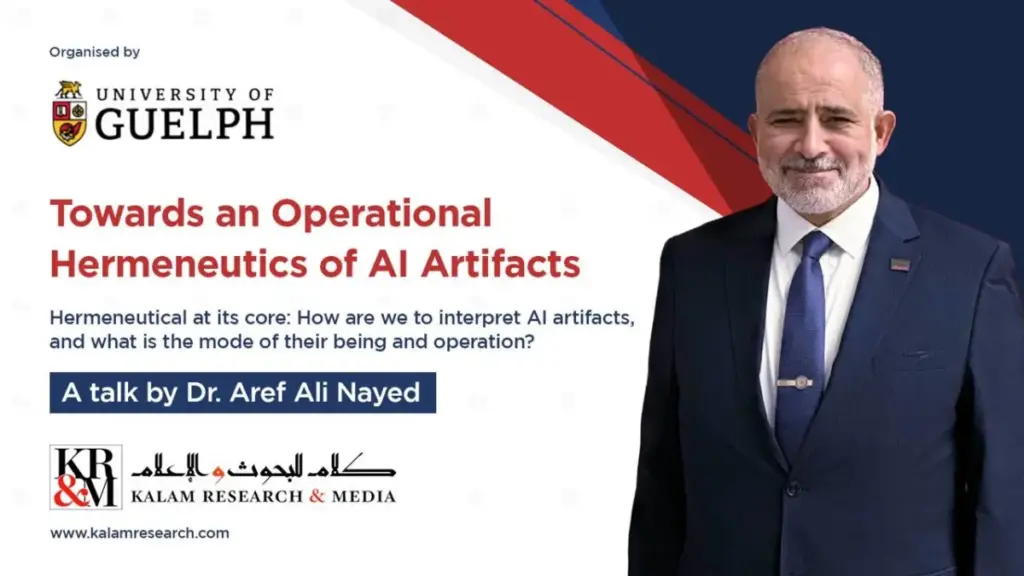
Dr. Aref Ali Nayed, Chairman of Kalam Research & Media (KRM), recently delivered a prominent academic lecture at the University of Guelph, offering deep insights into the intersection of hermeneutics, artificial intelligence, and the ethical governance of emerging technologies. The presentation marked a significant moment not only for contemporary discussions surrounding machine learning and artificial intelligence, but also for Dr. Nayed personally, as it served as a return to the institution where he originally laid the intellectual groundwork for his pioneering philosophical frameworks decades ago.
About the Lecture
During his comprehensive presentation, Dr. Nayed examined how Operational Hermeneutics—a theoretical framework he originally developed during the 1990s while conducting doctoral research at the University of Guelph—provides essential tools for understanding and ethically engaging with AI-generated artifacts. As artificial intelligence systems rapidly evolve from simple data processors into complex generators of text, imagery, and code, Dr. Nayed discussed how these systems function as operational artifacts. Rather than acting as neutral conduits of information, modern AI models actively interpret data, generate meaning, and shape human understanding in ways that demand rigorous philosophical and ethical scrutiny.
The lecture addressed the pressing need to move beyond standard technical metrics of AI performance. By applying operational hermeneutics to machine-generated outputs, researchers, policymakers, and technologists can better navigate the complexities of interpretation and meaning-making inherent in human-AI interactions. Dr. Nayed explored how these frameworks can guide the development of policies that ensure artificial intelligence remains aligned with human values, transparency, and accountability.
Watch the Full Lecture
For those unable to attend the event in person, the complete lecture has been made available to the public, offering a detailed look at Dr. Nayed’s discourse on the future of machine intelligence and ethical governance.
Related Initiatives
This high-profile lecture formed a central component of Dr. Nayed’s broader engagement with the Centre for Advancing Responsible and Ethical Artificial Intelligence (CARE-AI) at the University of Guelph. The visit successfully strengthened ongoing academic collaborations between Kalam Research & Media and Canadian AI research institutions that are actively dedicated to establishing robust ethical frameworks for artificial intelligence.
As automated systems assume greater responsibilities across various sectors of society, partnerships between philosophy-driven research organizations and technical centers like CARE-AI are becoming increasingly vital. These collaborations aim to bridge the persistent gap between technical capability and humanistic oversight, ensuring that emerging technologies are developed with a profound awareness of their social, cultural, and ethical implications.
Read more about Dr. Nayed’s visit to CARE-AI →
Further Reading
Building directly upon the themes explored during his lecture at the University of Guelph, Dr. Nayed has recently published a comprehensive academic paper that expands on the application of hermeneutical principles to modern technology.
Entitled “Towards an Operational Hermeneutics of AI Artifacts,” the publication examines how machine-generated outputs must be understood as operational artifacts that require active hermeneutical engagement rather than passive acceptance. The paper introduces innovative frameworks designed to assist scholars and practitioners in interpreting machine-generated content accurately, while directly confronting the multifaceted ethical dimensions that define contemporary human-AI interaction. This monograph serves as an essential resource for academics and industry professionals seeking a deeper philosophical grounding in AI ethics.
About the University of Guelph Partnership
The University of Guelph holds profound significance within Dr. Nayed’s broader intellectual journey. It was within the halls of this Canadian institution during the 1990s that he first formulated and articulated the foundational concepts of Operational Hermeneutics. His return to the campus represents a meaningful homecoming of ideas, bringing decades of theoretical refinement, cross-disciplinary dialogue, and practical application back to the very birthplace of the concept—now adapted to meet the unprecedented challenges of contemporary artificial intelligence.
This ongoing partnership between Kalam Research & Media and the University of Guelph, alongside CARE-AI, represents a crucial node in a wider network of academic cooperation. KRM maintains active collaborative relationships with other leading Canadian artificial intelligence institutions, including the Vector Institute for Artificial Intelligence and the Canadian Institute for Advanced Research (CIFAR). These networks foster rich dialogues between the humanities and the hard sciences, promoting a holistic approach to technological innovation.
KRM’s Artificial Understanding Research
While the vast majority of mainstream artificial intelligence research remains intensely focused on optimizing machine performance, processing speed, and computational efficiency, Kalam Research & Media has charted a distinctly different course. KRM has pioneered advanced research into Artificial Understanding (AU)—a specialized and forward-thinking approach that asks fundamental questions regarding comprehension, meaning, and interpretation within artificial systems.
Rather than merely measuring what an algorithm can compute or generate, the Artificial Understanding research program, which is deeply rooted in the traditions of Operational Hermeneutics, seeks to interrogate how artificial systems can genuinely engage with human meaning. This pioneering research agenda addresses the critical philosophical void left by purely technical assessments of AI, aiming to ensure that machines do not merely simulate understanding, but operate within well-defined hermeneutical and ethical parameters.