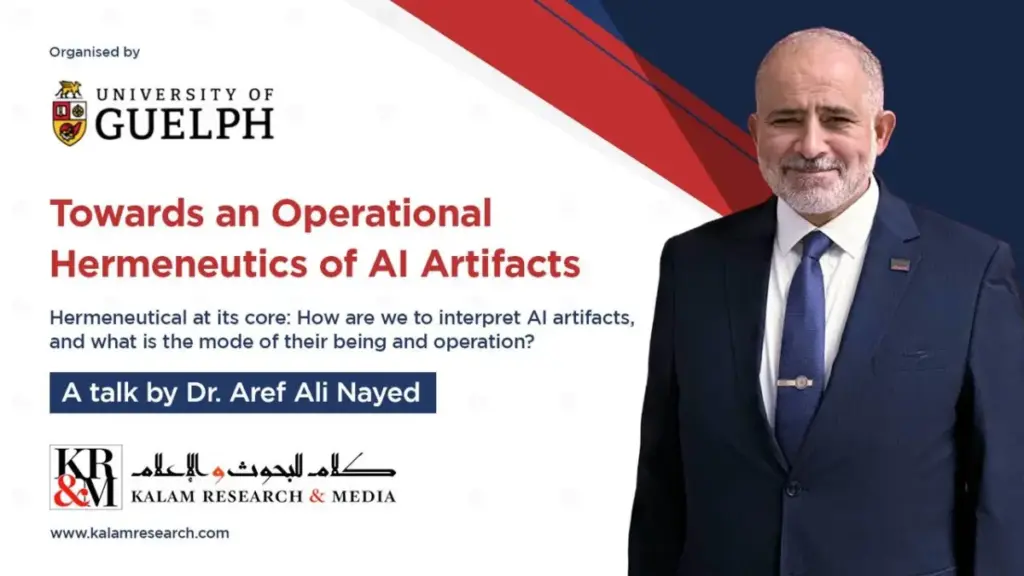
Dr. Aref Ali Nayed, Chairman of Kalam Research & Media (KRM), recently delivered a compelling and thought-provoking lecture at the University of Guelph, examining the profound intersection of hermeneutics, artificial intelligence, and the ethical governance of emerging technologies. The high-profile presentation brought together academics, researchers, and technology enthusiasts to explore how foundational philosophical frameworks developed decades ago can provide critical guardrails for managing the complexities of modern artificial intelligence.
The event marked a significant intellectual homecoming for Dr. Nayed and served to deepen ongoing academic collaborations between KRM and leading Canadian research institutions dedicated to responsible artificial intelligence.
About the Lecture
The core of Dr. Nayed’s presentation focused on how Operational Hermeneutics—a sophisticated theoretical and analytical framework that he originally developed during the 1990s while conducting doctoral research at the University of Guelph—provides essential tools for understanding and ethically engaging with AI-generated artifacts. As artificial intelligence systems become increasingly sophisticated, moving past simple data processing to generate complex content, human societies are forced to confront unprecedented interpretive challenges.
During the lecture, Dr. Nayed discussed the ways in which modern AI systems function as operational artifacts. Rather than acting as neutral conduits of information, these technologies actively interpret inputs, generate meaning, and shape human understanding in ways that can profoundly influence culture, governance, and daily life. By viewing AI systems through the lens of operational hermeneutics, researchers and policymakers can better decode how machine-generated outputs are constructed and how they impact human cognition and societal norms.
The lecture addressed several critical themes regarding the nature of machine intelligence, the interpretation of algorithmic outputs, and the urgent necessity of establishing robust ethical governance structures. Attendees were invited to rethink the relationship between human agency and machine autonomy, ensuring that emerging technologies remain aligned with human values and ethical standards.
Watch the Full Lecture
For those unable to attend the event in person, the complete lecture has been made available online. Viewers can watch the full presentation through the embedded video player below to experience the depth of Dr. Nayed’s insights into AI ethics and operational hermeneutics.
Related Initiatives
This special lecture formed an integral part of Dr. Nayed’s broader engagement with the Centre for Advancing Responsible and Ethical Artificial Intelligence (CARE-AI) at the University of Guelph. The visit successfully reinforced the ongoing partnership and collaborative efforts between KRM and Canadian research bodies that are actively working to establish comprehensive ethical frameworks for artificial intelligence development and deployment.
Scholars and practitioners interested in learning more about the scope of this institutional visit can read more about Dr. Nayed’s visit to CARE-AI through the official Kalam Research & Media platform.
Further Reading
To complement the themes explored during the lecture, Dr. Nayed has recently published a comprehensive academic paper that expands significantly upon the core arguments presented at the University of Guelph.
Titled “Towards an Operational Hermeneutics of AI Artifacts,” the publication examines the theoretical underpinnings of how artificial intelligence outputs should be understood as operational artifacts that demand rigorous hermeneutical engagement. The paper proposes innovative frameworks designed to assist researchers, ethicists, and developers in interpreting machine-generated content while directly confronting the complex ethical dimensions inherent in contemporary human-AI interaction.
Readers wishing to dive deeper into the academic foundations of this research can access the full monograph via the Kalam Research & Media website.
About the University of Guelph Partnership
The University of Guelph holds a uniquely special place in Dr. Nayed’s intellectual and professional journey. It was within the halls of this institution during the 1990s that he first formulated and developed the foundational concepts of Operational Hermeneutics during his doctoral studies. His return to Guelph represents a powerful homecoming of ideas, bringing decades of academic refinement, practical testing, and global application back to the very birthplace of the framework. Today, those original concepts are finding renewed relevance as they are applied to the most pressing contemporary challenges in artificial intelligence ethics and governance.
Furthermore, KRM’s enduring partnership with the University of Guelph and CARE-AI is part of a much broader, highly collaborative network connecting international researchers with leading Canadian AI institutions. This network includes esteemed organizations such as the Vector Institute for Artificial Intelligence and the Canadian Institute for Advanced Research (CIFAR), all of which share a common commitment to fostering safe, responsible, and ethically sound technological advancements.
KRM’s Artificial Understanding Research
While a vast majority of conventional artificial intelligence research remains narrowly focused on optimizing machine performance, computational speed, and data processing efficiency, Kalam Research & Media has charted a distinctly different path. KRM has pioneered dedicated research into Artificial Understanding (AU)—a transformative and comprehensive approach that asks fundamental, searching questions about comprehension, genuine meaning, and deep interpretation within artificial systems.
The AU research program, which is deeply grounded in the principles of Operational Hermeneutics, pursues several strategic aims designed to bridge the gap between mechanical output and true cognitive comprehension. By shifting the paradigm from mere artificial intelligence to genuine artificial understanding, KRM aims to reshape how humanity conceptualizes machine capabilities and limitations.
Those interested in following the trajectory of this groundbreaking work can learn more about KRM’s Artificial Understanding program through their dedicated research publications and updates.