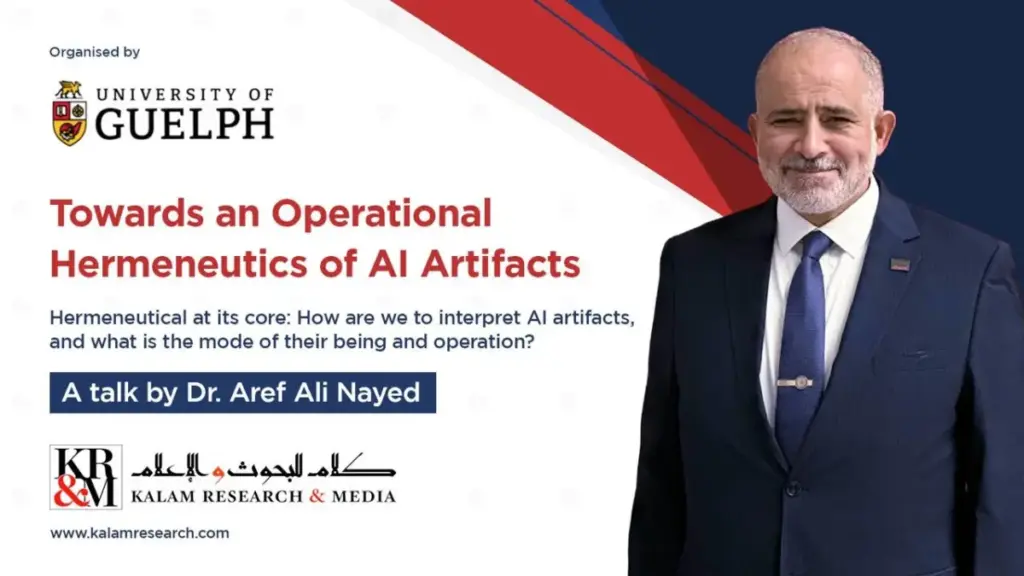
Dr. Aref Ali Nayed, Chairman of Kalam Research & Media (KRM), recently delivered a compelling and forward-looking lecture at the University of Guelph, exploring the profound intersection of hermeneutics, artificial intelligence, and the ethical governance of emerging technologies. The academic engagement marked a significant moment not only for contemporary discussions surrounding machine intelligence but also for Dr. Nayed personally, as it represented a return to the very institution where his foundational intellectual frameworks were first conceived decades ago.
About the Lecture
The presentation examined how Operational Hermeneutics—a theoretical and methodological framework developed by Dr. Nayed in the 1990s during his time at the University of Guelph—provides essential and timely tools for understanding and ethically engaging with AI-generated artifacts. Before a room of academics, researchers, and students, Dr. Nayed discussed how modern artificial intelligence systems function far beyond simple computational tools. Instead, they operate as operational artifacts that actively interpret data, generate meaning, and shape human understanding in ways that demand rigorous philosophical and ethical scrutiny.
As artificial intelligence systems become increasingly embedded in daily life, the ways in which machines process and present information carry significant weight. Dr. Nayed’s lecture unpacked the mechanisms through which these systems construct meaning and the responsibilities carried by the humans who design, deploy, and govern them. By applying operational hermeneutics to these technologies, the lecture offered a fresh perspective on navigating the complexities of machine-generated outputs and ensuring that technological advancements remain aligned with human values and ethical standards.
Related Initiatives and Institutional Collaboration
This high-profile lecture was a central component of Dr. Nayed’s broader engagement with the Centre for Advancing Responsible and Ethical Artificial Intelligence (CARE-AI) at the University of Guelph. The visit served to strengthen an ongoing and vital collaboration between KRM and Canadian AI research institutions, all of which share a common dedication to developing robust ethical frameworks for artificial intelligence governance.
The partnership with CARE-AI forms part of a much larger, interconnected network of collaborations involving leading Canadian AI centers of excellence, including the Vector Institute for Artificial Intelligence and the Canadian Institute for Advanced Research (CIFAR). Through these strategic engagements, KRM continues to foster international dialogue and cooperative research aimed at addressing the global challenges posed by rapidly evolving digital technologies.
Further Reading and Academic Contributions
To complement the themes addressed during his lecture at the University of Guelph, Dr. Nayed recently published a comprehensive academic paper that expands significantly on the core concepts of machine interpretation and ethics.
Titled “Towards an Operational Hermeneutics of AI Artifacts,” the publication examines how AI-generated outputs must be understood as operational artifacts requiring dedicated hermeneutical engagement. The paper proposes innovative frameworks for interpreting machine-generated content and carefully addresses the intricate ethical dimensions of human-AI interaction, offering scholars and practitioners a rigorous guide for future research in the field.
The University of Guelph Partnership and Intellectual Homecoming
The University of Guelph holds profound significance in Dr. Nayed’s long intellectual and academic journey. It was on this campus in the 1990s that he originally developed the foundational concepts of Operational Hermeneutics during his doctoral research. His return to Guelph represents a true homecoming of ideas, bringing decades of intellectual refinement back to their birthplace, where they are now being actively applied to the most pressing contemporary challenges in artificial intelligence ethics and governance.
This historical connection enriches the ongoing collaboration between KRM and the University, bridging past philosophical inquiries with cutting-edge technological developments of the twenty-first century.
KRM’s Artificial Understanding Research
While conventional artificial intelligence research has historically remained focused on raw machine performance, computational speed, and algorithmic efficiency, Kalam Research & Media has pioneered a distinct path through its research in Artificial Understanding (AU). This innovative approach moves beyond mere data processing to ask fundamental questions about comprehension, meaning, and interpretation within artificial systems.
Grounded firmly in the principles of Operational Hermeneutics, the AU research program is designed to explore the deep layers of how artificial systems process and represent meaning. By addressing the fundamental nature of comprehension in machines, KRM’s research initiative seeks to establish new standards for how society evaluates, interacts with, and governs artificial intelligence, ensuring that technological progress is matched by a profound comprehension of its implications for human culture and society.