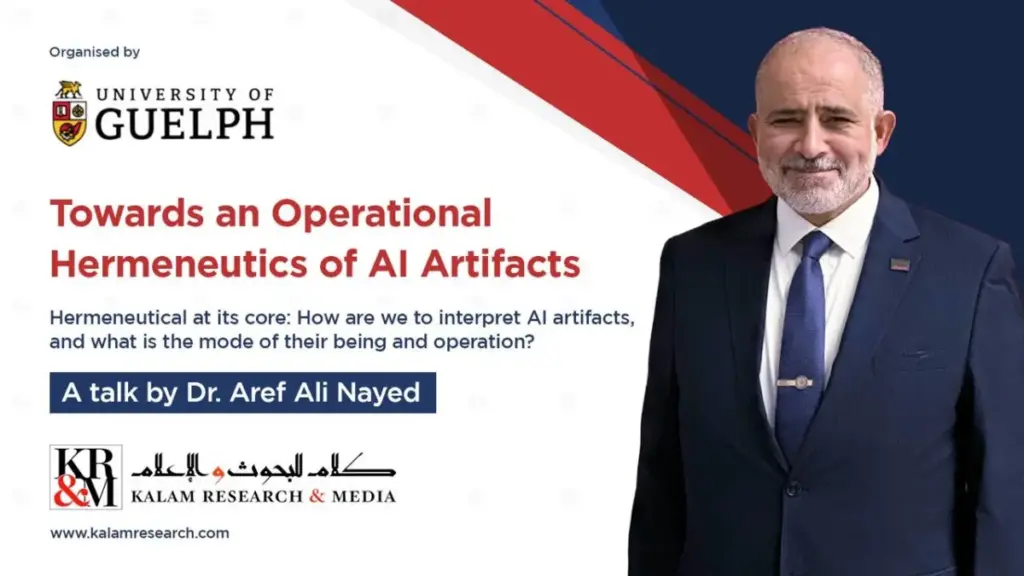
Dr. Aref Ali Nayed, Chairman of Kalam Research & Media (KRM), recently delivered a compelling public lecture at the University of Guelph, offering deep insights into the intersection of hermeneutics, artificial intelligence, and the ethical governance of emerging technologies. The academic gathering served as a significant platform for discussing how modern society must grapple with the rapid proliferation of artificial intelligence systems and the profound ways they reshape human communication, cognition, and culture.
About the Lecture
The presentation examined how Operational Hermeneutics—a robust philosophical and methodological framework originally developed by Dr. Nayed in the 1990s during his time at the University of Guelph—provides essential tools for understanding and ethically engaging with AI-generated artifacts. During the session, Dr. Nayed discussed at length how contemporary artificial intelligence systems function far beyond simple computational tools. Instead, they operate as active operational artifacts that interpret data, generate meaning, and fundamentally shape human understanding across various spheres of modern life.
The lecture addressed the critical need for robust interpretive models in the digital age. As machine learning models and generative AI systems become more deeply embedded in daily decision-making, governance, and creative industries, the challenge of comprehending how these systems arrive at their outputs has grown exponentially. Dr. Nayed emphasized that technical performance metrics alone are insufficient for addressing the broader societal implications of these technologies. A rigorous hermeneutical approach allows researchers, ethicists, and policymakers to decode the underlying assumptions, biases, and interpretive frameworks built into machine-generated content.
Watch the Full Lecture
For those unable to attend the event in person, the complete lecture has been made publicly available via video, capturing the depth of Dr. Nayed’s analysis and the engaging discussion that followed at the University of Guelph.
Watch the Full Lecture on YouTube
Related Initiatives
This high-profile lecture formed a core part of Dr. Nayed’s broader engagement with the Centre for Advancing Responsible and Ethical Artificial Intelligence (CARE-AI) at the University of Guelph. The visit successfully strengthened ongoing collaborations between Kalam Research & Media and prominent Canadian artificial intelligence research institutions. These institutional partnerships are intensely focused on developing practical, robust, and culturally sensitive ethical frameworks to guide the future development and deployment of artificial intelligence.
The dialogue established during the visit highlights a shared commitment among international scholars to ensure that rapid technological advancements remain aligned with human values, ethical standards, and societal well-being.
Read more about Dr. Nayed’s visit to CARE-AI
Further Reading
Expanding directly upon the themes and theoretical foundations addressed during his University of Guelph lecture, Dr. Nayed has recently published a comprehensive academic paper.
Titled “Towards an Operational Hermeneutics of AI Artifacts,” the publication examines in granular detail how machine-generated outputs must be understood as complex operational artifacts that demand active hermeneutical engagement. The paper proposes innovative frameworks specifically designed for interpreting machine-generated content while thoughtfully addressing the multifaceted ethical dimensions inherent in human-AI interaction. Scholars, technologists, and ethicists interested in a deeper academic dive into these concepts can access the full monograph online.
About the University of Guelph Partnership
The University of Guelph holds profound personal and intellectual significance within Dr. Nayed’s scholarly journey. It was precisely on this Canadian campus during the 1990s that he first formulated and developed the foundational concepts of Operational Hermeneutics during his doctoral research. His return to the university represented a meaningful homecoming of ideas, bringing decades of intellectual refinement back to their birthplace, where they are now being powerfully applied to contemporary challenges in AI ethics and digital philosophy.
Furthermore, KRM’s enduring partnership with the University of Guelph and CARE-AI is part of a much broader, interconnected network of collaborations with leading Canadian AI institutions. This network actively includes prominent entities such as the Vector Institute for Artificial Intelligence and the Canadian Institute for Advanced Research (CIFAR), reflecting a concerted international effort to bridge the gap between technical innovation and humanistic inquiry.
KRM’s Artificial Understanding Research
While conventional artificial intelligence research has historically remained narrowly focused on machine performance, computational efficiency, and data processing speeds, Kalam Research & Media has pioneered an entirely distinctive path. KRM has advanced groundbreaking research in Artificial Understanding (AU)—an innovative approach that asks fundamental, searching questions about true comprehension, deep meaning, and valid interpretation within artificial systems.
The AU research program, which remains firmly grounded in the principles of Operational Hermeneutics, is designed to challenge prevailing assumptions about what machines actually accomplish when they process language, images, and data. By shifting the paradigm from mere mechanical computation to genuine artificial understanding, KRM aims to foster a more profound dialogue between technology creators and humanities scholars.