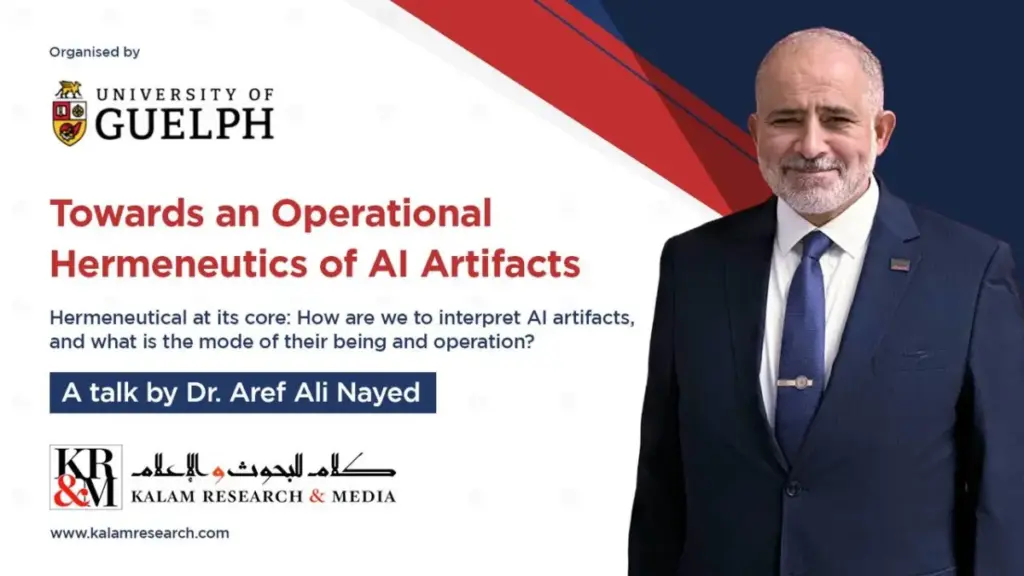
Dr. Aref Ali Nayed, Chairman of Kalam Research & Media (KRM), recently delivered a compelling lecture at the University of Guelph, focusing on the critical intersection of hermeneutics, artificial intelligence, and the ethical governance of emerging technologies. The academic engagement marked a significant intellectual homecoming for Dr. Nayed, offering an opportunity to revisit and expand upon foundational concepts he originally formulated decades ago during his time as a researcher at the institution.
The presentation examined how Operational Hermeneutics—a sophisticated theoretical framework originally developed by Dr. Nayed in the 1990s at the University of Guelph—provides essential tools for understanding and ethically engaging with AI-generated artifacts. As artificial intelligence systems increasingly permeate daily life, the lecture explored how these technologies function far beyond mere computational engines, operating instead as active operational artifacts that interpret data, generate meaning, and profoundly shape human understanding.
A Homecoming of Ideas and Academic Collaboration
The University of Guelph holds a special significance in Dr. Nayed’s intellectual journey. It was within these very lecture halls and research spaces in the 1990s that he laid the groundwork for Operational Hermeneutics. His recent return to the campus represents a powerful homecoming of ideas, bringing decades of philosophical and technological refinement back to their birthplace. Today, those original concepts are being freshly applied to some of the most urgent and contemporary challenges facing artificial intelligence ethics and human-computer interaction.
This high-profile lecture was a central component of Dr. Nayed’s broader engagement with the Centre for Advancing Responsible and Ethical Artificial Intelligence (CARE-AI) at the University of Guelph. The visit served to significantly strengthen the ongoing collaboration between Kalam Research & Media and prominent Canadian AI research institutions, all of which share a dedicated focus on developing robust ethical frameworks for the deployment of artificial intelligence.
KRM’s partnership with the University of Guelph and CARE-AI forms an integral part of a broader, highly collaborative network connecting KRM with leading Canadian AI hubs. These include prestigious organizations such as the Vector Institute for Artificial Intelligence and the Canadian Institute for Advanced Research (CIFAR), reflecting a concerted international effort to address the societal implications of rapidly advancing machine intelligence.
Pioneering Research in Artificial Understanding
While much of the global technology sector remains laser-focused on optimizing machine performance, processing speed, and computational efficiency, Kalam Research & Media has carved out a distinct path by pioneering research in Artificial Understanding (AU). This specialized approach moves beyond traditional computational metrics to ask fundamental philosophical and operational questions regarding comprehension, meaning, and true interpretation within artificial systems.
The AU research program, deeply rooted in the traditions of Operational Hermeneutics, addresses the profound implications of machine-generated outputs. Rather than treating AI as a transparent window to objective reality, KRM’s framework recognizes that machine outputs are mediated artifacts requiring deep hermeneutical engagement. This involves developing rigorous new methodologies for interpreting what machines produce, alongside a rigorous examination of the ethical dimensions inherent in everyday human-AI interactions.
Expanding the Discourse: Recent Publications and Further Reading
To complement the themes explored during his lecture at the University of Guelph, Dr. Nayed has recently published a comprehensive academic monograph that dives even deeper into the subject. Titled "Towards an Operational Hermeneutics of AI Artifacts," the paper examines the philosophical underpinnings of machine outputs, categorizing them as operational artifacts that demand active hermeneutical interpretation.
The publication provides scholars, technologists, and policymakers with advanced conceptual frameworks designed to decode and interpret machine-generated content accurately. Furthermore, it tackles the pressing ethical dilemmas that arise as artificial intelligence systems take on roles traditionally reserved for human interpreters, advisors, and creators. By offering these insights, KRM continues to contribute vital perspectives to the global dialogue surrounding the governance and moral oversight of modern technology.
As academic institutions and research bodies grapple with the rapid evolution of artificial intelligence, engagements such as Dr. Nayed’s visit to the University of Guelph underscore the vital necessity of bridging technical innovation with deep humanistic inquiry. Through continued collaboration with CARE-AI and other leading institutions, Kalam Research & Media remains at the forefront of shaping a thoughtful, ethically grounded future for artificial intelligence.