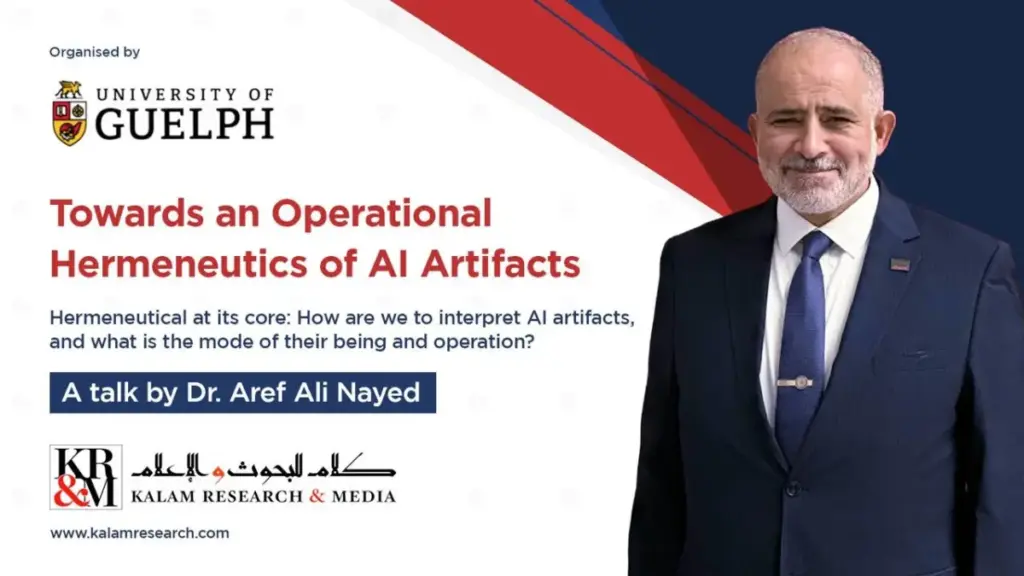
Dr. Aref Ali Nayed, Chairman of Kalam Research & Media (KRM), recently delivered a compelling lecture at the University of Guelph, offering deep insights into the intersection of hermeneutics, artificial intelligence, and the ethical governance of emerging technologies. The event served as a major platform for discussing how philosophical frameworks developed decades ago can illuminate and guide the rapid advancements of modern machine intelligence.
About the Lecture
The presentation examined how Operational Hermeneutics—a robust philosophical framework that Dr. Nayed originally developed in the 1990s during his time at the University of Guelph—provides essential tools for understanding and ethically engaging with AI-generated artifacts. During his address, Dr. Nayed discussed how contemporary artificial intelligence systems function not merely as computational tools, but as operational artifacts that actively interpret data, generate meaning, and shape human understanding in profound ways.
The lecture delved into the complex ways these digital systems process information and construct narratives, emphasizing that society must move beyond viewing technology through a purely technical lens. Instead, Dr. Nayed argued that human-AI interaction requires rigorous hermeneutical scrutiny to ensure that machine-generated outputs are interpreted accurately and managed responsibly within civic, academic, and professional spheres.
Watch the Full Lecture
Related Initiatives
This high-profile lecture formed a central part of Dr. Nayed’s broader engagement with the Centre for Advancing Responsible and Ethical Artificial Intelligence (CARE-AI) at the University of Guelph. The visit successfully strengthened ongoing collaborations between Kalam Research & Media and Canadian artificial intelligence research institutions, all of which are heavily focused on developing comprehensive ethical frameworks for the governance of advanced artificial intelligence.
The partnership underscores the vital importance of international and cross-disciplinary dialogue in addressing the societal implications of technology. By bridging philosophical inquiry with cutting-edge computer science initiatives, researchers at CARE-AI and KRM aim to foster responsible innovation that prioritizes human values, transparency, and accountability.
Read more about Dr. Nayed’s visit to CARE-AI →
Further Reading
Building upon the themes explored during his visit, Dr. Nayed has recently published a comprehensive academic paper that expands significantly on the core concepts of his lecture.
Titled “Towards an Operational Hermeneutics of AI Artifacts,” the publication examines how artificial intelligence outputs can be thoroughly understood as operational artifacts that demand active hermeneutical engagement. The paper proposes innovative frameworks for interpreting machine-generated content and directly addresses the multi-layered ethical dimensions inherent in modern human-AI interaction. Scholars, technologists, and ethicists interested in a deeper academic exploration of these topics can access the complete monograph online.
About the University of Guelph Partnership
The University of Guelph holds a deeply significant place in Dr. Nayed’s intellectual journey. It was on this very campus during the 1990s that he first formulated and developed the foundational concepts of Operational Hermeneutics during his rigorous doctoral research. His return to Guelph represents a powerful homecoming of ideas, bringing decades of intellectual refinement back to their birthplace and applying them directly to the unprecedented contemporary challenges posed by AI ethics.
Furthermore, KRM’s ongoing partnership with the University of Guelph and CARE-AI is part of a much broader, highly collaborative network connecting KRM with leading Canadian AI research institutions. This expanding network includes esteemed organizations such as the Vector Institute for Artificial Intelligence and the Canadian Institute for Advanced Research (CIFAR), reflecting a shared commitment to shaping a safer and more ethically grounded technological future.
KRM’s Artificial Understanding Research
While conventional artificial intelligence research has traditionally concentrated on optimizing machine performance, processing speed, and computational efficiency, Kalam Research & Media has charted a distinct path. KRM has pioneered research in Artificial Understanding (AU)—a specialized and innovative approach that asks fundamental, searching questions about comprehension, meaning, and interpretation within artificial systems.
The AU research program, deeply rooted in the principles of Operational Hermeneutics, seeks to redefine how society conceptualizes the capabilities and limitations of thinking machines. Rather than accepting AI outputs at face value, the program investigates the deep structures of machine interpretation and the ways artificial systems simulate or approximate human understanding.