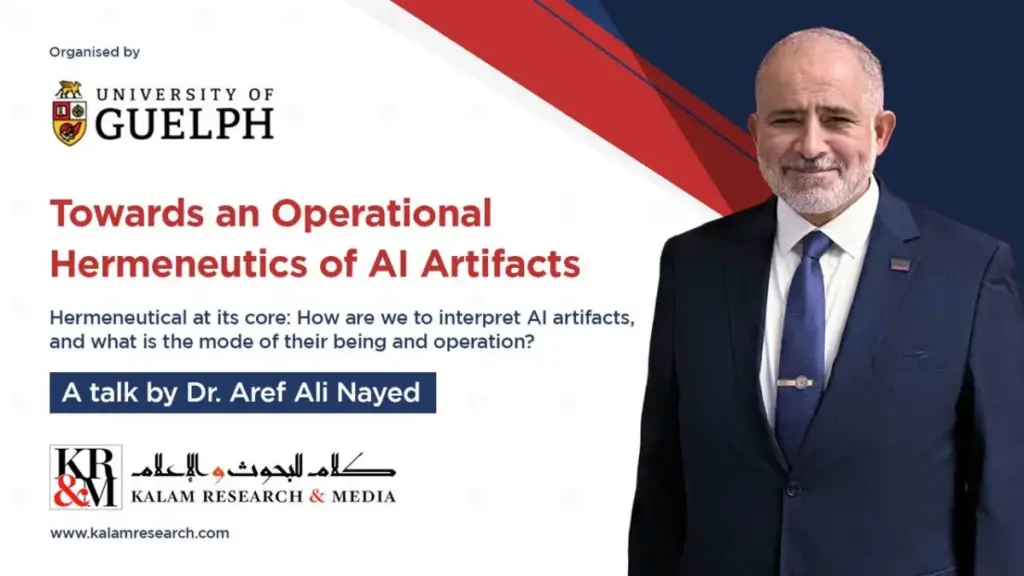
Dr. Aref Ali Nayed, Chairman of Kalam Research & Media (KRM), recently delivered a prominent academic lecture at the University of Guelph, offering deep insights into the intersection of hermeneutics, artificial intelligence, and the ethical governance of emerging technologies. The presentation brought together decades of philosophical inquiry and contemporary technological challenges, drawing an engaged audience of researchers, students, and faculty members interested in the future of responsible artificial intelligence.
The event served as a significant milestone in ongoing international academic exchanges, highlighting how classical frameworks of interpretation can be successfully applied to modern computational systems. By examining the ways machines process and produce information, the lecture opened up new avenues for academic discourse surrounding machine comprehension, data ethics, and human-AI interaction.
About the Lecture and Operational Hermeneutics
At the heart of Dr. Nayed’s presentation was the concept of Operational Hermeneutics—a robust theoretical and practical framework that he originally developed during the 1990s while conducting doctoral research at the University of Guelph. Decades later, this foundational framework has proven to be remarkably prescient, providing essential intellectual tools for understanding and ethically engaging with the complex artifacts generated by modern artificial intelligence systems.
During the session, Dr. Nayed discussed how contemporary AI systems operate far beyond simple automated calculators or data processors. Instead, they function as dynamic operational artifacts that actively interpret inputs, generate meaning, and shape human understanding across various domains of society. Because these systems synthesize information and produce outputs that heavily influence public discourse, education, and decision-making, they require a sophisticated hermeneutical approach.
Operational Hermeneutics provides scholars and technologists with the means to interrogate how machine-generated content is constructed, interpreted, and validated. Rather than viewing AI outputs as neutral reflections of objective reality, the framework encourages a critical examination of the interpretive layers embedded within algorithms, training datasets, and system architectures. This approach bridges the gap between technical computer science and the humanities, ensuring that the development of emerging technologies remains deeply anchored in ethical consideration and human-centric values.
Watch the Full Lecture
For those unable to attend the event in person, the complete lecture has been made available online. Viewers can watch the full presentation to explore Dr. Nayed’s detailed breakdown of Operational Hermeneutics, AI artifact interpretation, and the imperative for robust ethical governance frameworks in the digital age.
Related Initiatives and Institutional Collaboration
This special lecture formed an integral part of Dr. Nayed’s broader academic engagement with the Centre for Advancing Responsible and Ethical Artificial Intelligence (CARE-AI) at the University of Guelph. The visit successfully reinforced and strengthened ongoing collaborative efforts between Kalam Research & Media and prominent Canadian artificial intelligence research institutions.
Through these partnerships, researchers aim to establish rigorous ethical standards and governance models that can guide the deployment of powerful new technologies. As AI systems become more deeply integrated into critical societal infrastructure, cross-disciplinary cooperation between philosophy, theology, ethics, and computer science becomes increasingly vital. The engagement at CARE-AI highlights a shared commitment to ensuring that technological innovation advances hand-in-hand with human dignity and ethical responsibility.
Readers interested in learning more about this institutional engagement can read more about Dr. Nayed’s visit to CARE-AI →.
Further Reading and Academic Monographs
To expand upon the foundational themes addressed during the lecture, Dr. Nayed has recently published a comprehensive academic paper that dives deeper into the philosophy of machine intelligence.
Titled “Towards an Operational Hermeneutics of AI Artifacts,” the publication examines how artificial intelligence outputs must be understood not merely as data points, but as operational artifacts that demand active hermeneutical engagement. The paper proposes innovative frameworks for interpreting machine-generated content, offering scholars and developers new pathways to navigate the intricate ethical dimensions of human-AI interaction.
The monograph contributes significantly to the growing body of literature dedicated to the responsible stewardship of artificial intelligence, providing theoretical clarity in a rapidly shifting technological landscape. Those interested in a deeper academic exploration of these topics can read the full monograph →.
About the University of Guelph Partnership
The University of Guelph holds profound significance within Dr. Nayed’s intellectual journey. It was on this campus during the 1990s that he first formulated the foundational concepts of Operational Hermeneutics during his advanced graduate studies. Returning to the institution represented a powerful homecoming of ideas, bringing decades of scholarly refinement back to their birthplace and applying them directly to the unprecedented challenges posed by modern artificial intelligence.
This ongoing relationship with the University of Guelph and CARE-AI is part of a larger, highly collaborative network connecting Kalam Research & Media with leading Canadian AI research centers. These alliances include active dialogues and initiatives with esteemed organizations such as the Vector Institute for Artificial Intelligence and the Canadian Institute for Advanced Research (CIFAR), fostering a vibrant, international ecosystem dedicated to ethical technology.
KRM’s Artificial Understanding Research
While mainstream technology sectors often prioritize raw machine performance, computational speed, and data scale, Kalam Research & Media has charted a distinct path. KRM has pioneered dedicated research into Artificial Understanding (AU)—a specialized approach that moves beyond mere information processing to ask fundamental questions regarding comprehension, meaning, and true interpretation within artificial systems.
Grounded firmly in the principles of Operational Hermeneutics, the KRM Artificial Understanding research program seeks to redefine how society evaluates machine capabilities. By shifting the primary focus from artificial intelligence to artificial understanding, researchers can better address the deep philosophical and practical questions surrounding what machines actually grasp when they process human language, culture, and ethics.
Those seeking more detailed information regarding this pioneering academic trajectory can learn more about KRM’s Artificial Understanding program →.