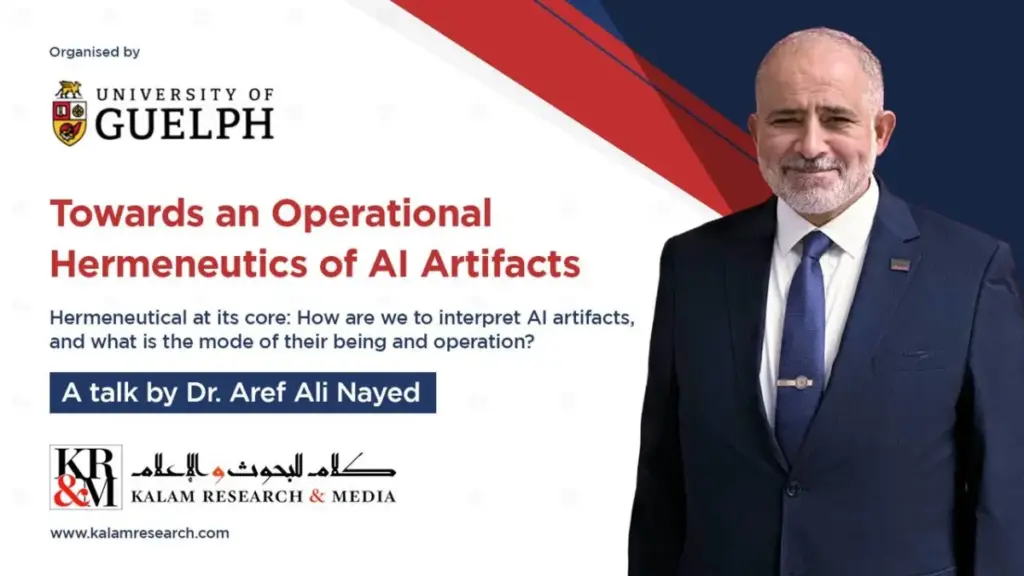
Dr. Aref Ali Nayed, Chairman of Kalam Research & Media (KRM), recently delivered a compelling and thought-provoking lecture at the University of Guelph, offering deep insights into the intersection of hermeneutics, artificial intelligence, and the ethical governance of emerging technologies. The academic engagement marked a significant moment not only for contemporary discussions surrounding machine intelligence but also for Dr. Nayed personally, as it represented a return to the very institution where he laid the intellectual foundations for his pioneering work decades ago.
The comprehensive lecture drew a diverse audience of students, faculty members, researchers, and technology ethicists eager to explore how classical frameworks of interpretation can be applied to modern computational systems. By bridging the gap between philosophy and cutting-edge computer science, the presentation provided a timely examination of how society must grapple with the profound implications of artificial intelligence as it rapidly integrates into daily life, governance, and culture.
About the Lecture
At the core of Dr. Nayed’s presentation was an examination of how Operational Hermeneutics—a theoretical framework he originally developed during the 1990s while pursuing his doctoral research at the University of Guelph—provides essential, indispensable tools for understanding and ethically engaging with AI-generated artifacts. As artificial intelligence systems become increasingly sophisticated, moving beyond simple data processing to generate complex texts, images, codes, and synthesized decisions, society faces a growing challenge in comprehending the true nature of these outputs.
Dr. Nayed discussed at length how modern AI systems function as operational artifacts. Rather than acting as neutral conduits of information, these systems actively interpret inputs, generate meaning through statistical and probabilistic modeling, and ultimately shape human understanding. Because artificial intelligence participates in the construction of cultural and intellectual reality, Dr. Nayed argued that treating them merely as mechanical tools is insufficient. Instead, scholars, developers, and policymakers must adopt rigorous hermeneutical approaches to decode, evaluate, and govern how these systems produce meaning and influence human perception.
The lecture delved into several key dimensions of this human-machine interaction, highlighting the necessity of looking past mere computational efficiency to examine the underlying interpretive frameworks embedded within algorithms. By analyzing AI through the lens of operational hermeneutics, the presentation offered attendees a structured way to evaluate the ethical stakes involved when machines begin to mediate human knowledge and social discourse.
Watch the Full Lecture
For those unable to attend the academic event in person, or for individuals wishing to revisit the depth of the discussion, the complete video recording of Dr. Nayed’s lecture at the University of Guelph has been made publicly available. The embedded video captures the full scope of his arguments, the accompanying visual presentations, and the nuanced exploration of artificial intelligence through a philosophical and ethical lens.
Related Initiatives and Institutional Collaboration
This high-profile academic lecture was not an isolated event; rather, it formed an integral part of Dr. Nayed’s broader engagement with the Centre for Advancing Responsible and Ethical Artificial Intelligence (CARE-AI) at the University of Guelph. The ongoing visit successfully strengthened institutional collaboration between Kalam Research & Media and Canadian AI research hubs that are dedicated to formulating robust ethical frameworks for artificial intelligence.
As the global technological landscape races forward, institutions like CARE-AI and organizations like KRM recognize that technical innovation must be matched by philosophical and ethical oversight. The strengthening of these bilateral ties ensures that researchers from different cultural and academic backgrounds can pool their expertise to address the shared global challenges posed by autonomous systems, algorithmic bias, and the shifting boundaries of human agency.
Further Reading and Academic Contributions
To complement the themes addressed during his lecture at the University of Guelph, Dr. Nayed has recently published a comprehensive academic paper that expands extensively on the relationship between machine outputs and interpretive theory. Titled “Towards an Operational Hermeneutics of AI Artifacts,” the publication offers a rigorous scholarly investigation into how AI-generated outputs must be understood as operational artifacts that demand active hermeneutical engagement.
The monograph proposes innovative frameworks designed to assist researchers, ethicists, and technologists in interpreting machine-generated content accurately. Furthermore, it addresses the deeply complex ethical dimensions inherent in human-AI interaction, urging the academic community to move beyond surface-level critiques of technology and engage with the foundational epistemological questions raised by artificial intelligence. The full text of this significant paper is available through KRM’s scholarly publications archive for researchers seeking a deeper dive into the theoretical underpinnings discussed during the Guelph lecture.
The University of Guelph Partnership and Intellectual Homecoming
The University of Guelph holds a special, formative significance in Dr. Nayed’s intellectual journey. It was within the halls of this Canadian institution during the 1990s that he first formulated the foundational concepts of Operational Hermeneutics during his doctoral studies. His return to the campus represented a true homecoming of ideas, bringing decades of intellectual refinement, practical application, and global experience back to their birthplace.
Today, those early concepts, once purely theoretical reflections on language and understanding, have found renewed relevance as they are applied directly to the contemporary challenges of AI ethics and machine comprehension. The enduring partnership between KRM and the University of Guelph, alongside CARE-AI, represents a vital node in a wider network of collaborations connecting KRM with leading Canadian artificial intelligence institutions. These collaborative networks also extend to renowned organizations such as the Vector Institute for Artificial Intelligence and the Canadian Institute for Advanced Research (CIFAR), reflecting a shared international commitment to responsible technological advancement.
KRM’s Artificial Understanding Research Program
While the broader technology sector remains heavily focused on machine performance, computational speed, and data throughput, Kalam Research & Media has charted a distinct path through its pioneering research in Artificial Understanding (AU). This specialized research agenda shifts the paradigm away from mere data processing, asking fundamental, searching questions about true comprehension, semantic meaning, and deep interpretation within artificial systems.
Grounded firmly in the principles of Operational Hermeneutics, KRM’s Artificial Understanding research program is structured around core aims that seek to redefine how society conceptualizes machine intelligence. By investigating whether artificial systems can truly understand—rather than merely simulate understanding—KRM aims to contribute critical philosophical depth to the global conversation on artificial intelligence. This ongoing research ensures that technological development remains anchored in human values, meaningful interpretation, and ethical clarity.