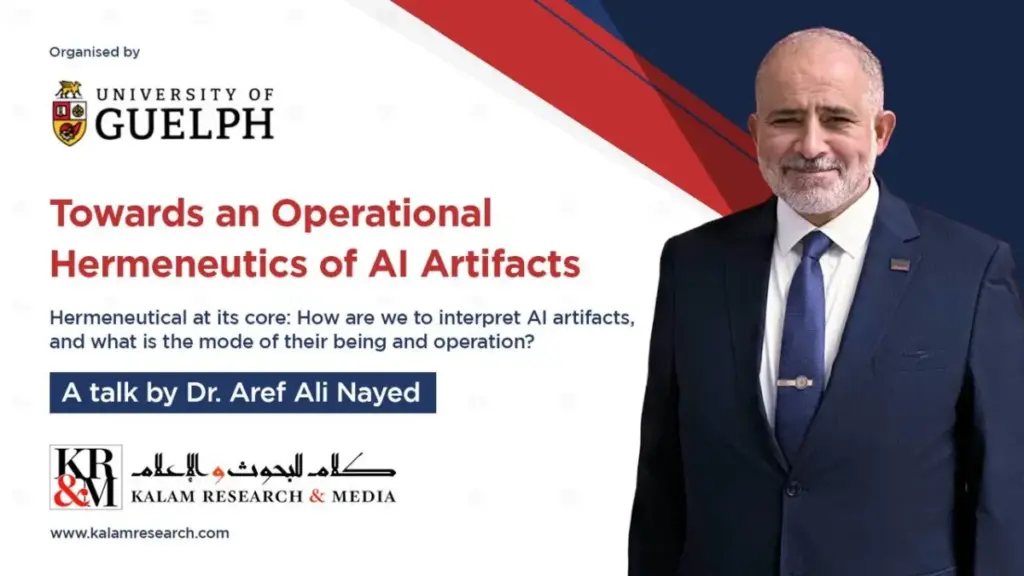
Dr. Aref Ali Nayed, Chairman of Kalam Research & Media (KRM), recently delivered a prominent academic lecture at the University of Guelph, offering deep insights into the intersection of hermeneutics, artificial intelligence, and the ethical governance of emerging technologies. The presentation served as a significant intellectual homecoming for Dr. Nayed, whose academic history with the institution spans decades and forms the bedrock of his current work in technology ethics.
About the Lecture
The core of Dr. Nayed’s presentation examined how Operational Hermeneutics—a theoretical framework he originally developed during the 1990s while conducting doctoral research at the University of Guelph—provides essential tools for understanding and ethically engaging with AI-generated artifacts. As artificial intelligence systems become increasingly sophisticated, Dr. Nayed discussed how these technologies function far beyond simple computational tools. Instead, they operate as operational artifacts that actively interpret inputs, generate meaning, and shape human understanding on a global scale.
The lecture detailed the pressing need for robust philosophical and ethical frameworks to accompany the rapid deployment of machine-learning models. By applying the principles of operational hermeneutics, researchers and policymakers can better evaluate how AI systems construct narratives, process cultural symbols, and influence human decision-making processes.
Watch the Full Lecture
For those unable to attend the event in person, the complete lecture has been made publicly available via video broadcast, allowing academics, technologists, and the general public to engage with the full scope of Dr. Nayed’s presentation on AI governance and hermeneutical interpretation.
Related Initiatives
The lecture was a key component of Dr. Nayed’s broader academic engagement with the Centre for Advancing Responsible and Ethical Artificial Intelligence (CARE-AI) at the University of Guelph. This high-profile visit further strengthened ongoing collaborative efforts between Kalam Research & Media and Canadian AI research institutions that are dedicated to formulating comprehensive ethical guidelines and frameworks for artificial intelligence development.
The partnership highlights the growing international importance of interdisciplinary approaches to technology, bringing together philosophical inquiry and computer science to address the societal implications of automated systems.
Further Reading
Expanding upon the core themes addressed during his University of Guelph lecture, Dr. Nayed recently published a comprehensive academic paper that dives deeper into the philosophy of machine intelligence. Titled “Towards an Operational Hermeneutics of AI Artifacts,” the monograph examines how AI-generated outputs must be understood as operational artifacts that necessitate rigorous hermeneutical engagement.
The paper proposes innovative frameworks designed to assist scholars and practitioners in interpreting machine-generated content while directly addressing the complex ethical dimensions inherent in human-AI interaction. The publication serves as an essential resource for researchers seeking to bridge the gap between technical AI deployment and human-centric philosophical analysis.
About the University of Guelph Partnership
The University of Guelph holds profound significance in Dr. Nayed’s intellectual journey. It was on this campus during the 1990s that he first formulated the foundational concepts of Operational Hermeneutics. His return to Guelph represents a powerful homecoming of ideas, bringing decades of theoretical refinement back to their birthplace and applying them directly to the contemporary challenges posed by artificial intelligence ethics.
This ongoing collaboration between KRM and the University of Guelph, alongside CARE-AI, is part of an expansive network of partnerships linking Kalam Research & Media with leading Canadian artificial intelligence institutions. These collaborative efforts extend to other prominent hubs of technological research, including the Vector Institute for Artificial Intelligence and the Canadian Institute for Advanced Research (CIFAR), fostering a collaborative international ecosystem dedicated to responsible technological advancement.
KRM’s Artificial Understanding Research
While conventional artificial intelligence research typically concentrates on improving machine performance, computational efficiency, and data processing speeds, Kalam Research & Media has taken a radically different path. KRM has pioneered dedicated research into Artificial Understanding (AU)—a distinctive approach that raises fundamental questions concerning comprehension, meaning, and true interpretation within artificial systems.
The AU research program, which remains firmly grounded in the principles of Operational Hermeneutics, seeks to challenge baseline assumptions about what machines actually accomplish when they process language and generate outputs. By shifting the paradigm from mere artificial intelligence to genuine artificial understanding, KRM aims to steer the global technological discourse toward more meaningful, transparent, and ethically sound outcomes.