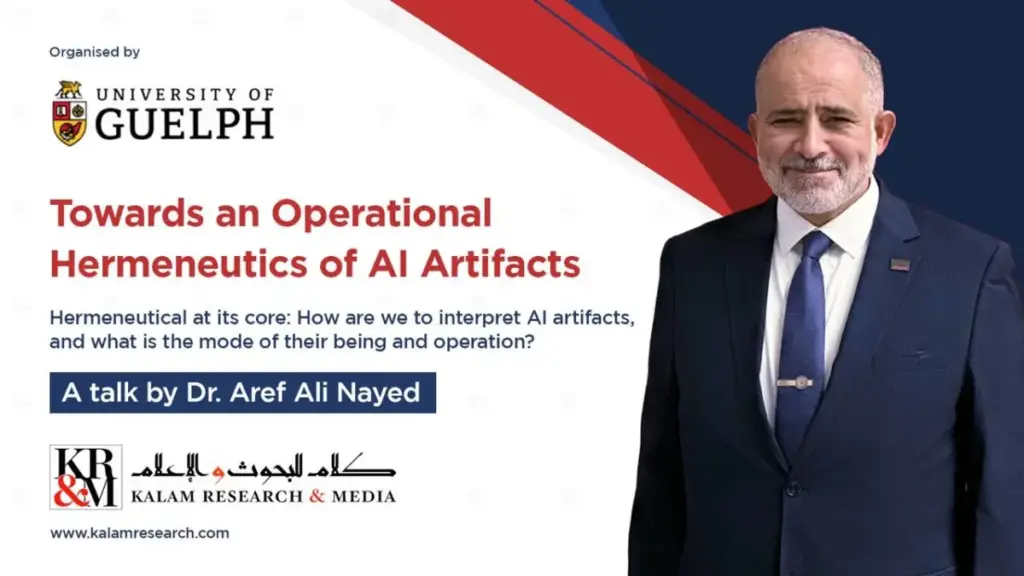
Dr. Aref Ali Nayed, Chairman of Kalam Research and Media (KRM), recently returned to the University of Guelph to deliver a comprehensive and thought-provoking academic lecture exploring the complex intersection of hermeneutics, artificial intelligence, and the ethical governance of emerging technologies. The presentation drew together decades of philosophical inquiry and contemporary technological challenges, offering scholars, researchers, and technology ethicists a rigorous framework for navigating the rapidly evolving landscape of machine-generated content and artificial intelligence systems.
About the Lecture
The presentation examined how Operational Hermeneutics—a pioneering philosophical framework originally developed by Dr. Nayed during his time at the University of Guelph in the 1990s—provides essential tools for understanding and ethically engaging with AI-generated artifacts. Throughout the lecture, Dr. Nayed discussed the multifaceted ways in which modern artificial intelligence systems function not merely as neutral computational tools, but as operational artifacts that actively interpret, generate meaning, and shape human understanding.
By analyzing AI through the lens of operational hermeneutics, the lecture challenged traditional perceptions of technology as passive instrumentality. Instead, Dr. Nayed emphasized that machine intelligence actively participates in hermeneutical processes, requiring human societies to develop sophisticated mechanisms for interpretation, critique, and ethical oversight. The discussion highlighted the urgent need for robust methodologies capable of evaluating how synthetic outputs influence culture, cognition, and human agency in an increasingly automated world.
Watch the Full Lecture
For those unable to attend the event in person, the complete lecture has been made publicly available through an embedded video presentation, capturing the depth of Dr. Nayed’s insights and the rich academic dialogue that characterized the gathering at the University of Guelph.
Related Initiatives and Institutional Collaboration
This significant academic lecture formed a core component of Dr. Nayed’s broader engagement with the Centre for Advancing Responsible and Ethical Artificial Intelligence (CARE-AI) at the University of Guelph. The visit served to strengthen and deepen ongoing scholarly collaboration between Kalam Research and Media and Canadian artificial intelligence research institutions that are dedicated to formulating robust ethical frameworks for the development and deployment of artificial intelligence.
The partnership underscores a shared commitment to ensuring that technological innovation is matched by rigorous ethical reflection. By bridging the gap between humanities-based hermeneutics and advanced computer science research, KRM and its Canadian academic partners are working to foster multidisciplinary approaches to some of the most pressing governance challenges posed by modern technology.
Further Reading and Academic Monographs
To expand upon the foundational themes addressed during his lecture at the University of Guelph, Dr. Nayed has recently published a comprehensive academic paper that dives deeper into the philosophy of machine intelligence.
Entitled "Towards an Operational Hermeneutics of AI Artifacts," the publication examines how AI-generated outputs must be understood as operational artifacts that inherently demand active hermeneutical engagement. The paper proposes innovative frameworks designed to assist scholars and practitioners in interpreting machine-generated content while systematically addressing the profound ethical dimensions of human-AI interaction. This monograph represents a major contribution to the growing global discourse on AI ethics, offering a structured approach to understanding the interpretive mechanics of advanced algorithms.
The University of Guelph Partnership and Intellectual Homecoming
The University of Guelph holds deep and lasting significance within Dr. Nayed’s personal and professional intellectual journey. It was precisely on this campus during the 1990s that he first formulated and developed the foundational concepts of Operational Hermeneutics during his doctoral research. His return to the university represents a powerful homecoming of ideas, bringing decades of intellectual refinement back to their birthplace where they are now being actively applied to contemporary challenges in artificial intelligence ethics.
This visit highlights the enduring legacy of cross-disciplinary research at the University of Guelph and illustrates how foundational philosophical theories developed decades ago can provide vital guidance for navigating entirely unprecedented technological revolutions. Furthermore, KRM’s ongoing partnership with the University of Guelph and CARE-AI forms an essential part of a much broader, interconnected network of collaborations with leading Canadian artificial intelligence institutions. This wider network includes esteemed organizations such as the Vector Institute for Artificial Intelligence and the Canadian Institute for Advanced Research (CIFAR), reflecting a concerted, international effort to shape the future of responsible technology.
KRM’s Pioneering Research in Artificial Understanding
While conventional artificial intelligence research has historically remained heavily focused on raw machine performance, computational efficiency, and data processing speeds, Kalam Research and Media has charted a distinctly different course. KRM has pioneered dedicated research into Artificial Understanding (AU)—a transformative and distinctive approach that moves beyond mere data processing to ask fundamental, foundational questions about comprehension, meaning, and interpretation within artificial systems.
The Artificial Understanding research program, deeply rooted in the traditions of Operational Hermeneutics, pursues several vital aims. It seeks to redefine how society conceptualizes machine intelligence by shifting the paradigm from mechanical calculation to genuine interpretive depth, ensuring that artificial systems remain aligned with human values, ethical norms, and meaningful communication. Through continued academic lectures, institutional partnerships, and foundational research publications, KRM continues to lead important conversations at the crossroads of technology, philosophy, and human understanding.