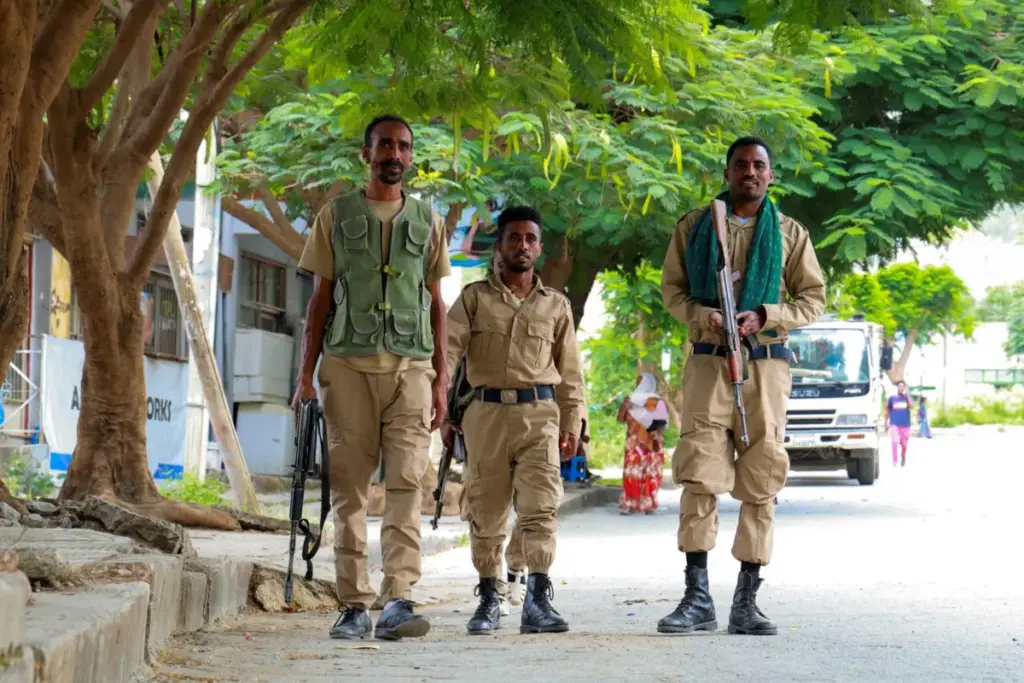
Intensified and widespread fighting between Ethiopia’s federal army and forces from the northern region of Tigray has ignited serious international and domestic concerns that the landmark peace agreement, which ended a devastating two-year civil war in November 2022, could completely unravel.
The dangerous military escalation unfolds just days after seven distinct armed factions from across various regions of Ethiopia formed an unprecedented new alliance. This coalition explicitly seeks the removal of Prime Minister Abiy Ahmed’s administration, setting the stage for a volatile multi-front political and military crisis. As violence flares once again, both the federal government and regional leaders have traded accusations, each blaming the other for instigating the latest breakdown in security.
For millions of ordinary citizens across the East African nation, the immediate and overriding fear is a terrifying return to the full-scale conflict that the country has spent nearly four years trying to recover from. The scars of the previous war run deep, and the renewal of hostilities threatens to plunge the entire country back into humanitarian catastrophe.
How Did Ethiopia Reach This Point?
The historical roots of the current crisis stretch back decades. The Tigray People’s Liberation Front, widely known as the TPLF, originated as a formidable armed movement that fought against Ethiopia’s military government during the 1970s. Following the overthrow of that regime, the TPLF evolved into the dominant political and military force within the ruling coalition that governed Ethiopia for nearly three decades.
That immense concentration of political influence proved deeply contentious in a country defined by a rich tapestry of numerous ethnic groups, where ethnic Tigrayans actually account for only about 6 percent of Ethiopia’s total population. When Prime Minister Abiy Ahmed assumed office in 2018, he initiated sweeping political reforms, establishing the Prosperity Party to replace the old governing coalition. This structural shift sharply reduced the TPLF’s historic influence at the center of national government, sowing the seeds of bitter political estrangement.
Relations between Addis Ababa and Tigrayan leaders deteriorated steadily until all-out war erupted in November 2020. During that brutal two-year conflict, federal troops, allied Eritrean forces, and fighters from the neighboring Amhara region engaged in fierce campaigns against Tigrayan forces. The conflict resulted in the deaths of hundreds of thousands of people, displaced millions from their homes, and left the Tigray region largely blockaded and cut off from the outside world.
A cessation of hostilities agreement, signed in Pretoria, South Africa, in November 2022, finally brought a formal end to the full-scale conventional war. However, while the accord successfully halted major military operations, it ultimately failed to resolve several of the deep-seated territorial and political disputes that had helped fuel the conflict in the first place.
What Has Driven the Renewed Fighting?
Among the most volatile disputes fueling the current tension is the contested status of western Tigray. During the 2020-2022 war, fighters from the neighboring Amhara region fought alongside Ethiopia’s federal army and took control of western Tigray. In the process, hundreds of thousands of Tigrayans were forcibly driven from their homes. Today, Tigrayan leaders demand that the territory be returned to regional administration and that all displaced residents be permitted to return safely.
Conversely, many people in Amhara vehemently reject Tigray’s historical claim to the territory. They argue that western Tigray should never have been incorporated into Tigray when Ethiopia’s regional administrative boundaries were redrawn in 1992, following the collapse of the previous military government.
This profound territorial dispute has persisted, creating a complex geopolitical paradox even though the TPLF and the Amhara Fano National Movement have now joined forces in the same newly formed alliance against Prime Minister Abiy Ahmed’s government.
Compounding these territorial grievances, the federal government has repeatedly accused Tigrayan forces of holding onto heavy weapons and military hardware that they were legally obligated to surrender under the terms of the Pretoria agreement. Tigrayan leaders counter these allegations by asserting that the federal government has utterly failed to secure the withdrawal of external forces from their region or to facilitate the safe return of displaced citizens to western Tigray.
Furthermore, the post-war political arrangements established by the peace accord have experienced severe fractures. Earlier this year, the faction of the TPLF led by Debretsion Gebremichael reclaimed control of Tigray’s regional administration, effectively sidelining and displacing an interim administration that had been established under international supervision as part of the peace process.
Jervin Naidoo, a senior political analyst at Oxford Economics Africa, highlighted the fragility of the situation in remarks to Al Jazeera. "Since the end of the war, while the Pretoria Agreement has held, there have been consistent violations on both sides," Naidoo noted, pointing out that Tigrayans remain deeply aggrieved over the unresolved status of western Tigray, the continued presence of outside forces, and the broader question of regional autonomy.
According to Naidoo, the federal government will likely portray the TPLF as a belligerent actor attempting to destabilize the nation, whereas Tigrayan leadership will frame renewed fighting as a necessary defense of their homeland.

Who Is in the New Alliance?
The political landscape shifted dramatically with the announcement of the Ethiopian Peoples’ Forces Alliance for Survival, a coalition formed this month by seven distinct armed movements. The largest and most influential members of this new coalition include the TPLF, the Amhara Fano National Movement, and the Oromo Liberation Army, known as the OLA. The alliance also incorporates various armed groups from Ethiopia’s Somali, Afar, and Benishangul-Gumuz regions.
Although these organizations possess vastly different political aims, ideologies, and histories, they are unified by a single, explicitly stated objective: the removal of Prime Minister Abiy Ahmed’s administration.
This sweeping coalition agreement marks a striking and ironic reversal of the alliances formed during the previous civil war. Fano fighters, who once fought shoulder-to-shoulder with federal troops against the TPLF, are now allied with Tigrayan forces against Addis Ababa.
The Pretoria agreement fundamentally reshaped these political relationships. While it successfully ended the war between the central government and the TPLF, key allies of Addis Ababa—specifically Eritrea and regional Amhara forces—were not direct parties to the negotiations. Over time, both Eritrea and Amhara forces experienced a falling out with Abiy’s government.
The geographic scope of the new alliance extends far beyond northern Ethiopia. The OLA has waged an insurgency against federal forces in the central Oromia region since 2018. Meanwhile, a faction of the Ogaden National Liberation Front has joined the coalition despite having signed a separate peace agreement with the government that same year, though the ONLF leadership inside the Somali region maintains it is not officially part of the new pact.
Despite their shared opposition to Prime Minister Abiy, analysts note that these groups harbor deeply competing visions for Ethiopia’s future, most notably illustrated by the unresolved territorial rivalry between Tigrayan and Amhara members over western Tigray. Additionally, the federal government has openly accused Eritrea of backing the broader opposition alliance, an allegation that Asmara has repeatedly denied.
What Is Happening on the Ground?
The current military escalation was preceded by weeks of localized small-scale clashes and reported drone strikes. Violence has since escalated sharply, spreading from southern Tigray into the neighboring Afar and Amhara regions.
Both sides in the conflict continue to point fingers regarding who initiated the latest major clashes. Tigrayan forces maintain they were responding to a coordinated federal offensive involving both ground troops and drone attacks, while government authorities insist that the TPLF launched the initial assault. Because fighting is active and ongoing, independent verification of specific military engagements and territorial control remains extremely difficult.
Reporting from Kenya, Al Jazeera correspondent Catherine Soi highlighted the immediate impact on contested border zones. "There has been overnight fighting in the border town of Abala," Soi reported, noting that the town in northern Afar, situated directly on the border with Tigray, had also suffered severe damage during the previous war. Reports regarding which faction currently holds the town have varied significantly. On a separate front within the Amhara region, the Ethiopian national army claimed to have killed more than 270 rebel fighters, a figure that has not been independently verified by neutral observers.
In an alarming operational development, Tigrayan forces have seized control of regional airports located in Mekelle, Axum, and Shire, severely disrupting civilian air traffic and humanitarian logistics. The African Union has publicly declared that this seizure is entirely inconsistent with the terms of the Pretoria agreement. The resumption of hostilities compounds an already dire humanitarian crisis, coming at a time when approximately three-quarters of a million people remained internally displaced within Tigray alone as a direct consequence of the previous war.
Could It Become a Wider War?
While international observers acknowledge a clear and present risk of a wider conflagration, regional analysts emphasize that the conflict has not yet descended into a total national civil war. However, fighting has already crossed traditional Tigrayan borders, compounding existing security challenges that the federal government is attempting to manage in multiple other regions simultaneously.
The potential for international escalation also looms large. Eritrea fought alongside the Ethiopian military during the prior Tigray war, but diplomatic relations between Asmara and Addis Ababa have deteriorated significantly in the interim, exacerbated by Prime Minister Abiy’s vocal push for sovereign access to Red Sea ports. Addis Ababa continues to accuse Eritrea of providing material support to armed insurgent groups operating inside Ethiopian territory.
In response to the deteriorating security situation, the African Union has issued urgent calls for an immediate halt to all military escalations and a return to structured negotiations under the framework of the Pretoria agreement. The continental body has asked former Nigerian President Olusegun Obasanjo, who played a pivotal mediating role in securing the 2022 deal, to engage all warring parties as a matter of extreme urgency. Concurrently, the East African regional bloc IGAD has urged neighboring countries to exercise restraint and avoid any actions that could further exacerbate the escalating crisis.