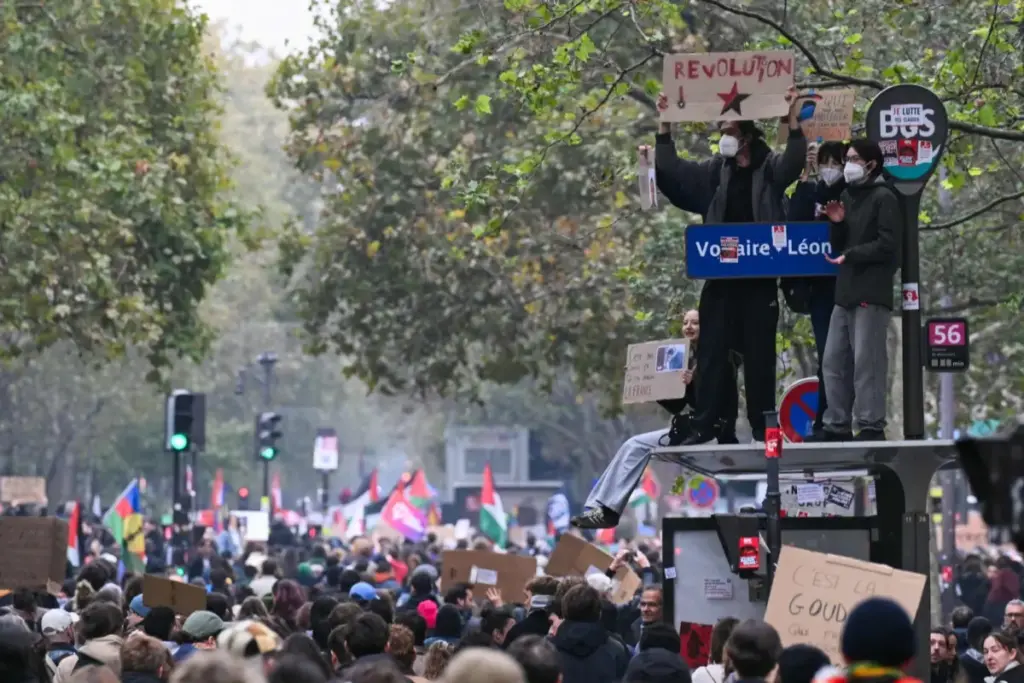
Tens of thousands of people are expected to take to the streets across France for another wave of intense anti-government demonstrations. As the country prepares for the fourth consecutive weekend of widespread unrest, police in Paris have dramatically tightened security measures, deploying heavy forces and establishing strict perimeters to prevent any unauthorized gatherings near the Élysée Palace and other critical government buildings.
The ongoing demonstrations come at a politically volatile time for France, arriving just five months ahead of the upcoming presidential elections. With public frustration mounting, the far right views the impending electoral race as its most viable and formidable opportunity yet to seize control of the presidency. The movement reflects a deep-seated and widening chasm between the populace and the central government, with demonstrators channeling grievances over the cost of living, economic policies, and broader social discontent.
National authorities estimated that up to 170,000 demonstrators would participate nationwide, including an anticipated 60,000 protesters concentrated in the capital city of Paris alone. This fresh wave of civil disobedience follows closely on the heels of major union-led demonstrations and nationwide strikes held just two days prior on November 5, maintaining an unrelenting pressure campaign against the administration of President Emmanuel Macron.
In response to the escalating unrest and determined to avoid a repetition of previous chaos, the French Ministry of the Interior deployed approximately 70,000 security personnel across the country. Authorities have been placed on high alert and instructed to respond swiftly, deeply mindful of the mid-October demonstrations that deteriorated into some of the worst urban riots France has witnessed in years.
In Paris, traditional trade unions mapped out a conventional and heavily policed march route starting from the bustling Place de la République in central Paris and culminating at the Place de la Nation in the eastern sector of the city. However, the operational landscape was complicated by calls from the enduring Yellow Vests movement—a decentralized grassroots coalition whose disruptive protests severely shook President Macron during the early years of his tenure nearly a decade ago. The movement called for a rival, unapproved demonstration at the Place de la Concorde in central Paris. This strategic location sits just steps away from the Élysée Palace, the official presidential residence, as well as the lower house of the French parliament.
Anticipating potential flashpoints, authorities swiftly banned the Place de la Concorde gathering. By Saturday morning, a massive and highly visible police presence had saturated the area, turning the iconic square into a heavily guarded fortress designed to block protesters from approaching key seats of government power. Paris police reported that by late morning, officers had already conducted more than 840 intensive identity checks at major railway stations throughout the capital and its surrounding inner suburbs, seeking to intercept potential troublemakers before they could reach the demonstration sites.
Meanwhile, protest marches were already well underway in several major regional cities, including Marseille along the southern coast, Bordeaux in the southwest, and Lille in the industrial north, according to on-the-ground reports from Agence France-Presse journalists. As a precautionary measure, shopkeepers and business owners in Paris and other urban centers once again boarded up their display windows with heavy wooden shutters, hoping to shield their properties from potential vandalism and looting.
Interior Minister Laurent Nunez addressed the security situation, acknowledging the persistent and unpredictable nature of the threats facing law enforcement. "The risk is exactly the same as on previous Saturdays," Interior Minister Laurent Nunez said, urging authorities "not to lower their guard in the face of more fragmented, or even sporadic, incidents, where the level of violence will not diminish in intensity." He issued a stern warning to potential agitators: "If there are any rioters or looters … we’ll be ready and waiting for them."
‘Mass disobedience’
Despite the heavy security clampdown and the official ban on their chosen assembly point, the Yellow Vests movement urged its supporters to press forward with the rally, framing the prohibition as a direct assault on democratic liberties and an attempt by the state to suppress the French public’s fundamental right to protest.
"Estamos calling for mass disobedience," declared Benjamin Ball, a prominent member of the movement’s coordinating committee, signaling the group’s refusal to back down in the face of governmental resistance.
This latest chapter of sustained civil unrest was originally ignited in late September, when high school students first took to the streets to voice intense dissatisfaction with conditions and resources at their educational institutions. The movement rapidly snowballed as university students joined the cause, ensuring that young people remain right at the beating heart of the ongoing protests and street-level confrontations.
The aggressive police response to these demonstrations has triggered widespread criticism and intense public scrutiny regarding allegations of excessive force. Dozens of official internal investigations have been launched to probe claims of police brutality directed at peaceful demonstrators and bystanders alike. The situation has also impacted the media; following multiple incidents involving apparent police aggression toward journalists covering the events, international news agency Agence France-Presse issued a formal call on Friday demanding robust protections for its reporters working in the field.
The French government finds itself trapped in a difficult policy corner, struggling to formulate effective solutions to appease the disgruntled public while facing severe financial constraints. France’s mounting public debt has severely limited fiscal maneuverability, a reality that has already rattled financial markets and raised concerns among international economic observers.
In an effort to de-escalate the mounting tensions, Prime Minister Sébastien Lecornu was scheduled to sit down with labor union leaders and employer federation representatives on Monday to discuss critical issues surrounding wages, household purchasing power, and economic relief.
However, the path to a resolution remains uncertain. "The only thing that will bring the protests to an end is a response to the demands that have been put forward for several weeks by workers, civil servants, young people and pensioners," an inter-union coalition asserted in a joint statement released Friday.
The pressure on the administration shows no sign of abating. Student and teacher organizations across France have already scheduled another major strike for Tuesday, aiming to maintain maximum leverage over the government to secure increased public spending on education. Representatives for the educational groups stated that they felt "in a position of strength (and) the government in a position of weakness and starting to yield."
Against this backdrop of continuous social upheaval, the political landscape is shifting dramatically. Recent opinion polls indicate that far-right candidate Marine Le Pen stands as the frontrunner and favorite to capture the presidency in the 2027 election cycle. Interestingly, her primary challenger in current projections is not a centrist ally of President Macron, but rather hard-left leader Jean-Luc Mélenchon, who was scheduled to deliver a major address to a large political rally later Saturday.