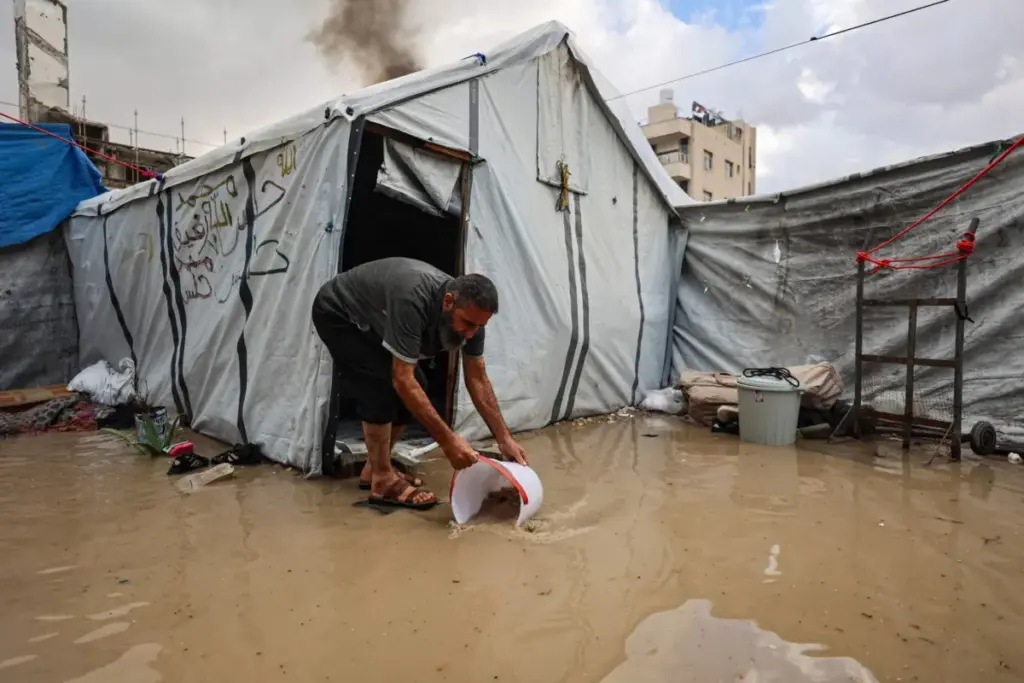
Heavy seasonal rain on Saturday swept across the war-ravaged Gaza Strip, flooding tens of thousands of tents housing displaced Palestinians and leaving thousands of families entirely without shelter, according to local Palestinian authorities. The severe weather hit on the very first day of significant rainfall, dramatically worsening an already desperate situation for hundreds of thousands of people who are struggling to survive in makeshift camps after more than two years of devastating conflict.
Palestinian officials reported that approximately 70,000 tents were flooded during the storm, inundating temporary living spaces that offer little to no protection against severe weather. Compounding the misery, dozens of weakened walls and damaged roofs collapsed across several parts of the territory under the weight of the downpour and relentless moisture, resulting in multiple injuries, some of which are described as critical.
Since early Saturday morning, hundreds of displaced families have been forced to flee their flooded encampments in Gaza City, as well as across the central and northern sectors of the Gaza Strip, desperately searching for higher or drier ground as rainwater rapidly filled their temporary shelters. The sudden onset of the storm has left families scrambling in the mud, trying to salvage whatever belongings they have left.
Mahmoud Bassal, a spokesman for the Gaza Civil Defense, told Agence France-Presse (AFP) that emergency teams had received more than 1,500 urgent distress calls overnight from residents whose tents had been completely swamped by floodwaters. Bassal noted that local civil defense operations are currently functioning "without any equipment or capabilities," severely hampering their ability to respond to widespread emergencies.
"We have issued an urgent distress call to the international community and humanitarian organizations to intervene immediately to save hundreds of thousands of displaced people from the flooding of their tents," Bassal said, underscoring the severity of the crisis. "We cannot face the consequences of this storm on our own."
The human toll of the flooding is starkly visible in the testimonies of displaced residents trying to weather the storm with their children. Um Muhammad al-Hersh, a 45-year-old mother living with her family in a tent in western Gaza, described the immediate devastation of her family’s meager possessions to AFP. "We were not able to save the mattresses, and all the clothes were soaked," she said. "Our suffering is repeated every winter."
Similarly, Maryam Odeh, a 34-year-old mother residing with her children in Deir al-Balah, expressed deep despair over her inability to shield her family from the elements. "We no longer know how to protect our children," Odeh said. "My children ask me where we will sleep tonight, and I have no answer."
For many parents, the immediate threat of rising water is compounded by the looming specter of freezing temperatures and widespread illness. Khaled al-Najjar, 41, voiced grave concerns about the long-term health implications of the storm for vulnerable children living in damp and exposed conditions. "We fear for our children not only from the flooding of the tents, but also from the cold and the widespread diseases," he said.
Echoing these fears, a coalition of Palestinian civil society organizations released a statement warning of "the catastrophe that has come to threaten the lives of hundreds of thousands of residents," specifically highlighting the escalating risk of infectious disease outbreaks as stagnant water accumulates around crowded residential areas. The coalition, which comprises dozens of local institutions and humanitarian organizations, issued an urgent appeal, calling for intense international "pressure on Israel to allow the entry of humanitarian aid without restrictions."
The humanitarian emergency unfolds against the backdrop of a fragile cease-fire that took effect on October 10, 2025. That agreement brought a formal pause to two years of catastrophic violence that began with Hamas’s incursion into southern Israel on October 7, 2023. Despite the cease-fire agreement—which was successfully brokered through Egyptian, Qatari, and U.S. mediation—the Israeli military has continued to carry out airstrikes and ground operations on an almost daily basis, keeping the territory in a state of ongoing instability and restricting normal civic recovery.
Local municipal officials emphasize that the physical infrastructure of Gaza remains fundamentally incapable of supporting the displaced population under severe weather conditions. Mustafa Qazzaat, a member of the Gaza City Council and an official with the Gaza Strip’s emergency committee, pointed out that Israel has not permitted prefabricated housing units to enter the territory to shelter displaced Palestinians since the truce officially went into effect. According to Qazzaat, authorities have only allowed limited numbers of basic tents to enter, which have proven entirely inadequate against heavy rain and wind.
Speaking to AFP on Saturday, Qazzaat stated that the Gaza Strip "needs 200,000 prefabricated homes urgently, in addition to the entry of heavy machinery to remove the rubble of destroyed homes and buildings, open main roads, and urgently provide electricity and heating." Without these vital interventions, local leaders warn that the winter months will bring continuous suffering and escalating health crises for a population already pushed to the absolute brink of survival.