For every five plates of food served around the world, roughly one ends up in the bin. That startling statistic adds up to more than a billion tonnes of discarded food every year, representing an immense drain on global resources, economic stability, and environmental health. Meanwhile, an estimated 645 million people—translating to roughly one in every thirteen individuals on the planet—struggled with hunger in 2025, according to United Nations figures.
This stark paradox between mass global waste and widespread deprivation forms the core focus of World Food Day, observed annually on October 16. Marking the founding of the UN Food and Agriculture Organization (FAO) in 1945, this year’s observance carries the theme "Innovate today, nourish tomorrow." The campaign serves as an urgent call to redesign global food systems so they are capable of feeding a growing population while drastically curbing inefficiency and waste.
Hunger Is Falling, Slowly
Global hunger has experienced a downward trend for the third consecutive year, yet it stubbornly remains above the baseline levels recorded before the disruptions of the COVID-19 pandemic.
According to the UN’s annual State of Food Security and Nutrition in the World report, an estimated 645 million people, or 7.8 percent of the global population, faced hunger in 2025. While this represents a modest improvement from 8.1 percent in 2024 and a post-pandemic peak of 8.6 percent in 2022, the figures reveal that recovery remains painfully slow. Today’s total still leaves about 61 million more people undernourished than in 2019, underscoring the lingering vulnerabilities within international supply chains, economic structures, and social safety nets.
Where Are People the Most Hungry?
Geographically, the burden of hunger is distributed unevenly, with Africa bearing the heaviest weight of any continent. In 2025, an estimated 309 million people across Africa were undernourished. That figure means roughly one in five residents on the continent is chronically hungry, accounting for nearly half of the total undernourished population worldwide.

By comparison, the scale of undernourishment looks different in other heavily populated regions. In Asia, an estimated 292 million people—representing 6 percent of the continent’s population—faced hunger, while Latin America and the Caribbean recorded 32 million undernourished individuals, or 4.8 percent of their regional population.
The 2026 Global Hunger Index paints a similarly concerning picture at the individual country level. The index evaluates nations on a 100-point scale, synthesizing data on undernourishment alongside child stunting, child wasting, and child mortality. Scores of 35 or higher are categorized as "alarming."
Based on these metrics, hunger is currently classified as alarming in eight nations, seven of which are located in Africa. Somalia records the most severe score among the 122 countries ranked, closely followed by the Democratic Republic of the Congo, Chad, and Madagascar. Sudan, South Sudan, Burundi, and Yemen were also designated as facing alarming conditions, though active conflict and critical data gaps prevented the index from calculating precise scores for them.
How Much Food Is Wasted Every Year?
While millions suffer from acute shortages, a staggering proportion of the food grown globally never even makes it to a dining table. Food loss and waste occur continuously along the complex journey from farm to fork.
According to the FAO, approximately 13 percent of all food produced globally is lost post-harvest before it ever reaches retail storefronts. This initial waste typically occurs due to spoilage during storage, inadequate transport infrastructure, or processing inefficiencies, with perishable items like fresh fruits and vegetables suffering the highest losses. The economic value of this pre-retail loss exceeds $400 billion annually.

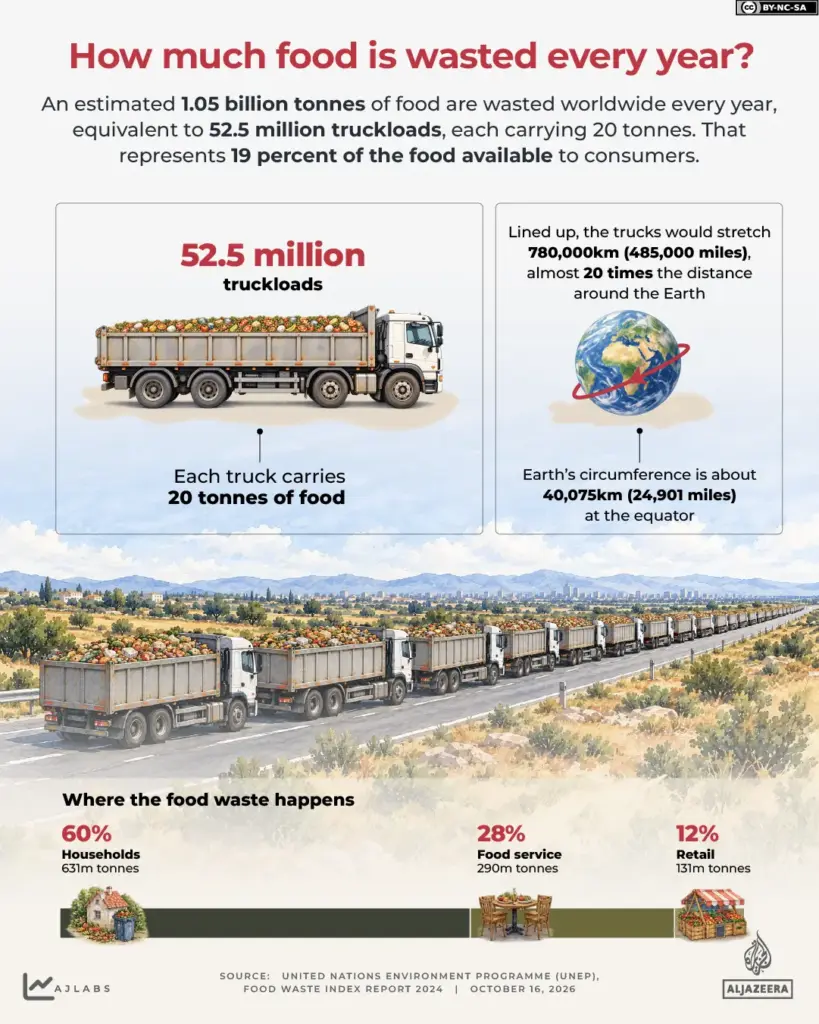
Once food successfully reaches commercial markets, the waste dynamic shifts toward consumer-facing entities and private households. Retail shops, restaurants, and domestic kitchens throw away nearly a fifth of the total food available to consumers. Data compiled by the UN Environment Programme (UNEP) shows that approximately 1.05 billion tonnes of food were discarded at these stages in 2022. To visualize the scale, that volume is equivalent to 52.5 million heavy-duty trucks, each loaded with 20 tonnes of food.
Private households are the primary contributors to this consumer-level waste, accounting for 60 percent of the total. Restaurants and other food service providers are responsible for 28 percent, while retail shops account for the remaining 12 percent.
Which Country Wastes the Most?
On average, every person on Earth discards roughly 132 kilograms, or 291 pounds, of food each year—an amount roughly equivalent to the combined weight of two adults. Of that total, about 79 kilograms, or 174 pounds, is thrown away directly within the home.
However, individual habits and national averages vary dramatically across the globe. UNEP data indicates that hotter countries tend to register higher levels of household food waste, a trend potentially driven by the rapid spoilage of fresh produce in warmer climates combined with lower rates of domestic refrigeration.
The Maldives records the highest per capita food waste globally, with each resident throwing away approximately 260 kilograms, or 573 pounds, annually—roughly double the worldwide average. Countries such as Syria, the Dominican Republic, Seychelles, Mexico, and Tunisia follow closely behind, with each nation averaging more than 210 kilograms, or 463 pounds, of wasted food per person each year.

At the other end of the spectrum, nations like Spain have recorded some of the lowest municipal waste levels, averaging around 39 kilograms, or 86 pounds, or less per person annually.
What Does Food Waste Cost?
Beyond the moral implications of widespread hunger in a world of abundance, the global economy pays a staggering price for inefficiency. Food loss and waste cost the global economy in excess of $1 trillion every year, according to UN estimates.
To contextualize that immense financial figure, $1 trillion represents capital that could otherwise be deployed across dozens of critical societal and developmental categories. Furthermore, throwing away food means squandering all the vital inputs—including financial capital, arable land, and energy—that were invested in producing it in the first place.
Approximately 1.4 billion hectares, or 3.5 billion acres, of land are currently dedicated to growing food that is ultimately never consumed. This accounts for 28 percent of the world’s total agricultural land, an expansive terrestrial footprint larger than the entire landmass of Canada.
Additionally, the lifecycle of lost and discarded food generates an estimated 8 to 10 percent of global greenhouse gas emissions. This carbon footprint includes significant volumes of methane, a potent heat-trapping gas released as organic matter decomposes in crowded landfills, compounding the global climate crisis while millions go without their next meal.