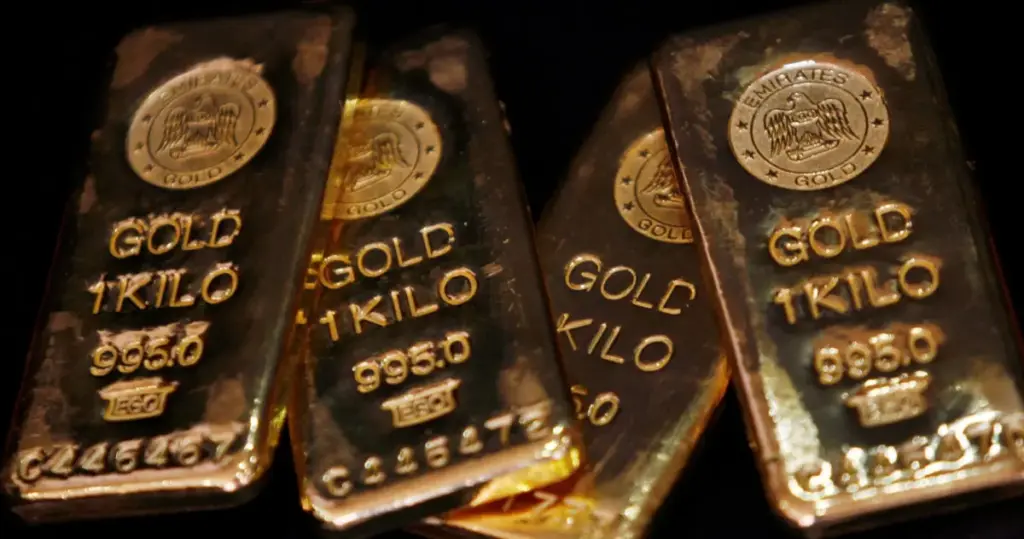
Gold prices tumbled to a more than seven-week low on Monday, dragged down by a potent mix of surging oil prices, a stronger US dollar, and climbing Treasury yields that have intensified broader inflation fears. The sharp decline in the precious metals market follows escalating geopolitical tensions between the United States and Iran, creating a turbulent economic backdrop that has left investors recalibrating their portfolios in the face of shifting monetary policies.
Spot gold prices fell precipitously by 3.3 percent, settling at $4,146.51 per ounce by the end of the trading session. This downward movement marks the lowest valuation for the safe-haven asset since August 5, signaling a notable shift in market sentiment. US gold futures mirrored the spot market’s downward trajectory, also dropping 3.3 percent to close at $4,178.40 per ounce.
The losses were not confined to gold alone. Precious metals across the board faced heavy selling pressure, with spot silver leading the retreat by plunging 4.7 percent to $61.27 per ounce. Platinum also declined significantly, dropping 2.9 percent to $1,726.30 per ounce, while palladium recorded a 4.4 percent loss, finishing the day at $1,211.45 per ounce. Market analysts have described the convergence of these macroeconomic factors as an exceptionally hostile environment for non-yielding assets.
Geopolitical Tensions and Energy Shocks Fuel Market Volatility
The root of the latest market shock traces back to the intensifying conflict between the United States and Iran, which has directly threatened global energy supplies. Oil prices spiked by approximately 3 percent on Monday after US President Donald Trump rejected an Iranian diplomatic offer aimed at resolving the ongoing conflict and reopening the critical Strait of Hormuz.
The Strait of Hormuz serves as a vital global chokepoint for petroleum transit, and any disruption or heightened risk in the region instantly sends shockwaves through international energy markets. The resulting spike in fuel prices has immediately stoked renewed fears of stubborn, persistent inflation, forcing financial markets to reevaluate the future path of global monetary policy.
These energy-driven inflation concerns have translated directly into upward pressure on the US dollar, which remained steady near a two-week high, and US Treasury yields. For precious metals like gold, which have traditionally been embraced by investors as a reliable hedge against rising consumer prices, the simultaneous strength in the dollar and Treasury yields has created a hostile trading environment.
Jim Wyckoff, a market analyst at the American Gold Exchange, summed up the current market dynamics by noting that higher Treasury yields and a robust US dollar are “creating a perfect storm to push the metals prices sharply lower.”
The Paradox of Gold in an Inflationary Environment
While gold is historically touted as a primary defense mechanism against inflation, the mechanics of the current economic cycle have introduced a counterbalancing force: rising interest rates. Because gold does not generate interest or yield dividends, its relative attractiveness diminishes significantly when investors can secure high returns from risk-free or low-risk, yield-bearing assets like government bonds.
The US Federal Reserve recently moved to address persistent inflation pressures by lifting benchmark interest rates by a quarter of a percentage point earlier this month. Furthermore, central bank officials have signaled that monetary tightening may not be finished yet, flagging that at least one more rate hike is likely in the coming months as economic data continues to roll in.
This hawkish stance from central bankers has been reinforced by recent commentary from regional Federal Reserve officials. Cleveland Fed President Beth Hammack is among the latest policymakers to reiterate that inflation risks remain stubbornly elevated, suggesting that interest rates may need to remain higher for longer to cool economic activity.
Sherif Othman, CEO of the Maryland-based Poise Investment Advisors, explained the mechanics of this shift and its impact on everyday investors to Al Jazeera.
“There might be no notable direct impact on regular people due to that. However, investors who had turned to gold will see a hit, especially under the current high inflation rates,” Othman said.
“Gold does not yield interest, so when Treasury yields go up, investors turn away from gold, impacting its value,” he added.
As investors continue to weigh the compounding pressures of geopolitical conflict in the Middle East, stubborn inflation figures, and the likelihood of further monetary tightening by the Federal Reserve, the near-term outlook for precious metals remains fraught with uncertainty. For now, market participants are watching closely to see how the standoff in the Strait of Hormuz evolves and whether energy markets will settle, offering some much-needed relief to an increasingly volatile global economy.