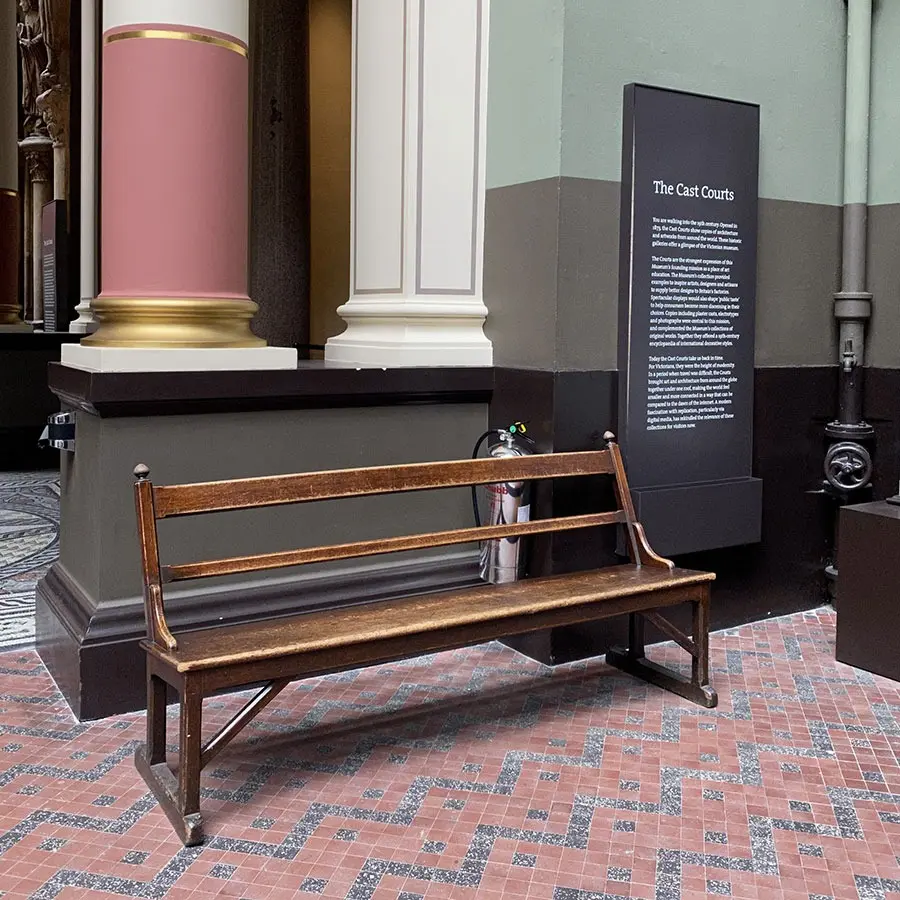
Museum seating is frequently invisible to the general public. Visitors tend to notice a seat, or the frustrating absence of one, only when exhaustion sets in and a place to rest becomes an immediate necessity. By design and necessity, museums prioritize the visitor experience alongside the meticulous preservation and display of their collections, treating seating primarily through the lens of a functional accessibility requirement.
Yet, as the renowned design historian Judy Attfield observed, such everyday objects belong firmly to a institution’s "material culture of everyday life." By recognizing museum seating as a vital form of material culture, disciplines like design history are able to unlock unknown narratives belonging to the wider, often overlooked biography of museums.
At the Victoria and Albert (V&A) Museum in London, the institution’s collection of historic benches—some of which have remained in active service for more than 150 years—conceals surprisingly rich accounts of how the museum actively shaped the ways generations of visitors have viewed and experienced its collections.
The Historic Benches
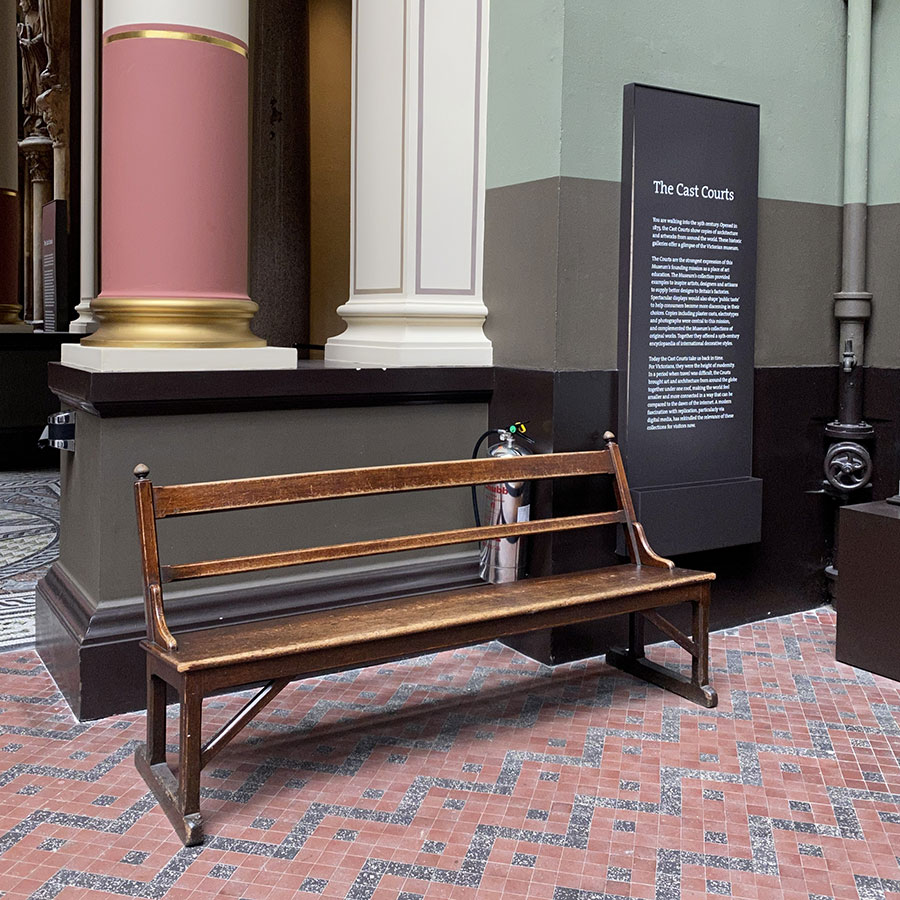
For a contemporary visitor arriving at the V&A’s Cast Courts in search of a place to sit, the initial encounter is likely with a series of long, wooden benches. Their edges are worn, effaced, and discolored by decades of use, yet they retain an understated elegance defined by carefully carved finials. Most visitors passing through these soaring, cast-filled halls remain entirely unaware that these benches have witnessed the turn of two centuries, two world wars, and the countless social and architectural shifts that have unfolded since the 1850s. Indeed, historical evidence suggests that some of these very seats have likely been in continuous use since the exact day the South Kensington Museum (SKM)—the direct predecessor to the V&A—first opened its doors to the public.
Referred to informally as "historic benches" by the museum’s current staff, these wooden pieces appear prominently in numerous archival photographs dating back to the 1860s, documenting the early days of the South Kensington Museum. Archival research reveals that many of these pieces were manufactured by Johnstone & Jeanes, a prominent Victorian firm of cabinetmakers and upholsterers. While the company’s precise business name shifted several times over the years due to changes in partnership and ownership, the firm operated under the specific banner of "Johnstone & Jeanes" between 1840 and 1882, effectively anchoring the manufacture of these V&A benches firmly within that mid-to-late 19th-century window.
During its Victorian heyday, Johnstone & Jeanes enjoyed a formidable reputation for innovative craftsmanship and sophisticated furniture design. The firm’s famous Jupe expandable table attracted widespread public attention at the Great Exhibition of 1851, and many of their creations earned international prizes. The company’s elite clientele included Queen Victoria herself, and they manufactured bespoke furniture designed by Prince Albert for Buckingham Palace, as well as the celebrated interior designs created by Lawrence Alma-Tadema for Henry Gurdon Marquand’s lavish Music Room in New York City. Furthermore, the firm supplied secure display cases for the South Kensington Museum and manufactured the museum’s official director’s chair, a piece likely used by the institution’s driving force, Henry Cole. Because surviving commercial stock from Johnstone & Jeanes is exceptionally rare today, the presence of these authentic benches within the V&A carries profound historical significance.

A Bench for All
In the early decades of the South Kensington Museum, these wooden benches were strategically placed across various high-profile galleries. Among them was the celebrated "Raphael Room," a gallery designed to house the Raphael Cartoons—the magnificent set of 16th-century paintings on paper by Raphael that originally served as working designs for the tapestries hung in the Sistine Chapel. By balancing these monumental cartoons between the distinct realms of fine art and industrial design, the museum deliberately shaped how audiences experienced their dual nature through evolving gallery layouts, display strategies, and furniture choices. The historic benches, adhering to a visual script of stark simplicity that contrasted sharply with the SKM’s heavily embellished and ornate architecture, played a quiet yet vital role in that overarching pedagogical discourse.
The use of thin strips of wood within a highly functional structural design ensured that the seating created minimal visual interference with the surrounding artistic displays. Unlike the comfortable, deeply domesticized ottomans found in the Louvre’s Salon Carré, where wealthy flaneurs and fashionable ladies could languidly admire fine art, these were utilitarian seats designed to educate a broader public within an institution built specifically for learning. Furthermore, their subtle aesthetic resemblance to traditional park benches or modest church pews conveyed a powerful institutional message of universality and democratic access.
This egalitarian ethos was reinforced by other progressive museum policies of the era, including free public admission and extended evening opening hours. Within this framework, the SKM’s benches functioned as silent agents of accessibility, designed not for leisurely lounging, but to accommodate a diverse, less socially selective audience that required sturdy, resilient seating capable of withstanding heavy daily use.

Despite their overarching emphasis on utilitarian function, the design did not completely eschew the artistic sensibilities of the era. This was revealed in the carved finials that punctuated the backs of the benches, showcasing the characteristically Victorian combination of structural pragmatism and a passionate fondness for ornament. These modest finials served as a quiet surrender to decorative convention, offering tangible proof that even the most functional museum furniture remained deeply rooted in the aesthetic vocabulary of its time.
Design History Underneath the Seat
In the absence of comprehensive administrative archives detailing the original commissioning, purchase, and exact deployment of these pieces of furniture, the V&A’s benches provide design historians with a rare window into a chapter of the museum’s past that was never formally recorded in written documents. Remarkably, these benches were literally concealing physical evidence of their origins underneath their wooden boards, hiding details that would otherwise have remained lost to history.
It was only through targeted, investigative fieldwork—turning the heavy benches upside down and examining their undersides with a smartphone’s flashlight during quiet hours when the galleries were closed to the public—that faded, stamped maker’s marks from Johnstone & Jeanes were uncovered. The discovery of these obscured engravings allowed researchers to accurately date specific benches within the collection and bring entirely new institutional stories to the surface. This methodological approach highlights the core objective of design history: guiding the researcher into close physical readings of everyday objects, extracting the hidden messages embedded within their construction, and situating them accurately within the broader cultural and historical contexts of their creation.

This ongoing research emerged directly from graduate scholarship completed within the V&A and Royal College of Art’s joint History of Design MA program, shedding new light on the material culture that underpins the world-famous museum.