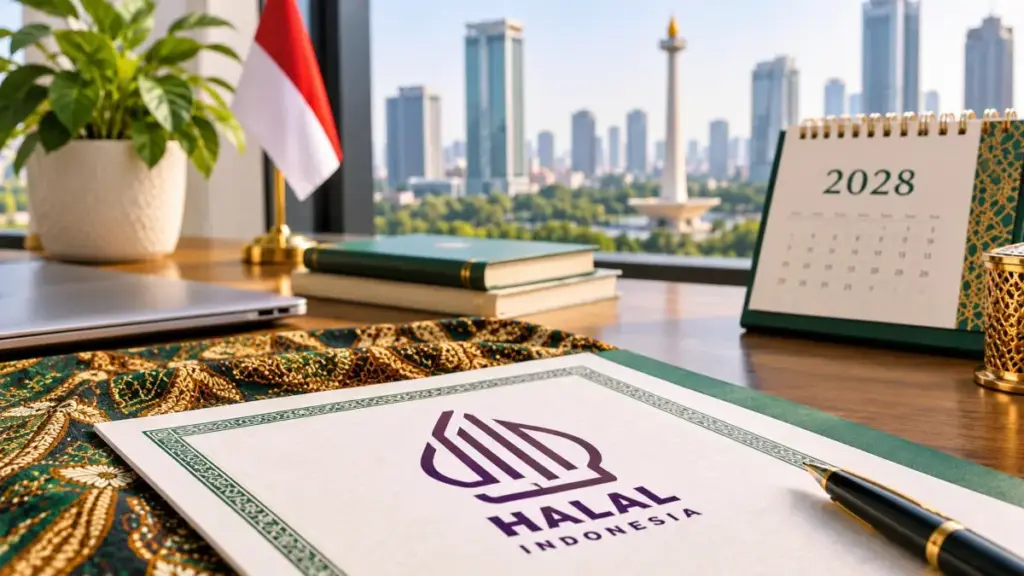
JAKARTA — In a significant policy adjustment aimed at aligning regulatory requirements with national infrastructure readiness, the Government of Indonesia has officially relaxed its mandatory halal certification deadlines. Under Articles 160 and 161 of Government Regulation (PP) No. 42/2024, the administration has extended the implementation timeline for several key product and service categories, moving the compliance deadline from October 2026 to October 2028.
The decision was announced during an online public dissemination session held on Friday, October 16, 2026. The virtual gathering brought together a wide array of stakeholders, including representatives from the Halal Product Assurance Organizing Agency (BPJPH), the Ministry of State Secretariat, the Coordinating Ministry for Economic Affairs, and various prominent industry associations.
Elaborating on the rationale behind the policy shift, Susiwijono Moegiarso, Secretary of the Coordinating Ministry for Economic Affairs, pointed directly to the current state of the nation’s commercial ecosystem.
"Taking into account the readiness of Indonesia’s halal ecosystem, the Government has extended the phased implementation of mandatory halal certification through amendments to Government Regulation No. 42 of 2024," Moegiarso stated during the dissemination session.
The regulatory update also involves concurrent administrative adjustments. Notably, the policy revokes BPJPH Regulation No. 4 of 2026, which previously governed the inspections of imported halal products. Furthermore, it initiates a comprehensive review of Government Regulation No. 42/2024 alongside other related regulatory frameworks to ensure seamless implementation moving forward. Further operational provisions and technical guidelines are expected to be detailed in forthcoming official government regulations.
Which Products and Services Are Covered?
The newly established October 2028 deadline applies to specific product and service categories that require additional time for administrative preparation, supply chain adjustments, and compliance verification. While the exact scope continues to be defined through overarching government frameworks, businesses operating across diverse sectors are strongly advised to thoroughly review their operational portfolios. Enterprises must determine whether their specific goods, merchandise, or commercial services fall within the categories granted this two-year extension.
Additionally, micro and small enterprises, as well as foreign enterprises, retain specific provisions and extended pathways regarding core consumer goods such as food, beverages, animal-derived products, and specialized slaughtering services. Industry observers note that identifying the correct classification early will prevent administrative bottlenecks as the updated 2028 horizon approaches.
LPPOM Urges Businesses to Use the Extra Time Strategically
As the commercial sector digests the implications of the extended timeline, leading Halal Inspection Bodies (LPH) have stepped forward to offer guidance. LPPOM views the regulatory adjustment not as a reprieve from compliance, but as a crucial strategic window for businesses to fortify their internal processes and achieve rigorous, long-term adherence to national standards.
Operating as an established LPH with representative offices spanning all 34 provinces of Indonesia, alongside robust international networks, LPPOM has reaffirmed its institutional commitment to supporting a credible, inclusive, and globally competitive halal ecosystem. The organization provides comprehensive science-based halal inspection services, targeted educational programs, and hands-on technical assistance tailored to businesses of all sizes, with a particular emphasis on empowering micro, small, and medium enterprises (MSMEs).
To assist companies navigating the transition, LPPOM maintains accessible support channels, including the dedicated 14065 hotline and official information platforms designed to clarify complex certification requirements, administrative processes, and compliance milestones. Industry stakeholders are encouraged to leverage these resources proactively rather than delaying preparations until the final approach of the 2028 deadline.
Building Trust Through Science-Based Halal Assurance
Maintaining the integrity of the halal supply chain remains a paramount priority for regulatory authorities and inspection agencies alike. LPPOM’s inspection services are underpinned by a workforce of highly qualified halal auditors and advanced laboratory testing facilities. The organization continually refines the quality, reliability, and transparency of its testing and auditing protocols to protect the authenticity of the halal certification process and safeguard public trust in certified goods.
Beyond domestic inspections, LPPOM actively collaborates with a diverse network of government agencies, national and regional industry associations, chambers of commerce, overseas halal certification bodies, and international partners. Through these strategic partnerships, the organization aims to broaden halal literacy, enhance overall business preparedness, and elevate the international competitiveness of Indonesia’s burgeoning halal industry in both domestic and global markets.
As the regulatory landscape continues to evolve, businesses are advised to closely monitor upcoming government regulations, maintain open channels with supervisory bodies, and utilize authorized inspection networks to ensure their operations remain fully aligned with Indonesian law.