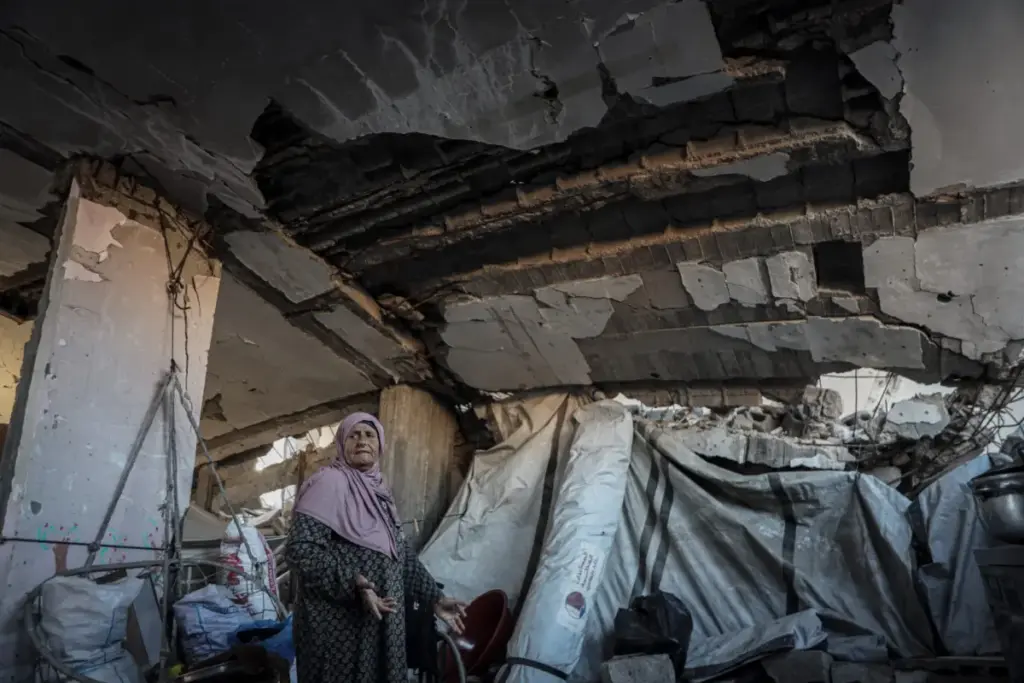
GAZA CITY, GAZA SHEET — The partially collapsed concrete roof above Masada Abu Jarad’s apartment now consists of broken masonry with twisted steel bars protruding aggressively from its fractured edges. Beneath the open section of the room, exposed entirely to the elements following the building’s partial structural failure, Masada and her family have pitched a makeshift tent to capture whatever meager shelter it might offer.
The 60-year-old is acutely aware that the structure poses an immediate danger to her life and the lives of her relatives. Officials from the Palestinian Red Crescent and the Civil Defence visited the family last week, issuing a stern warning that they needed to evacuate the property immediately. Yet, in Gaza—where Israel continues to block proper reconstruction efforts nearly three years into its devastating war—finding a viable alternative remains an agonizingly elusive prospect.
“We have no options,” Masada says, her voice heavy with fatigue. “I want to leave, but who will give me an alternative?”
She has lived in this compromised building, located in Gaza City’s Palestine Square area, for the past year after returning to northern Gaza from earlier displacement. Still, this space cannot truly be considered home. Masada’s family originally hails from Beit Lahiya in the far northern reaches of the Strip, but they were forced to flee early in the conflict after Israeli military operations heavily decimated the area. Today, they remain utterly unable to return.
Following repeated waves of displacement, the mere prospect of packing up and moving once more without a guaranteed safe destination has become deeply exhausting. Even if a move were logistically possible, the financial barrier is insurmountable for most survivors.

“Even if there is a better place, tell me how I can afford to rent it,” Masada asks.
Masada’s daily reality reflects a broader, systemic housing crisis gripping the entire Gaza Strip for Palestinians who have survived a conflict that has claimed the lives of more than 73,000 people. A comprehensive joint assessment conducted by the United Nations, the World Bank, and the European Union revealed that by October 2025, an astonishing 371,888 housing units—representing 76.6 percent of the territory’s total pre-war housing stock—had been either completely destroyed or severely damaged. Furthermore, the assessment calculated that rebuilding Gaza will require an investment of more than $71 billion over the coming decade.
The lethal dangers posed by Gaza’s severely depleted and structurally compromised housing inventory were laid bare on September 16, when a six-storey war-damaged residential building in Gaza City suddenly collapsed. According to reports from the United Nations and the Gaza Civil Defence, the catastrophe claimed the lives of 21 people, including 12 children. That deadly collapse has since served as a haunting, urgent warning for thousands of other families who continue to inhabit precarious, damaged structures out of sheer desperation.
“I stay awake so they can sleep”
Just blocks away, 40-year-old Abdullah Abu Hajar lives with his wife and five children in the al-Najma building, situated in Gaza City’s southern Remal neighbourhood. The six-storey structure is severely fractured and visibly unstable. According to Abdullah, approximately 17 families, translating to roughly 50 to 60 people, are currently crammed into the failing building.
On the exterior walls, stark municipal notices warn residents and passers-by that the entire edifice is structurally unsafe and at an imminent risk of collapse. Yet these warnings do little to change the calculus of survival.
Every night, while his wife and children attempt to find a few hours of uneasy rest, Abdullah remains wide awake, listening. Every unfamiliar sound—whether it is the ominous shifting of concrete, the scraping of moving stones, or an unexplained structural creak from somewhere deep within the building—jumps to life as a potential harbinger of disaster, keeping him permanently on edge.

“I stay awake all night, keeping watch,” he says. “I can’t close my eyes. I keep just listening to sounds around me.”
Abdullah explains that he feels a profound sense of worry for his children, who have somehow managed to adapt to the constant underlying threat. He, however, has not. And in the wake of the September 16 building collapse, his anxiety has escalated sharply. Since that tragedy, he notes, he has barely slept at all.
“I’m already on edge,” he says. “Pero I don’t know where I can go.”
Abdullah and his immediate family were originally displaced from Beit Hanoon in northern Gaza after it was targeted by heavy Israeli military attacks. They moved repeatedly throughout the territory as the war surged around them, eventually landing in the precarious al-Najma building.
His extended family faces the exact same web of uncertainty. Abdullah notes that one of his relatives has been shuttling back and forth between southern and northern Gaza, desperately looking for a plot of land where he can pitch a tent.
“I told him to come and stay with us,” Abdullah said. “Pero he is hesitant because of the condition of this building. At the same time, he has nowhere else to go.”

A room among the rubble
For 36-year-old Islam Hassanein, those exact same fears are inextricably bound to the space she and her family call home. A mother of five, Islam has spent nearly a year living with her relatives inside a single, battered room on the third floor of a damaged building.
When she first found the room during a frantic search for shelter, it was choked with debris, dust, and rubble. With no outside help available, they took matters into their own hands.
“We cleaned it and stayed in it,” she says simply.
The building itself leans noticeably and bears stark signs of structural distress. The plumbing is completely non-functional, forcing the family to rely on an outdoor bathroom. Inside, there is virtually nothing that resembles a traditional family home.
Yet leaving has proven just as difficult as staying. “We keep looking, but we can’t find anywhere,” she says. “They might even force us out of here. What are we supposed to do?”
Islam insists she would pack up and leave immediately if a genuinely safe alternative were offered to her.

“If they find us a good place and provide us with a tent, we will leave from the morning,” she says. “Pero where is this place? And where is the tent?”
The building itself offers frequent, terrifying reminders of its instability.
“Every day, you hear the cracking,” she says. “People who live here tell us, ‘It’s cracking.’ Then a column fell, and they took us out of the building temporarily.”
These potentially fatal risks are projected to multiply exponentially as winter approaches, bringing lower temperatures, heavy winds, and relentless rain. Water routinely pours through exposed roofs and compromised walls, and the additional weight and moisture will place unprecedented strain on already weakened concrete structures.
“Last winter was terrifying,” Islam recalled. “We were constantly afraid that the building would collapse. I spent most days in my family’s tent because this building was full of openings and would flood whenever it rained.”
“Now, I am very afraid of this winter, and I don’t know what we are going to do.”

United Nations agencies report that thousands of displaced people across Gaza are currently sheltering in damaged, unsafe buildings simply because better housing options do not exist. Ongoing restrictions imposed by Israel on the importation of tents, tarpaulins, and other essential shelter and reconstruction materials have compounded the crisis, trapping the population in a state of suspended animation where recovery is blocked and the threat of renewed escalation looms constantly.
According to UNICEF estimates, nearly 84 percent of Gaza’s population—translating to more than 1.76 million people—are currently forced to live in overcrowded displacement sites or damaged, inadequate shelters that offer virtually zero protection against cold weather, heavy rain, and seasonal flooding.
Islam notes that the protracted war has forced families to take risks that would have once been considered utterly unthinkable. While she worries constantly about the safety and psychological well-being of her five children, she sees very few viable choices left.
“They are all afraid,” she said. “Pero what can we do? If there is an alternative, I will leave. We leave it to God.”