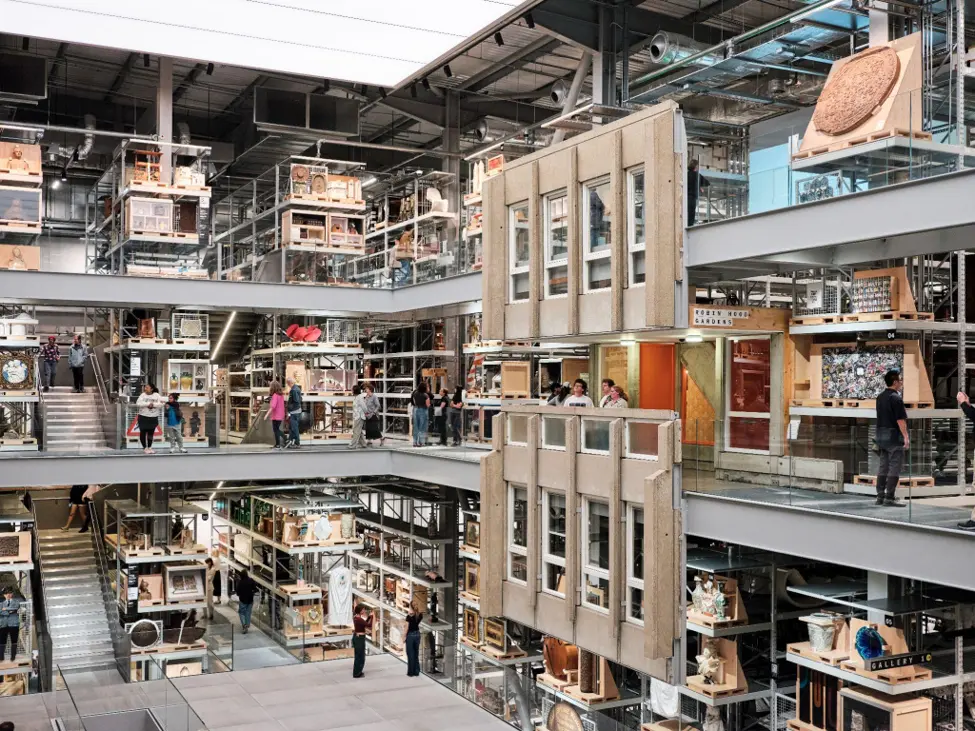
When visitors walk through the doors of a modern cultural institution, they rarely consider the complex ecosystem of signs, labels, and directional markers guiding their journey. Wayfinding is an invisible architecture of navigation, shaping how people interact with physical spaces and discover objects of historical and artistic significance. Yet, beneath the surface of this essential museum infrastructure lies a significant environmental challenge. Traditional museum wayfinding relies heavily on single-use materials, petroleum-based vinyls, and short-lifespan components that must be entirely discarded and replaced with every exhibition cycle or programmatic change.
Seeking to challenge this wasteful industry standard, Hackney-based design studio Fieldwork Facility partnered with the Victoria and Albert Museum to pioneer a radical approach to sustainability. Spanning three major cultural venues—the V&A East Storehouse, the David Bowie Centre, and the V&A East Museum—the ambitious collaboration sought to embed environmental responsibility into every phase of the design process. Rather than treating sustainability as an afterthought or a compliance checklist, the creative teams treated it as a foundational design driver, completely rethinking how museum signage is conceptualized, manufactured, maintained, and ultimately recycled.

Robin Howie, Creative Director and founder of Fieldwork Facility, reflected on the unprecedented nature of the project. Working across the interconnected frontiers of culture, climate, and place, Howie noted that the sustainability element of the institutional brief was initially astounding. While design studios are increasingly accustomed to bringing environmental agendas to the table, the V&A’s directive challenged the creative team to dig deeper and push further than they ever had before.
At its core, the collaboration required a holistic philosophy centered on material lifecycles. Sustainable design in this context demands a rigorous examination of where materials originate, how they perform during their operational lifespan, and precisely what happens to them when they are no longer needed. The overriding objective was to keep materials in active circulation for as long as possible, keeping waste out of landfills and fundamentally disrupting the traditional linear consumption model of contemporary museum exhibitions.
Creating a Kit of Parts Through Modular Design
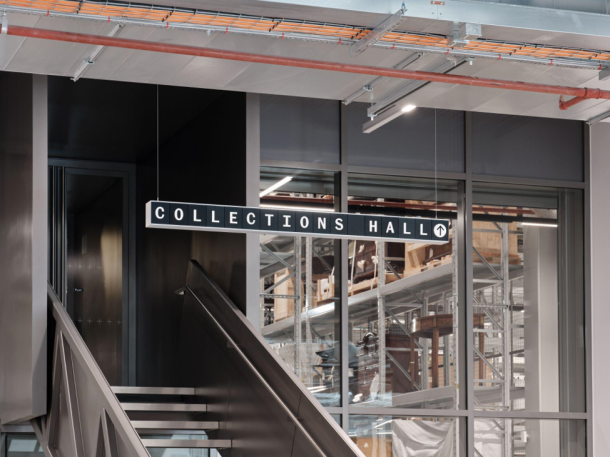
A primary architectural and operational achievement of the project is the creation of a unified wayfinding system for the V&A East Storehouse and the V&A East Museum. Although each venue maintains its own distinct visual identity and atmospheric character, their underlying structural logic was designed in tandem. The solution relied heavily on modular design principles, resulting in a flexible "kit of parts" where individual signs can be effortlessly disassembled, reconfigured, and adapted for different spatial contexts.
This modularity ensures that the wayfinding apparatus is future-proofed. When institutional needs shift or spatial layouts change, the signs do not need to be thrown away; instead, components can be unscrewed, reorganized, and updated with minimal effort. Furthermore, when individual parts finally reach the absolute end of their usable lifecycle, the modular construction allows maintenance teams to easily separate the elements into distinct material streams for efficient recycling.
Designing Bespoke Fonts for Reuse
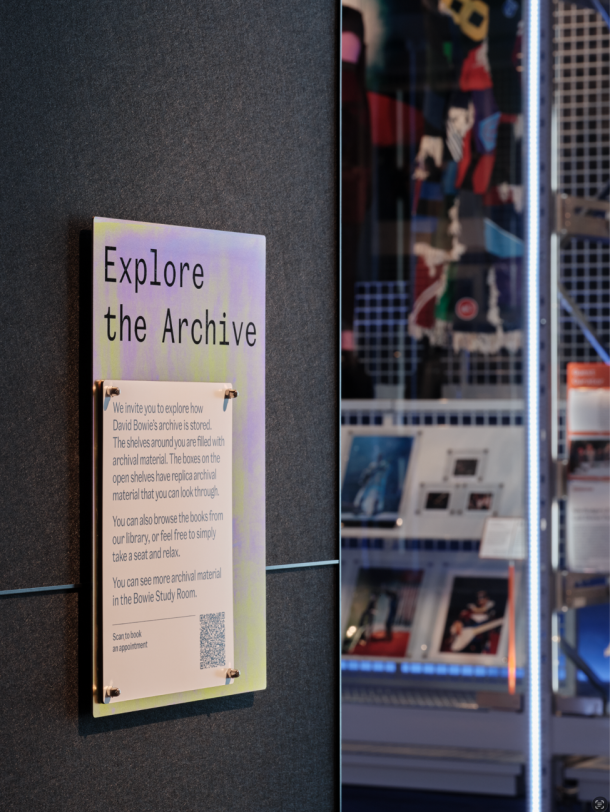
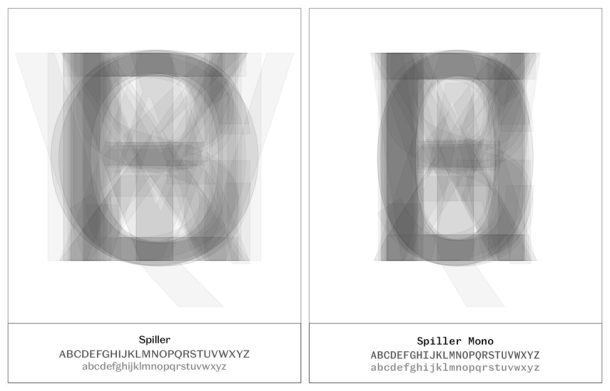
The pursuit of absolute modularity quickly uncovered unexpected technical hurdles, beginning with typography. The V&A utilizes a bespoke brand typeface known as Spiller, which serves as a powerful visual anchor for the institution’s identity. However, in its original form, Spiller presented significant layout challenges within a modular, tile-based setting. Certain letterforms were exceptionally wide while others were extremely thin, creating irregular spacing and legibility issues when constrained to uniform grid systems.
To resolve this issue without compromising the museum’s visual identity, type foundry Commercial Type was commissioned to develop a brand-new iteration of the typeface: Spiller Mono. This specialized monospaced font features evenly sized letterforms designed specifically to perform harmoniously within the rigid constraints of a modular grid. The creation of Spiller Mono ensured that textual information across the wayfinding system remained crisp, legible, and visually balanced, regardless of how frequently individual sign tiles were rearranged or updated.

What Goes Into Making Signs?
While the V&A East Storehouse and V&A East Museum share this underlying structural philosophy, they express their individuality through distinct palettes of low-carbon and recycled materials. Sourcing these materials required meticulous research and cross-disciplinary collaboration, with the design team working alongside environmental consultants from Urge Collective to analyze the carbon impact of every proposed substance early in the design phase.
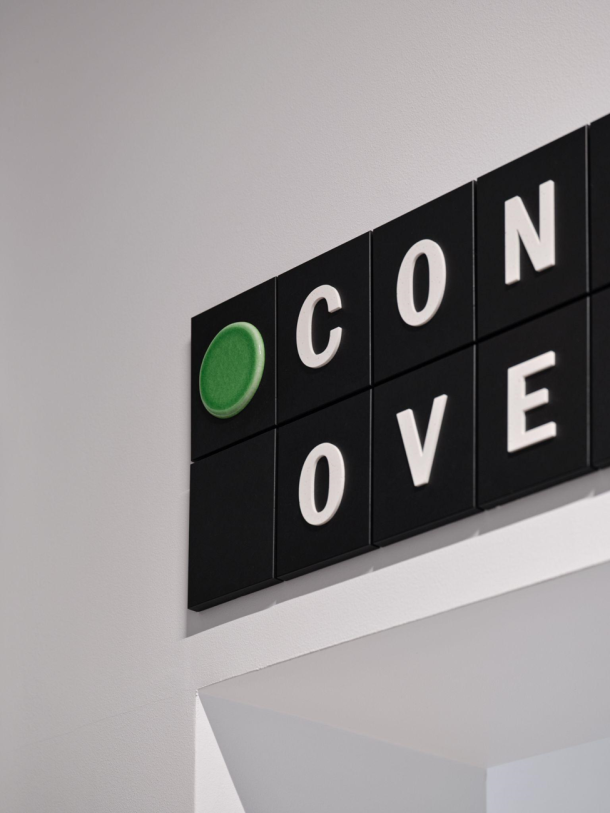
At the V&A East Storehouse, the primary signage architecture is constructed from recycled composite paper, forming the foundational black blocks and tiles, paired with recycled plastics for the lettering. These components are housed within sturdy aluminium cases. A select few installations feature enameled lava-stone roundels. The enameling process—wherein powdered glass is fused to natural lava stone at extreme temperatures—yields a hard, glossy, tactile finish. While the intense heat required for enameling made it perhaps the least carbon-friendly element of the scheme, the technique was intentionally chosen as a deliberate nod to the V&A’s deep-rooted institutional celebration of craft and making.
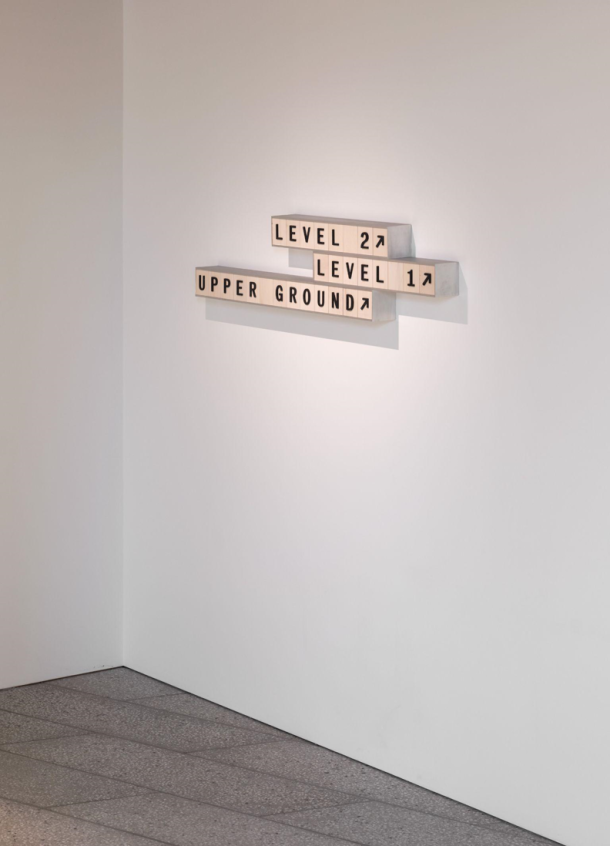
In contrast, the V&A East Museum establishes its own distinct aesthetic by combining natural wood with recycled plastics. A critical environmental choice made during this phase involved the timber selection. Rather than sourcing bamboo from China, which would incur a heavy carbon footprint through international shipping, the team opted for sustainably sourced European sycamore, significantly curtailing the logistics-related emissions of the project.
Designing to Reduce Waste
Beyond material selection, extensive measures were put in place to ensure that manufacturing partners minimized waste during production while guaranteeing that any leftover scraps could be recaptured and redirected into new manufacturing streams. Throughout the fabrication process, all material offcuts were systematically returned to the suppliers. Rather than being discarded as industrial waste, these remnants were reprocessed into entirely new raw materials, closing the loop on the production cycle.
Beyond Single-Use Vinyl
One of the most persistent sustainability challenges in the museum sector is the heavy reliance on self-adhesive vinyl graphics. For decades, vinyl has been the industry standard for museum walls, providing a quick, cheap, and easy medium for printing, installing, and removing temporary titles, wayfinding, and marketing messages. However, these petroleum-based plastics cannot be easily reused or recycled, turning every exhibition turnover into a major source of avoidable plastic waste.
Fieldwork Facility aggressively targeted this vulnerability across both V&A East sites, eliminating single-use vinyl wherever feasible by painting graphic communications directly onto the architectural walls. Reflecting on this paradigm shift, Robin Howie noted that visitors stepping into almost any museum worldwide are typically greeted by a barrage of signage and marketing materials composed entirely of single-use vinyl. With every new exhibition or programmatic change, the entire scheme is traditionally stripped away and replenished from scratch. For the creative team, a brand-new museum deserved a fundamentally cleaner, more responsible approach.
Designing Signage for Exhibitions
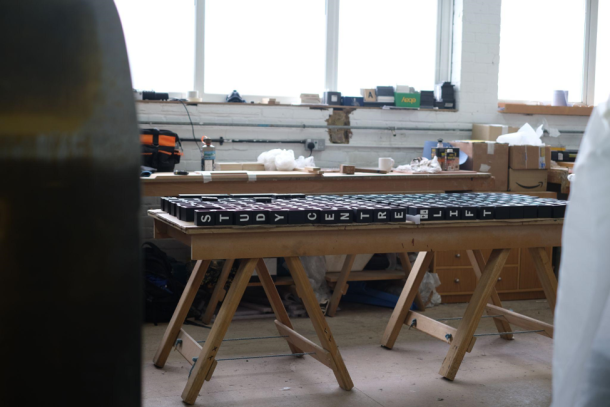
Accommodating temporary exhibitions without resorting to disposable materials required innovative engineering. For the V&A East Museum, wayfinding was specifically engineered to encompass shifting exhibition calendars. The team designed and manufactured 1,240 individual tiles crafted from wood and recycled plastics. Each tile was individually cut, engraved, finished, and assembled by hand, ensuring that rather than peeling away discarded vinyl banners between shows, museum staff can physically remove, reorder, and repurpose the modular tiles for incoming exhibitions.
To ensure an adequate supply of temporary exhibition tiles, Fieldwork Facility conducted a comprehensive retrospective analysis, reviewing exhibition titles from the preceding five years to calculate average name lengths and character counts. This data-driven research informed the creation of a dedicated reserve bank consisting of 1,115 spare tiles, allowing staff to seamlessly update Welcome Directories and Discovery signs whenever a programme changes.
To prevent the creeping return of single-use vinyl for transient event information, the museum integrated narrow, scrolling LED ticker signs. These digital displays provide real-time, dynamic information that can be instantly updated for live events and temporary exhibitions without generating physical waste. A bespoke typeface, appropriately named V&A Eastbound, was developed specifically for the LED tickers, complete with unique symbols and glyphs designed to accommodate future programming needs.
Despite these exhaustive mitigation strategies, approximately six square meters of vinyl did remain within the V&A East Museum wayfinding scheme. Vinyl was retained purely as a permanent technical solution in localized areas where traditional screen printing was physically unfeasible.
The realization of V&A East demonstrates how integrating sustainability from the earliest stages of conceptual design can yield institutional signage that is both visually striking and environmentally responsible. By implementing modular construction that permits endless disassembly and reuse, meticulously tracing material origins to minimize transport emissions, and eliminating the reflex reliance on single-use plastics, the collaboration between Fieldwork Facility and the V&A has established a compelling new benchmark for sustainable museum design.