By Adnan Ali
Indore: Madhya Pradesh’s commercial capital, Indore, celebrated widely across India for its top-tier cleanliness and progressive urban reputation, is currently grappling with a growing wave of social unease that has very little to do with municipal sanitation. Instead, the city is witnessing a sharp rise in polarization, marked by incidents of alleged discrimination, targeted economic boycott calls, and growing friction directed against the local Muslim community.
The escalating tensions highlight a troubling departure from the city’s historical ethos of shared cultural traditions and communal coexistence. The latest flashpoints in the city stem from coordinated efforts by right-wing figures and political actors aimed at restricting Muslim traders, workers, and tenants from participating in local commerce and public events.

The most prominent among these recent campaigns has been led by Eklavya Singh Gaur, a right-wing figure and the son of senior Bharatiya Janata Party (BJP) MLA Malini Laxman Singh Gaur. Eklavya Singh Gaur has previously drawn public attention for targeting comedian Munawar Faruqui during controversial events in the city. Recently, he issued a direct and provocative appeal to traders operating within Sitalamata Bazaar, one of Indore’s bustling commercial hubs.
Gaur publicly urged local merchants in Sitalamata Bazaar to immediately remove all Muslim salesmen from their employment and demanded that Muslim tenants vacate their commercial shops within a strict timeframe of two months. In his public statements, Gaur attempted to justify these exclusionary demands by invoking communal narratives, claiming without evidence that the market environment encourages what right-wing groups term “love jihad.” He alleged, without substantiation, that Muslim salesmen misuse their positions of employment to obtain the phone numbers of female customers.
Despite the pressure exerted by these boycott calls, several local merchants and business owners within Sitalamata Bazaar have openly rejected the allegations and pushed back against the divisive rhetoric. Balwant Singh Rathore, a shopkeeper operating in the market, voiced his opposition to the forced exclusions, emphasizing the cooperative economic fabric that has long sustained local businesses.
"I believe that no one’s livelihood should be snatched away," Rathore said, highlighting his own professional arrangement. "My partner is a Muslim, and together we run a shop."

The brewing crisis in Sitalamata Bazaar has also drawn the attention of senior political leaders, further intensifying the political fallout. On September 27, 2025, former Madhya Pradesh Chief Minister and Congress Rajya Sabha MP Digvijay Singh attempted to visit Sitalamata Bazaar to assess the ground situation and speak with affected traders. However, police and local authorities blocked his entry, citing security reasons.
Following the restriction, Singh proceeded to the Sarafa Police Station, where he met with Additional DCP (Zone-4 Indore) Dishesh Agrawal to discuss a formal memorandum submitted earlier by the Congress party regarding the communal tensions in the market.
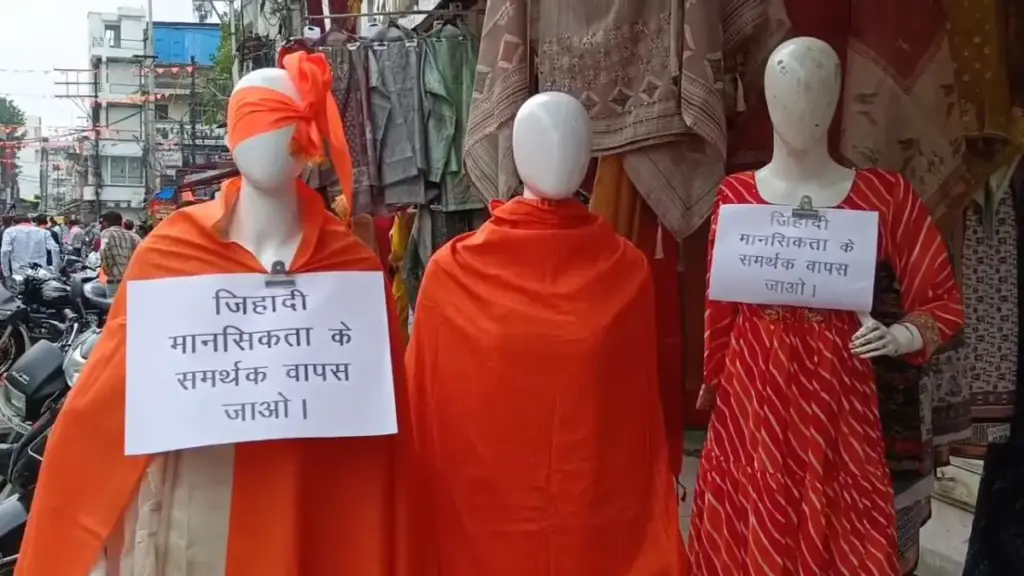
The political visit was met with hostile demonstrations outside the police station. Hindutva activists gathered to protest Singh’s presence, displaying traditional glass bangles and accusing him of supporting what they termed "jihadis." Meanwhile, inside the market itself, the atmosphere bore clear signs of targeted exclusion. Saffron flags were prominently raised across the commercial area, and posters were plastered throughout the bazaar declaring it a "jihad-free market."
The political opposition had previously mobilized against Eklavya Singh Gaur’s actions. On September 15, local Congress leaders submitted a formal memorandum to law enforcement authorities demanding strict legal action and the immediate registration of a First Information Report (FIR) against Gaur. In their submission, Congress representatives argued that Gaur’s public appeals constituted a deliberate and malicious attempt to dismantle Indore’s long-standing culture of communal harmony and pluralism. However, local law enforcement agencies have faced sharp criticism from civil society and opposition leaders for their perceived inaction, as no FIR has been registered in connection with the complaint so far.

The social friction and boycott campaigns have not been isolated to Sitalamata Bazaar. Similar tensions quickly spread to the Kankeshwari Mela ground, centering on a controversy surrounding a fair contract. The trouble began when BJP MLA Ramesh Mendola awarded the contract for organizing the fair to an individual named Mahesh Paliwal. Paliwal subsequently sub-contracted the responsibilities to a Muslim youth named Firoz.
The involvement of a Muslim contractor immediately drew objections from local right-wing organizations, most notably the Hindu Jagran Manch, which claimed that the arrangement hurt Hindu religious sentiments and demanded immediate punitive action from local authorities.
The opposition to the arrangement intensified on September 24, when Jitu Yadav (Jatav)—an expelled BJP councillor and supporter of MLA Ramesh Mendola—intervened directly at the fairgrounds. Defending the mobilization against the contractor, Yadav addressed the media, stating, "When contracts related to fairs and such religious and cultural events are given to non-Hindus, it creates resentment in the society, which can never be accepted."
Yadav further alleged that Firoz had secured the contract by using the name of Mahesh Paliwal and subsequently permitted individuals belonging to the Muslim community to set up commercial stalls and amusement rides within the fair premises.

Following these objections, Yadav claimed that he personally inspected identification documents at the fairground and summarily removed shopkeepers belonging to non-Hindu communities, permitting only a small number of Hindu stallholders to retain their positions. He added that the official organizing contract was subsequently revoked from Mahesh, also known as Guddu.
These parallel episodes—ranging from the systematic pressure on business owners in Sitalamata Bazaar to the policing of vendors at the Kankeshwari Mela—have sparked deep concern among residents, activists, and observers across Indore. Once widely recognized for its social openness, commercial inclusivity, and shared cultural traditions, the city is now navigating a period of profound introspection. The systematic and increasingly public exclusion of Muslim traders, workers, and entrepreneurs is being viewed by many as a troubling indicator of deepening social divisions that threaten the foundational fabric of Indore’s civic life.