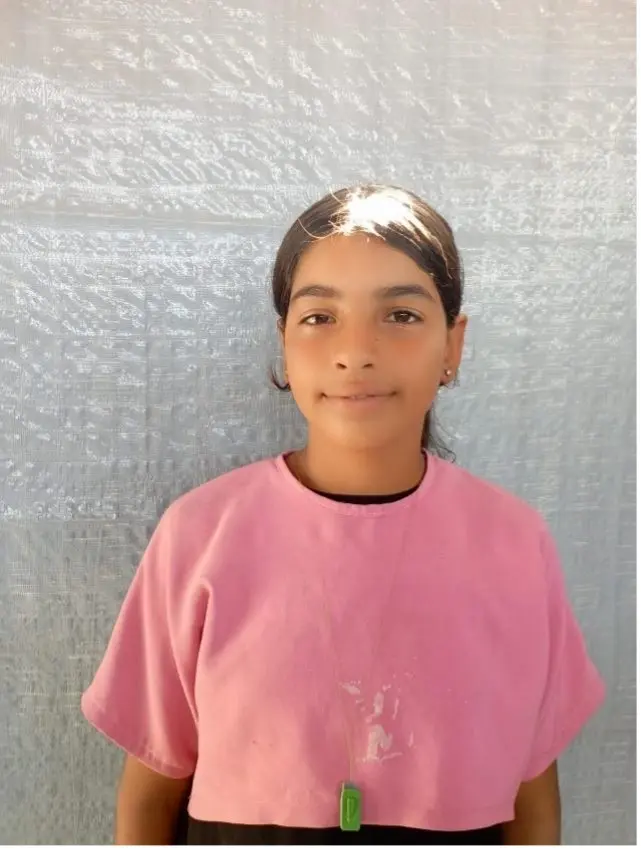
At just 12 years old, Amira has already endured a lifetime of profound grief and disruption. Having lost her father to cancer years before the outbreak of the war in Gaza, she has since faced displacement, the destruction of her family home, and the sudden loss of even the modest shelter they managed to build afterward. Yet, despite the immense hardships and the daily struggle for survival, she continues her education online and holds steadfast to her dream of one day becoming a nurse.
Amira’s childhood shifted dramatically when she was nine years old and lost her father to cancer. She remembers him as a steadfast source of love, safety, and strength, a guiding presence whose passing fundamentally altered her young life. When the war in Gaza began, Amira and her family were plunged into another devastating period defined by widespread loss and constant fear, compounding the grief they had already carried for years.
Forced to Leave Their Home and Everything They Knew
Before the escalation of the conflict, Amira lived with her mother, Manal, and her siblings in the Al-Salam neighbourhood of Rafah. When the family was ultimately forced to flee their home under imminent threat, they were compelled to leave the vast majority of their belongings behind. They packed only a few essential items: a small selection of clothes, basic bedding, and a handful of rudimentary kitchen utensils.
At the time, they clung to the hope that the displacement would be temporary and that they would soon be able to return to their neighborhood and resume their normal lives. Instead, their house was entirely destroyed, rendering a return impossible and leaving the family trapped in protracted displacement. With nowhere else to go, they eventually managed to set up a tent to serve as makeshift shelter.
Life inside the tent was exceptionally grueling and pushed the family to their physical limits. During the blistering summer months, the canvas structure absorbed and trapped the intense heat, turning the interior into an oven. Conversely, when winter arrived, the tent offered little protection against the biting cold, while driving rainwater leaked through the fabric and turned the ground underneath into thick, unforgiving mud.
Daily survival required a constant, exhausting effort. The family struggled to secure reliable access to basic necessities like clean water and sufficient food. They frequently had to spend hours waiting in long lines to collect water from passing distribution trucks, while relying entirely on community kitchens whenever they lacked the financial resources to purchase food independently.
Losing Everything Again to Fire
The family’s precarious existence suffered yet another catastrophic blow when their tent caught fire, destroying whatever meager possessions they had managed to salvage or acquire during their displacement. The sudden blaze consumed their remaining clothes, cooking equipment, and any other personal belongings that had offered a semblance of normality.
“Everything we owned was turned to ashes,” Manal shares, describing the sheer devastation of the incident. The fire left the family once again stripped of the basic items required to sustain daily life, compounding their vulnerability in an already volatile environment.
In the aftermath of the fire, the family’s needs have grown even more urgent. They are currently in dire need of sturdier shelter materials and waterproof coverings to protect them from the elements, as well as a functional bathroom, cooking equipment, clothes, and proper shoes.
Continuing to Study Despite Displacement
Despite the overwhelming nature of the daily challenges she faces, Amira refuses to abandon her education. Operating under extreme constraints, she continues her studies online and has advanced to the seventh grade.
Without access to reliable electricity or modern conveniences such as a washing machine, Amira also contributes significantly to the household by washing clothes entirely by hand. Amid these arduous chores and the uncertainty of her surroundings, she maintains a clear vision for her future, driven by a deep ambition to become a nurse. She hopes that conditions will improve enough for her to complete her education and enter the medical field.
In her rare moments of downtime, Amira enjoys drawing, finding creative expression despite the fact that she lacks the basic materials and art supplies needed to properly practice and develop her talent. Her immediate personal needs remain basic and urgent, centering primarily on winter clothing, proper underwear, and shoes to shield her from the seasonal cold.
Supporting Orphaned Children in Gaza
The realities faced by Amira and her family reflect a much broader crisis affecting countless children across Gaza who have lost parents, homes, and any lingering sense of security. To address these immense needs, organizations like Islamic Relief have worked on the ground to provide targeted assistance, notably through their Orphan Sponsorship Programme, which has been active in Gaza since 1999.
The programme operates on a one-to-one sponsorship model, matching an individual donor with a child. Under this arrangement, the child’s guardian receives a regular monthly payment. In the context of Gaza, families are given the flexibility to direct this financial support toward the needs they deem most critical at any given moment, whether that includes purchasing food, securing clothing, covering healthcare expenses, or funding educational materials.
In response to the current crisis, Islamic Relief has significantly scaled up the reach of the Orphan Sponsorship Programme. More than 25,000 children throughout Gaza are currently receiving regular sponsorship support, while an additional 5,000 children remain on the waiting list, highlighting the sheer scale of the need.
Where operational access and logistics permit, sponsored families also receive supplementary seasonal support. This can include targeted assistance such as Ramadan and Qurbani food parcels, Eid gifts, and specialized winter items designed to help families weather harsh conditions.
Holding On to Hope
Amira’s journey is emblematic of the resilience demonstrated by children caught in prolonged conflicts, navigating the heavy burden of profound personal loss while attempting to preserve a normal childhood. Yet, even in the face of destroyed homes, recurring displacement, and the loss of their belongings to fire, she continues to study and look forward to what tomorrow might bring.
Her aspirations remain remarkably grounded: she wishes to continue her education, train to become a nurse, and ultimately live in safety with her family.
Through ongoing humanitarian interventions like Islamic Relief’s Orphan Sponsorship Programme, vital resources continue to reach vulnerable children and their families in Gaza, offering a measure of stability and support amid overwhelming adversity.